. 2019 Jul 1;11(7):1829-1837.
doi: 10.1093/gbe/evz130.

First Estimation of the Spontaneous Mutation Rate in Diatoms

Affiliations

First Estimation of the Spontaneous Mutation Rate in Diatoms

Marc Krasovec et al. Genome Biol Evol. .

Abstract

Mutations are the origin of genetic diversity, and the mutation rate is a fundamental parameter to understand all aspects of molecular evolution. The combination of mutation-accumulation experiments and high-throughput sequencing enabled the estimation of mutation rates in most model organisms, but several major eukaryotic lineages remain unexplored. Here, we report the first estimation of the spontaneous mutation rate in a model unicellular eukaryote from the Stramenopile kingdom, the diatom Phaeodactylum tricornutum (strain RCC2967). We sequenced 36 mutation accumulation lines for an average of 181 generations per line and identified 156 de novo mutations. The base substitution mutation rate per site per generation is μbs = 4.77 × 10⁻¹⁰ and the insertion-deletion mutation rate is μid = 1.58 × 10⁻¹¹. The mutation rate varies as a function of the nucleotide context and is biased toward an excess of mutations from GC to AT, consistent with previous observations in other species. Interestingly, the mutation rates between the genomes of organelles and the nucleus differ, with a significantly higher mutation rate in the mitochondria. This confirms previous claims based on indirect estimations of the mutation rate in mitochondria of photosynthetic eukaryotes that acquired their plastid through a secondary endosymbiosis. This novel estimate enables us to infer the effective population size of P. tricornutum to be Ne∼8.72 × 10⁶.

Keywords: Phaeodactylum tricornutum; diatoms; mutation accumulation; mutation spectrum; spontaneous mutation rate.


Figures

<sc>Fig</sc>. 1.
Fig. 1.
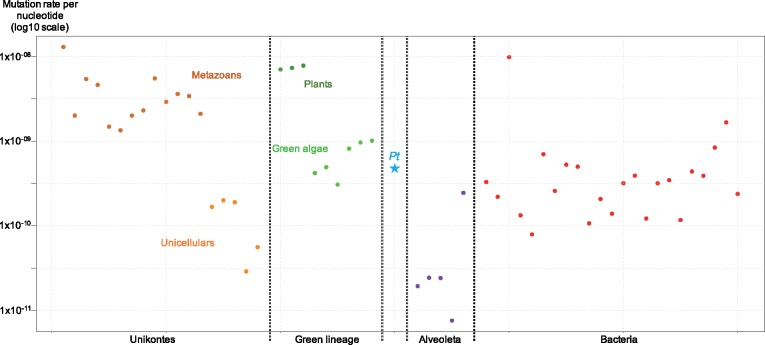
—Spontaneous mutation rates from mutation accumulation and pedigree studies, left to right: Homo sapiens (Besenbacher et al. 2016); Clupea harengus (Feng et al. 2017); Mus musculus (Uchimura et al. 2015); Ficedula albicollis (Smeds et al. 2016); Caenorhabditis elegans, Caenorhabditis briggsae (Denver et al. 2012); Pristionchus pacificus (Weller et al. 2014); Daphnia pulex (Flynn et al. 2017); Drosophila melanogaster (Schrider et al. 2013); Heliconius melpomene (Keightley et al. 2015); Bombus terrestri, Apis mellifera (Liu et al. 2017); Chironomus riparius (Oppold and Pfenninger 2017); Saccharomyces cerevisiae (Zhu et al. 2014); Schizosaccharomyces pombe (Farlow et al. 2015); Dictyostelium discoideum (Saxer et al. 2012); Sphaeroforma arctica (Long et al. 2018); Arabidopsis thaliana (Ossowski et al. 2010); Silene latifolia (Krasovec et al. 2018); Prunus persica (Xie et al. 2016); Ostreococcus tauri, Ostreococcus mediterraneus, Bathycoccus prasinos, Micromonas pusilla (Krasovec et al. 2017); Chlamydomonas reinhardtii (Ness et al. 2015); Picochlorum costavermella (Krasovec et al. 2018); Pt: Phaeodactylum tricornutum; Paramecium tetraurelia (Sung et al. 2012); Paramecium biaurelia (Long et al. 2018); Paramecium sexaurelia (Long et al. 2018); Tetrahymena thermophila (Long et al. 2016); Plasmodium falciparum (Hamilton et al. 2017); Bacillus subtilis (Sung et al. 2015); Escherichia coli (Lee et al. 2012); Mesoplasma florum (Sung et al. 2012); Burkholderia cenocepacia (Dillon et al. 2015); Pseudomonas aeruginosa (Dettman et al. 2016); Salmonella typhimurium (Lind and Andersson 2008); Mycobacterium tuberculosis (Ford et al. 2011); Mycobacterium smegmatis (Kucukyildirim et al. 2016); Deinococcus radiodurans (Long et al. 2015); Vibrio cholerae, Vibrio fischeri (Dillon et al. 2017); Ruegeria pomeroyi (Sun et al. 2017); Arthrobacter sp., Flavobacterium sp., Janthinobacterium lividum, Micrococcus sp., Caulobacter crescentus, Rhodobacter sphaeroides, Staphylococcus aureus, Kineococcus radiotolerans, Colwellia psychrerythraea, Lactococcus lactis, Gemmata obscuriglobus (Long et al. 2018).
<sc>Fig</sc>. 2.
Fig. 2.
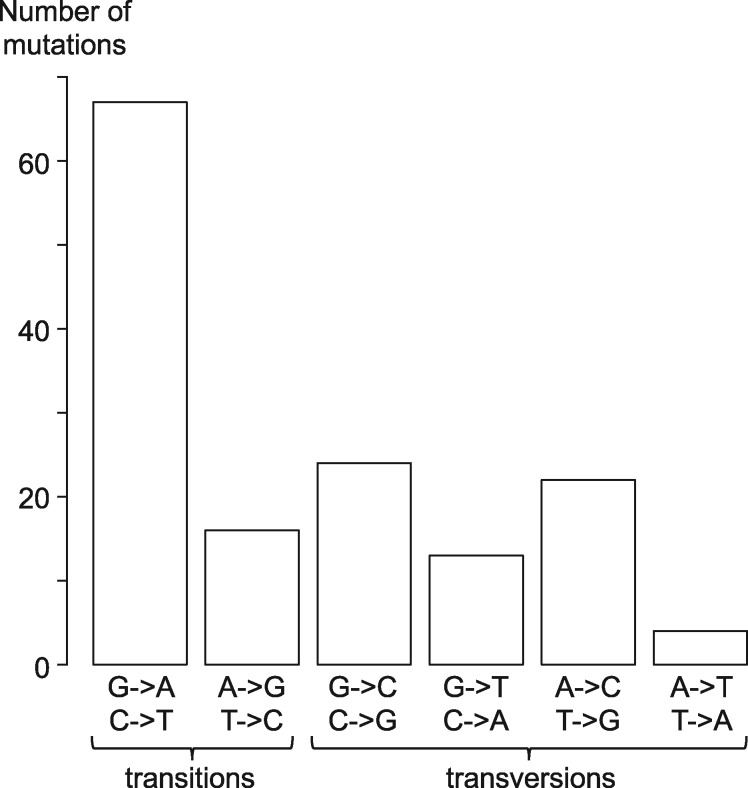
—Distribution of the 146 de novo base substitution mutations in the nuclear genome across the 36 MA lines.

References

    1. Allen AE, et al. 2008. Whole-cell response of the pennate diatom Phaeodactylum tricornutum to iron starvation. Proc Natl Acad Sci U S A. 105(30):10438–10443. - PMC - PubMed
    1. Anders S, Pyl PT, Huber W.. 2015. HTSeq – a Python framework to work with high-throughput sequencing data. Bioinformatics 31(2):166–169. - PMC - PubMed
    1. Armbrust EV. 2009. The life of diatoms in the world’s oceans. Nature 459(7244):185–192. - PubMed
    1. Baer CF. 2008. Does mutation rate depend on itself. PLoS Biol. 6(2):e52.. - PMC - PubMed
    1. Barbier EB, et al. 2011. The value of estuarine and coastal ecosystem services. Ecol Monogr. 81(2):169–193.

Publication types