


Patients' experiences of remote communication after pacemaker implant: The NORDLAND study
- PMID: 31220146
- PMCID: PMC6586402
- DOI: 10.1371/journal.pone.0218521
Patients' experiences of remote communication after pacemaker implant: The NORDLAND study
Erratum in
-
Correction: Patients' experiences of remote communication after pacemaker implant: The NORDLAND study.PLoS One. 2019 Jul 5;14(7):e0219584. doi: 10.1371/journal.pone.0219584. eCollection 2019. PLoS One. 2019. PMID: 31276574 Free PMC article.
Abstract
Background: The concept of 'patient experience' has become central to how to improve healthcare. Remote communication with patients is today a frequent practice in healthcare services, showing similar outcomes to standard outpatient care while enabling cost reduction in both formal and informal care. The purpose of this study was to analyse the experiences of people with telemonitoring pacemakers.
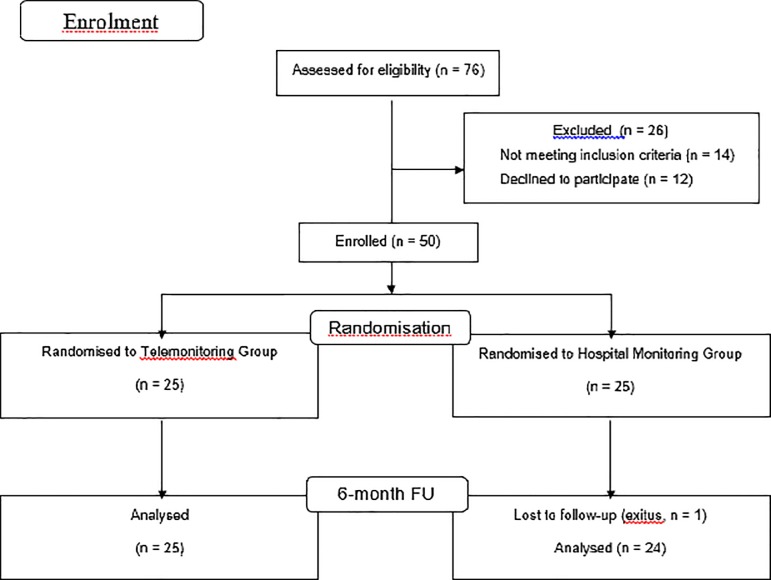
Methods: Patients were randomly allocated to either the telemonitoring or hospital monitoring follow-ups. Using the 'Generic Short Patient Experiences Questionnaire' (GS-PEQ), as well as an ad-hoc survey from the 'telehealth patient satisfaction survey' and 'costs survey', patients' experiences were measured six months after the pacemaker implant in a cohort of 50 consecutive patients. The mean age was 74.8 (± 11.75) years and 26 (52%) patients were male of which 1 was lost in follow-up. Finally, 24 patients were followed up with standard hospital monitoring, while 25 used the telemonitoring system. Differences in baseline characteristics between groups were not found.
Results: Findings showed overall positive and similar experiences in patients living with telemonitoring and hospital monitoring pacemakers. Significant differences were found in GS-PEQ concerning how telemonitoring patients received less information about their diagnosis/afflictions (p = 0.046). We did not find significant differences in other items such as 'confidence in the clinicians' professional skills', 'treatment perception adapted to their situation', 'involvement in decisions regarding the treatment', 'perception of hospital organisation', 'waiting before admission', 'satisfaction of help and treatment received', 'benefit received', and 'incorrect treatment'.
Conclusions: The remote communication of pacemakers was met with positive levels of patients' experiences similarly to patients in the hospital monitoring follow-up. However, telemonitoring patients received less information. Thus, improving the quality and timing of information is required in telemonitoring patients in the planning and organisation of future remote communication healthcare services for people living with a pacemaker implant.
Conflict of interest statement
The authors have declared that no competing interests exist.
References
-
- Norwegian Institute of Public Health. Disease Burden in Norway 2015 Results from the Global Burden of Diseases, Injuries, and Risk Factors Study 2015. Oslo, Norway: Norwegian Institute for Public Health; 2017. https://www.fhi.no/globalassets/dokumenterfiler/rapporter/2015/sykdomsby.... Accessed 12 Apr 2018.
-
- Lippeveld T, Sauerborn R, Bodart C, World Health Organization, editors. Design and implementation of health information systems. Geneva: World Health Organization; 2000.
-
- Epstein AE, DiMarco JP, Ellenbogen KA, Estes NAM, Freedman RA, Gettes LS, et al. ACC/AHA/HRS 2008 Guidelines for Device-Based Therapy of Cardiac Rhythm Abnormalities: a report of the American College of Cardiology/American Heart Association Task Force on Practice Guidelines (Writing Committee to Revise the ACC/AHA/NASPE 2002 Guideline Update for Implantation of Cardiac Pacemakers and Antiarrhythmia Devices) developed in collaboration with the American Association for Thoracic Surgery and Society of Thoracic Surgeons. J Am Coll Cardiol. 2008;51:e1–62. 10.1016/j.jacc.2008.02.032 - DOI - PubMed
-
- Wilkoff BL, Auricchio A, Brugada J, Cowie M, Ellenbogen KA, Gillis AM, et al. HRS/EHRA expert consensus on the monitoring of cardiovascular implantable electronic devices (CIEDs): description of techniques, indications, personnel, frequency and ethical considerations. Heart Rhythm. 2008;5:907–25. - PubMed
Publication types
MeSH terms
LinkOut - more resources
Full Text Sources
Medical
Miscellaneous
