Long-term mortality of patients discharged from the hospital after successful critical care in the ICU in Korea: a retrospective observational study in a single tertiary care teaching hospital
- PMID: 31220909
- PMCID: PMC7113159
- DOI: 10.4097/kja.d.18.00275
Long-term mortality of patients discharged from the hospital after successful critical care in the ICU in Korea: a retrospective observational study in a single tertiary care teaching hospital
Abstract
Background: The long-term outcomes of patients discharged from the hospital after successful care in intensive care unit (ICU) are not briskly evaluated in Korea. The aim of this study was to assess long-term mortality of patients treated in the ICU and discharged alive from the hospital and to identify predictive factors of mortality.
Methods: In 3,679 adult patients discharged alive from the hospital after ICU care between 2006 and 2011, the 1-year mortality rate (primary outcome measure) was investigated. Various factors were entered into multivariate analysis to identify independent factors of 1-year mortality, including sex, age, severity of illness (APACHE II score), mechanical ventilation, malignancy, readmission, type of admission (emergency, elective surgery, and medical), and diagnostic category (trauma and non-trauma).
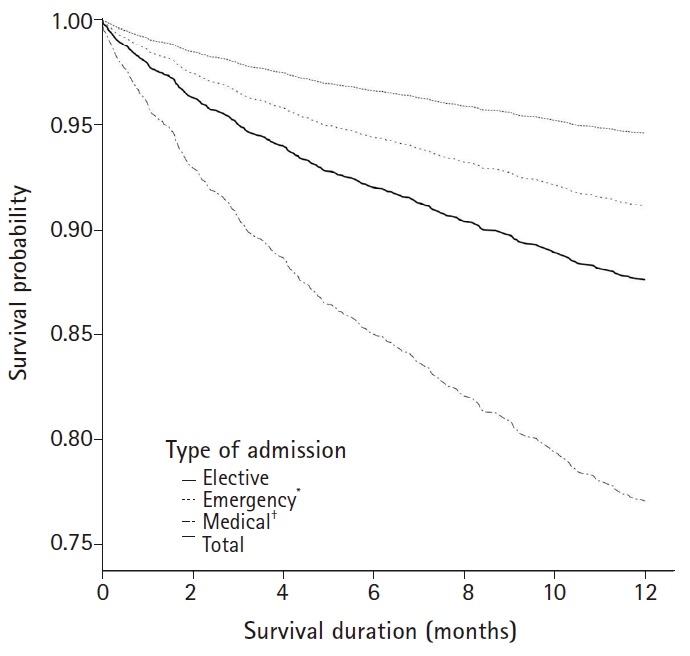
Results: The 1-year mortality rate was 13.4%. Risk factors that were associated with 1-year mortality included age (hazard ratio: 1.03 [95% CI, 1.02-1.04], P < 0.001), APACHE II score (1.03 [1.01-1.04], P < 0.001), mechanical ventilation (1.96 [1.60-2.41], P < 0.001), malignancy (2.31 [1.82-2.94], P < 0.001), readmission (1.65 [1.31-2.07], P < 0.001), emergency surgery (1.66 [1.18-2.34], P = 0.003), ICU admission due to medical causes (4.66 [3.68-5.91], P < 0.001), and non-traumatic diagnostic category (6.04 [1.50-24.38], P = 0.012).
Conclusions: The 1-year mortality rate was 13.4%. Old age, high APACHE II score, mechanical ventilation, malignancy, readmission, emergency surgery, ICU admission due to medical causes, and non-traumatic diagnostic category except metabolic/endocrinologic category were associated with 1-year mortality.
Keywords: Critical care outcomes; Intensive care unit; Long-term outcomes; Mortality; Risk factors; Survival analysis.
Conflict of interest statement
No potential conflict of interest relevant to this article was reported.
Figures

Comment in
-
In response to Na et al.'s long-term mortality of patients discharged from the hospital after successful critical care: do we need more comprehensive data?Korean J Anesthesiol. 2020 Apr;73(2):171-172. doi: 10.4097/kja.19366. Epub 2019 Sep 26. Korean J Anesthesiol. 2020. PMID: 31556258 Free PMC article. No abstract available.
References
-
- Health Insurance Review Agency . Seoul: ICU benefits appropriateness evaluation report. HIRA e-Book [Internet] 2004 Dec [cited 2018 Sep 17]. Available from: https://www.hira.or.kr/sViewer/index.do?ebookSn=418.
-
- Angus DC, Carlet J, Brussels Roundtable P. Surviving intensive care: a report from the 2002 Brussels roundtable. Intensive Care Med. 2003;29:368–77. - PubMed
-
- Dowdy DW, Needham DM, Mendez-Tellez PA, Herridge MS, Pronovost PJ. Studying outcomes of intensive care unit survivors: the role of the cohort study. Intensive Care Med. 2005;31:914–21. - PubMed
Publication types
MeSH terms
LinkOut - more resources
Full Text Sources
Medical