


Internet and WeChat used by patients with Crohn's disease in China: a multi-center questionnaire survey
- PMID: 31221086
- PMCID: PMC6584988
- DOI: 10.1186/s12876-019-1011-3
Internet and WeChat used by patients with Crohn's disease in China: a multi-center questionnaire survey
Abstract
Background: Currently, WeChat is widely used in disease education for patients with Crohn's disease (CD) in China. It is beneficial for the patients to actively engage in their disease management.
Methods: In this study, we examined the source and expectations of disease information for Chinese CD patients, analysing the content of popular WeChat public accounts and their potential association with medication adherence.
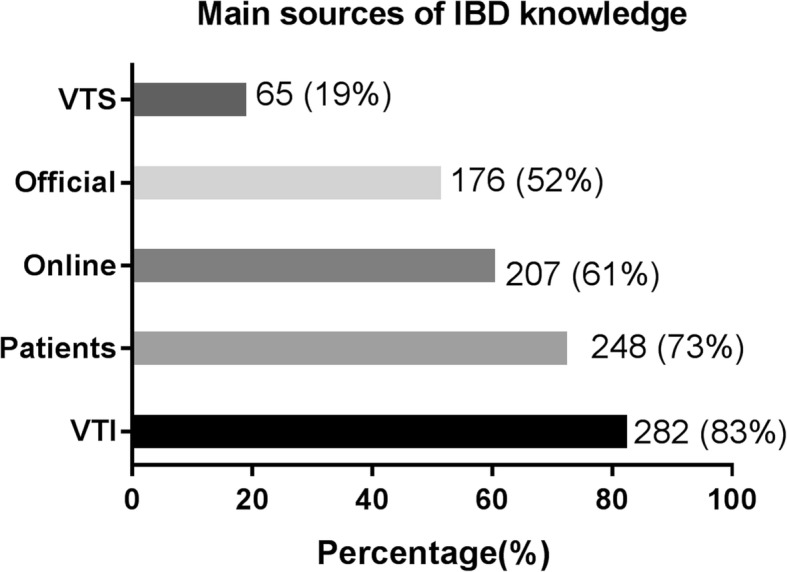
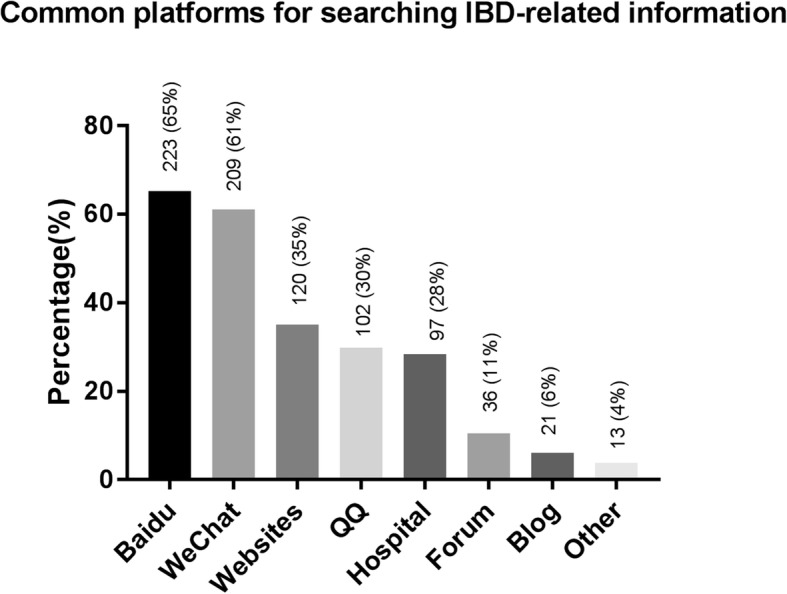
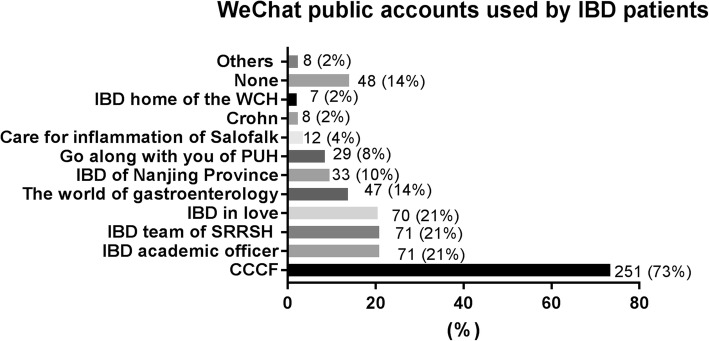
Results: Between November 24th, 2017 and April 10th, 2018, online questionnaires were sent to CD patients from eight different large urban hospitals in China. In all, 436 patients with CD were surveyed, and 342 patients responded. Patients most frequently visited Baidu (65%), WeChat (61%) and medical websites such as Haodaifu (35%) when searching for IBD-related information. Among ten WeChat IBD public accounts, the China Crohn's and Colitis Foundation (CCCF) (73%), "IBD Academic Officer" (21%) and "IBD in love" (21%) were the most popular. CD patients were most interested in information from the internet about diet and day-to-day health-related living with IBD (83%), an introduction to the disease (80%), and medication advances and side effects (80%). The correlation between the information provided by the top five WeChat public accounts and patients' expectations was low. Additionally, most patients (64%) had greater confidence in overcoming the disease after learning about CD through their internet searches. Medical adherence was also related to internet access and income (p < 0.05).
Conclusions: WeChat has become a major source of information for IBD education in China, but the content of WeChat didn't fully meet patients' expectations. Therefore, future initiatives should aim to provide high-quality information that based on patients' demands.
Keywords: Crohn’s disease; Inflammatory bowel disease; Internet; Multicentre; Questionnaire survey; Social media.
Conflict of interest statement
The authors declare that they have no competing interests.
Figures
References
-
- Zhao J, Ng SC, Lei Y, et al. First prospective, population-based inflammatory bowel disease incidence study in mainland of China: the emergence of “western” disease. Inflamm Bowel Dis. 2013;19:1839–1845. - PubMed
-
- Wechat wikipedia. https://en.wikipedia.org/wiki/WeChat. Accessed 24 Sept 2018.
-
- Li XQ. The effect of WeChat education on the life quality of IBD patients. J Med Theory Pract. 2017;30:2799-2800.
Publication types
MeSH terms
Grants and funding
LinkOut - more resources
Full Text Sources
Medical
Miscellaneous
