


Young Children Have Higher Variability of Insulin Requirements: Observations During Hybrid Closed-Loop Insulin Delivery
- PMID: 31221700
- PMCID: PMC6609966
- DOI: 10.2337/dc18-2625
Young Children Have Higher Variability of Insulin Requirements: Observations During Hybrid Closed-Loop Insulin Delivery
Abstract
Objective: To quantify age-related variability of insulin needs during day and night closed-loop insulin delivery.
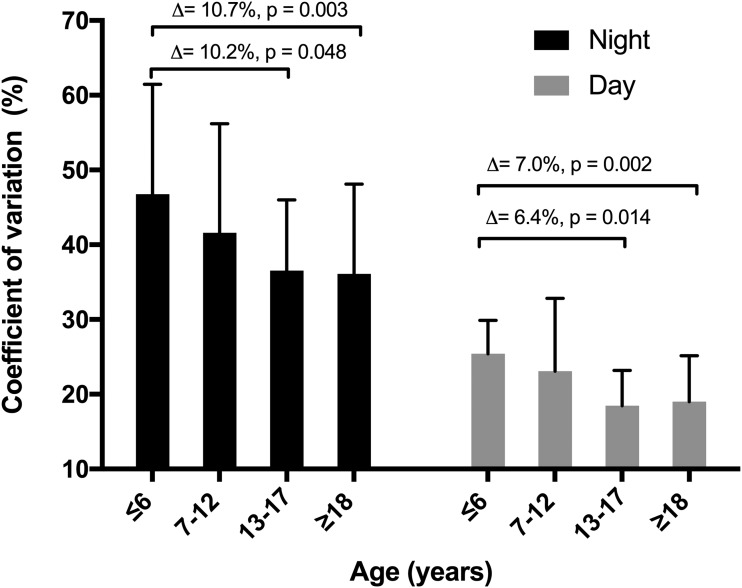
Research design and methods: We retrospectively analyzed data from hybrid closed-loop studies involving young children (1-6 years old, n = 20), children (7-12 years, n = 21), adolescents (13-17 years, n = 15), and adults (>18 years, n = 58) with type 1 diabetes. The coefficient of variation quantified variability of insulin needs during 3 weeks of unrestricted-living hybrid closed-loop use.
Results: Data from 2,365 nights and 2,367 days in 114 participants were analyzed. The coefficient of variation of insulin delivery was higher in young children compared with adults (mean difference at nighttime 10.7 percentage points [95% CI 2.9-18.4], P = 0.003; daytime 6.4 percentage points [95% CI 2.0-10.9], P = 0.002) and compared with adolescents (mean difference at nighttime 10.2 percentage points [95% CI 0.0-20.4], P = 0.049; daytime 7.0 percentage points [95% CI 1.1-12.8], P = 0.014).
Conclusions: Diabetes management in young children is complicated by higher variability in insulin requirements, supporting fast-track clinical practice adoption of closed-loop in this vulnerable population.
© 2019 by the American Diabetes Association.
Figures
References
-
- Weisman A, Bai J-W, Cardinez M, Kramer CK, Perkins BA. Effect of artificial pancreas systems on glycaemic control in patients with type 1 diabetes: a systematic review and meta-analysis of outpatient randomised controlled trials. Lancet Diabetes Endocrinol 2017;5:501–512 - PubMed
-
- Ruan Y, Thabit H, Leelarathna L, et al. .; AP@home Consortium . Variability of insulin requirements over 12 weeks of closed-loop insulin delivery in adults with type 1 diabetes. Diabetes Care 2016;39:830–832 - PubMed
-
- Wiegand S, Raile K, Reinehr T, et al. .; DPV-Wiss Study Group . Daily insulin requirement of children and adolescents with type 1 diabetes: effect of age, gender, body mass index and mode of therapy. Eur J Endocrinol 2008;158:543–549 - PubMed
