Review
. 2019 Jul;71(3):316-344.
doi: 10.1124/pr.118.017160.

REBUS and the Anarchic Brain: Toward a Unified Model of the Brain Action of Psychedelics

Affiliations
Review

REBUS and the Anarchic Brain: Toward a Unified Model of the Brain Action of Psychedelics

R L Carhart-Harris et al. Pharmacol Rev. 2019 Jul.

Abstract

This paper formulates the action of psychedelics by integrating the free-energy principle and entropic brain hypothesis. We call this formulation relaxed beliefs under psychedelics (REBUS) and the anarchic brain, founded on the principle that-via their entropic effect on spontaneous cortical activity-psychedelics work to relax the precision of high-level priors or beliefs, thereby liberating bottom-up information flow, particularly via intrinsic sources such as the limbic system. We assemble evidence for this model and show how it can explain a broad range of phenomena associated with the psychedelic experience. With regard to their potential therapeutic use, we propose that psychedelics work to relax the precision weighting of pathologically overweighted priors underpinning various expressions of mental illness. We propose that this process entails an increased sensitization of high-level priors to bottom-up signaling (stemming from intrinsic sources), and that this heightened sensitivity enables the potential revision and deweighting of overweighted priors. We end by discussing further implications of the model, such as that psychedelics can bring about the revision of other heavily weighted high-level priors, not directly related to mental health, such as those underlying partisan and/or overly-confident political, religious, and/or philosophical perspectives. SIGNIFICANCE STATEMENT: Psychedelics are capturing interest, with efforts underway to bring psilocybin therapy to marketing authorisation and legal access within a decade, spearheaded by the findings of a series of phase 2 trials. In this climate, a compelling unified model of how psychedelics alter brain function to alter consciousness would have appeal. Towards this end, we have sought to integrate a leading model of global brain function, hierarchical predictive coding, with an often-cited model of the acute action of psychedelics, the entropic brain hypothesis. The resulting synthesis states that psychedelics work to relax high-level priors, sensitising them to liberated bottom-up information flow, which, with the right intention, care provision and context, can help guide and cultivate the revision of entrenched pathological priors.


Figures

Fig. 1.
Fig. 1.
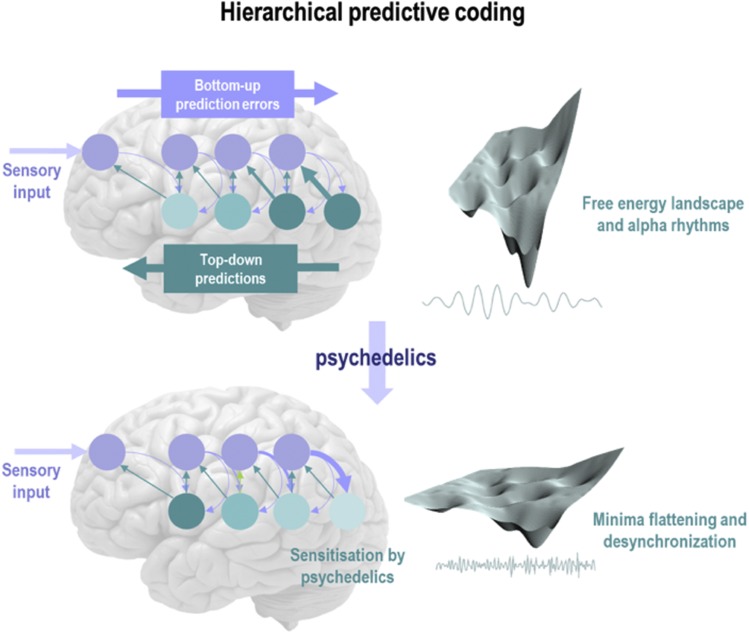
This schematic illustrates the proposed effects of psychedelics on hierarchical predictive coding, a predominant process theory for Bayesian inference and variational free-energy minimization in the brain. Under these computational architectures, sensory input arrives at the sensory epithelia and is compared with descending predictions. The ensuing prediction error (blue circles; e.g., neuronal populations of superficial pyramidal cells) is then passed forward into hierarchies, to update expectations at higher levels (blue arrows). These posterior expectations (teal circles; e.g., deep pyramidal cells) then generate predictions of the representations in lower levels, via descending predictions (teal arrows). The recurrent neuronal message passing (i.e., neuronal dynamics) tries to minimize the amplitude of prediction errors at each and every level of the hierarchy, thereby furnishing the best explanation for sensory input at multiple levels of hierarchal abstraction. Crucially, this process depends upon the precision (ascribed importance or salience) afforded to the ascending prediction errors (surprise) and the precision (felt confidence) of posterior beliefs. The basic idea—pursued in this article—is that psychedelics act preferentially via stimulating 5-HT2ARs on deep pyramidal cells within the visual cortex as well as at higher levels of the cortical hierarchy. Deep-layer pyramidal neurons are thought to encode posterior expectations, priors, or beliefs. The resulting disinhibition or sensitization of these units lightens to precision of higher-level expectations so that (by implication of the model) they are more sensitive to ascending prediction errors (surprise/ascending information), as indicated by the thick blue arrow in the lower panel. Computationally, this process corresponds to reducing the precision of higher-level prior beliefs and an implicit reduction in the curvature of the free-energy landscape that contains neuronal dynamics. Effectively, this can be thought of as a flattening of local minima, enabling neuronal dynamics to escape their basins of attraction and—when in flat minima—express long-range correlations and desynchronized activity. This schematic uses the format in Bastos et al. (2012), to which the reader is referred for details.
Fig. 2.
Fig. 2.
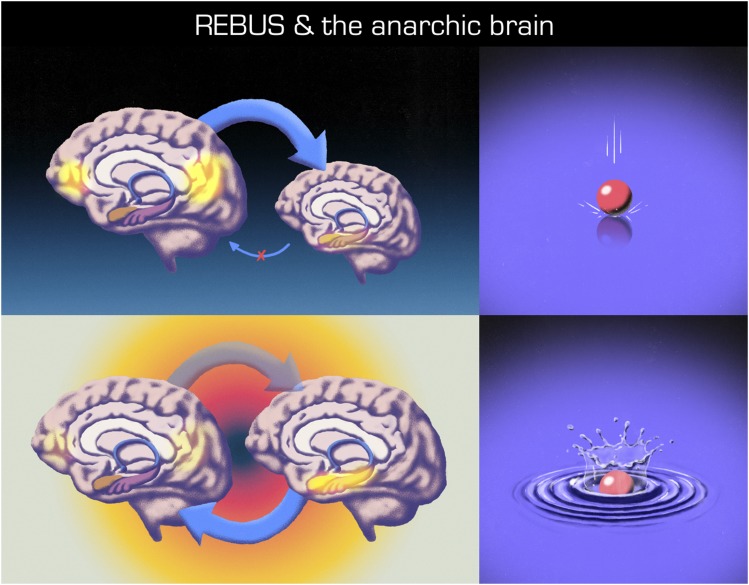
These schematics depict: on the top row, brain organization in psychopathologies such as depression in which high-level priors (e.g., instantiated by the DMN) are overweighted (thick top-down arrow), causing a suppression of and insensitivity to bottom-up signaling (e.g., stemming from the limbic system). In this figure, we show compromised bottom-up signaling via a thin arrow with a red cross over its center. The graphic on the top right depicts a pathologically rigid or frozen system, insensitive to perturbation, represented in this figure as a heavy ball dropped on a solid surface having a minimal effect on the system, i.e., the ball lands with an uneventful thud. The bottom row depicts brain organization under a psychedelic. In this figure, the top-down arrow has been made translucent to reflect a deweighting or relaxation of high-level priors or beliefs (this component of the model is referred to by the acronym REBUS). The effect of this deweighting is to enable bottom-up information intrinsic to the system, to travel up the hierarchy with greater latitude and compass. We refer to this component of the model as the anarchic brain. That the two brains on the bottom row are on the same level and of the same size is intended to reflect a generalized decrease in hierarchical constraints under the psychedelic. The graphic on the bottom right represents a phenomenon known as critical slowing, i.e., systems at criticality display maximal sensitivity to perturbation. In this figure, one can see ripples appearing after a heavy ball is dropped into a liquid surface, reflecting how, in this particular system, and unlike its frozen counterpart above, there will be a slow recovery to the same perturbation. Illustrations by Pedro Oliveira, courtesy of Favo Studio.

References

    1. Adams RA, Napier G, Roiser JP, Mathys C, Gilleen J. (2018) Attractor-like dynamics in belief updating in schizophrenia. J Neurosci 38:9471–9485. - PMC - PubMed
    1. Aghajanian GK. (2009) Modeling “psychosis” in vitro by inducing disordered neuronal network activity in cortical brain slices. Psychopharmacology (Berl) 206:575–585. - PMC - PubMed
    1. Aghajanian GK, Marek GJ. (1999) Serotonin, via 5-HT2A receptors, increases EPSCs in layer V pyramidal cells of prefrontal cortex by an asynchronous mode of glutamate release. Brain Res 825:161–171. - PubMed
    1. Alboni S, van Dijk RM, Poggini S, Milior G, Perrotta M, Drenth T, Brunello N, Wolfer DP, Limatola C, Amrein I, et al. (2017) Fluoxetine effects on molecular, cellular and behavioral endophenotypes of depression are driven by the living environment. Mol Psychiatry 22:552–561. - PMC - PubMed
    1. Alexander BK. (2008) The Globalisation of Addiction: A Study in Poverty of the Spirit, Oxford University Press, Oxford.

Publication types