. 2019 Jun 20;9(1):8959.
doi: 10.1038/s41598-019-45544-x.

Delayed development of the protective IL-17A response following a Giardia muris infection in neonatal mice

Affiliations

Delayed development of the protective IL-17A response following a Giardia muris infection in neonatal mice

Oonagh Paerewijck et al. Sci Rep. .

Abstract

Giardia is an intestinal protozoan parasite that has the ability to infect a wide range of hosts, which can result in the clinical condition 'giardiasis'. Over the years, experimental research has shown the crucial involvement of IL-17A to steer the protective immune response against Giardia. The development of the protective response, as reflected by a significant drop in cyst secretion, typically takes around 3 to 4 weeks. However, early-life infections often have a more chronic character lasting for several weeks or months. Therefore, the aim of the current study was to investigate the dynamics of a Giardia muris infection and the subsequent host immune response in neonatal mice infected 4 days after birth. The outcome of the study showed that a G. muris infection in pre-weaned mice failed to trigger a protective IL-17A response, which could explain the prolonged course of infection in comparison to older mice. Only after weaning, a protective intestinal immune response started to develop, characterized by an upregulation of IL-17A and Mbl2 and the secretion of parasite-specific IgA.


Conflict of interest statement

The authors declare no competing interests.

Figures
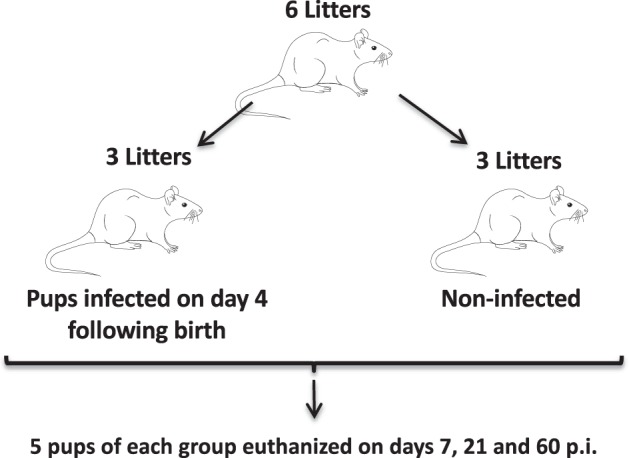
Figure 1
Figure 1
Study design of the artificial infection experiment in neonatal mice. Male and female pups from 3 litters were infected 4 days after birth with G. muris cysts. At days 7, 21 and 60 post-infection, corresponding with days 11, 25 and 64 after birth, respectively, 5 pups were selected at random from both the infected and control litters. The pups were euthanized, tissue samples were collected and trophozoites present in the small intestine counted. Faecal cyst counts were performed every 2 days from day 21 p.i. onwards.
Figure 2
Figure 2
Dynamics of a G. muris infection in neonatally infected mice. (A) Cysts present in the faeces of infected mice were monitored every 2 days from day 21 p.i. until day 60 p.i., corresponding with day 25 and day 64 after birth respectively. Mean numbers of cysts per gram faeces obtained from 5 mice at every time point are depicted, with SEM as error bars. The time of weaning, i.e. 28 days after birth, is indicated by a dotted line. (B) The absolute numbers of trophozoites present in the small intestine obtained from 5 infected mice, each represented as one dot with SEM as error bars, are shown at 7, 21, and 60 days p.i. (*p ≤ 0.05, **p ≤ 0.01).
Figure 3
Figure 3
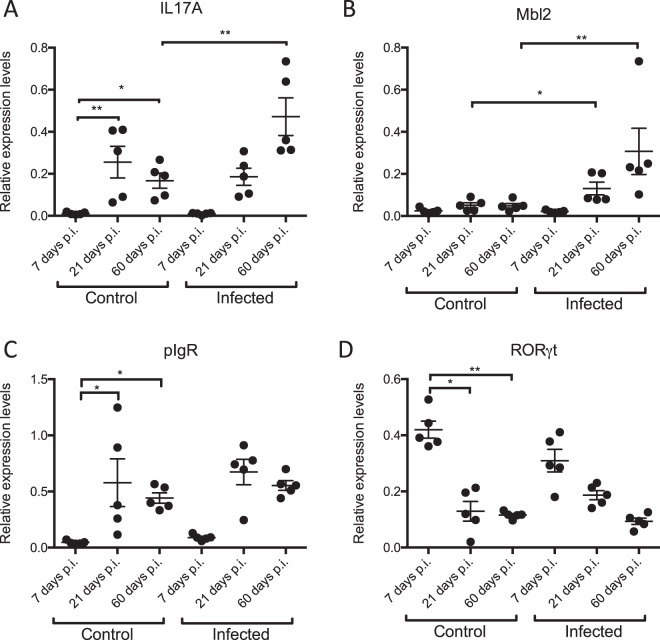
Kinetics of the intestinal immune response following a G. muris infection in neonatal mice. Relative mRNA expression levels of several immune-related genes were measured by qPCR at days 7, 21 and 60 p.i., both in infected and uninfected control mice. Every dot represents data obtained from 1 mouse, with SEM as error bars. (*p ≤ 0.05, **p ≤ 0.01).
Figure 4
Figure 4
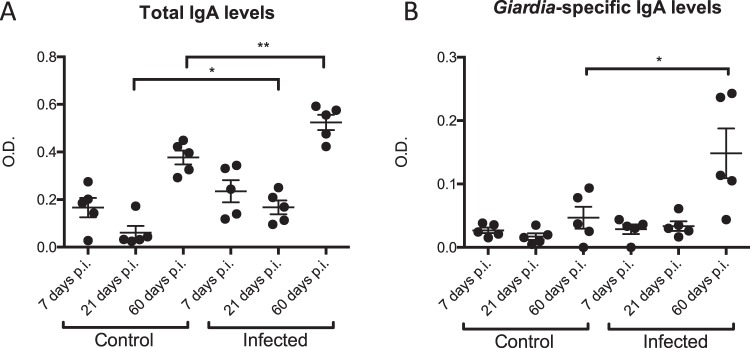
Intestinal IgA levels in uninfected control and G. muris infected neonatal mice. (A) Total IgA levels and (B) Giardia-specific IgA levels in the small intestinal tissue were measured by means of ELISA at days 7, 21 and 60 p.i. Optical density is shown in the graphs. Every dot represents data obtained from 1 mouse, with SEM as error bars. (*p ≤ 0.05, **p ≤ 0.01).

References

    1. Geurden T, Vercruysse J, Claerebout E. Is Giardia a significant pathogen in production animals? Exp. Parasitol. 2010;124:98–106. doi: 10.1016/j.exppara.2009.03.001. - DOI - PubMed
    1. Heyworth MF. Immunological aspects of Giardia infections. Parasite. 2014;21:55. doi: 10.1051/parasite/2014056. - DOI - PMC - PubMed
    1. Fink MY, Singer SM. The intersection of immune responses, microbiota, and pathogenesis in Giardiasis. Trends Parasitol. 2017;33:901–913. doi: 10.1016/j.pt.2017.08.001. - DOI - PMC - PubMed
    1. Dreesen L, et al. Giardia muris infection in mice is associated with a protective interleukin 17A response and induction of peroxisome proliferator-activated receptor alpha. Infect. Immun. 2014;82:3333–3340. doi: 10.1128/IAI.01536-14. - DOI - PMC - PubMed
    1. Dann SM, et al. IL-17A promotes protective IgA responses and expression of other potential effectors against the lumen-dwelling enteric parasite Giardia. Exp. Parasitol. 2015;156:68–78. doi: 10.1016/j.exppara.2015.06.003. - DOI - PMC - PubMed

Publication types