


Sleep-like slow oscillations improve visual classification through synaptic homeostasis and memory association in a thalamo-cortical model
- PMID: 31222151
- PMCID: PMC6586839
- DOI: 10.1038/s41598-019-45525-0
Sleep-like slow oscillations improve visual classification through synaptic homeostasis and memory association in a thalamo-cortical model
Abstract
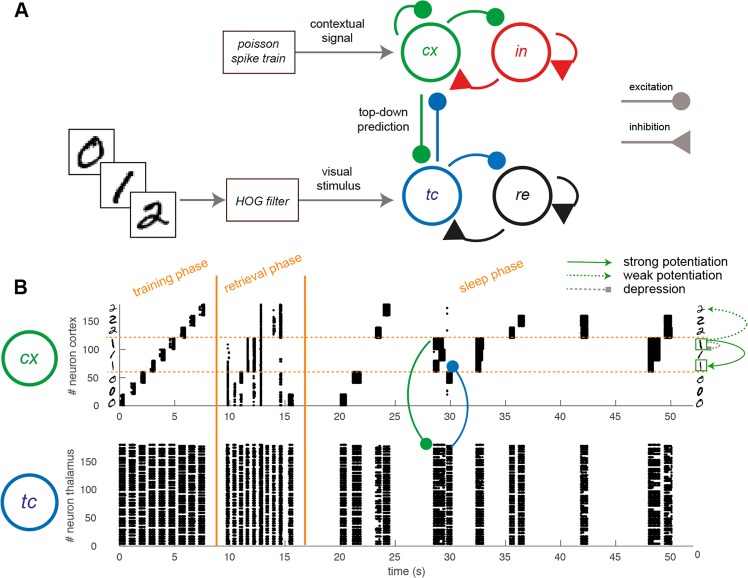
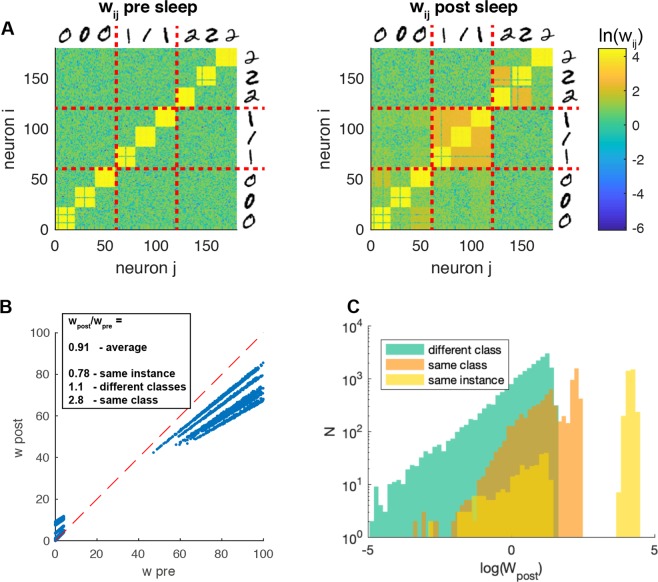
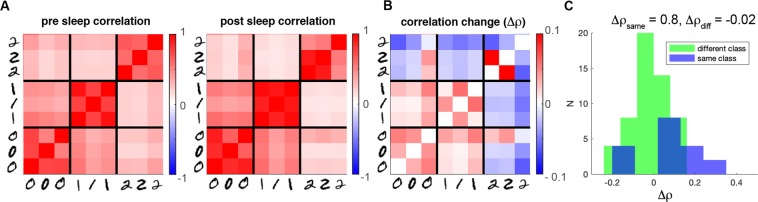
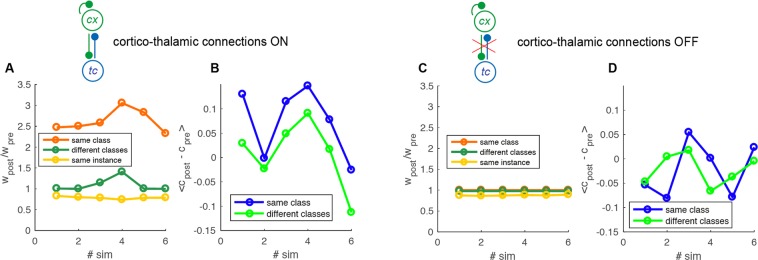
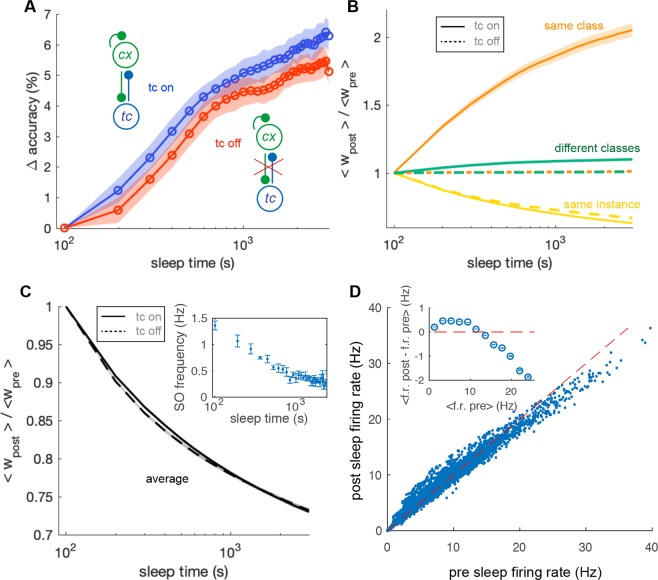
The occurrence of sleep passed through the evolutionary sieve and is widespread in animal species. Sleep is known to be beneficial to cognitive and mnemonic tasks, while chronic sleep deprivation is detrimental. Despite the importance of the phenomenon, a complete understanding of its functions and underlying mechanisms is still lacking. In this paper, we show interesting effects of deep-sleep-like slow oscillation activity on a simplified thalamo-cortical model which is trained to encode, retrieve and classify images of handwritten digits. During slow oscillations, spike-timing-dependent-plasticity (STDP) produces a differential homeostatic process. It is characterized by both a specific unsupervised enhancement of connections among groups of neurons associated to instances of the same class (digit) and a simultaneous down-regulation of stronger synapses created by the training. This hierarchical organization of post-sleep internal representations favours higher performances in retrieval and classification tasks. The mechanism is based on the interaction between top-down cortico-thalamic predictions and bottom-up thalamo-cortical projections during deep-sleep-like slow oscillations. Indeed, when learned patterns are replayed during sleep, cortico-thalamo-cortical connections favour the activation of other neurons coding for similar thalamic inputs, promoting their association. Such mechanism hints at possible applications to artificial learning systems.
Conflict of interest statement
The authors declare no competing interests.
Figures
References
-
- Tononi, G. et al. Center for sleep and consciousness - research (2018).
-
- Killgore William D.S. Progress in Brain Research. 2010. Effects of sleep deprivation on cognition; pp. 105–129. - PubMed
Publication types
MeSH terms
LinkOut - more resources
Full Text Sources
Medical
