


Functional Aging Index Complements Frailty in Prediction of Entry Into Care and Mortality
- PMID: 31222213
- PMCID: PMC7357456
- DOI: 10.1093/gerona/glz155
Functional Aging Index Complements Frailty in Prediction of Entry Into Care and Mortality
Abstract
Background: The aim of this study was to develop a functional aging index (FAI) that taps four body systems: sensory (vision and hearing), pulmonary, strength (grip strength), and movement (gait speed) and to test the predictive value of FAI for entry into care and mortality.
Method: Growth curve models and Cox regression models were applied to data from 1,695 individuals from three Swedish longitudinal studies of aging. Participants were aged 45-93 at intake and data from up to eight follow-up waves were available.
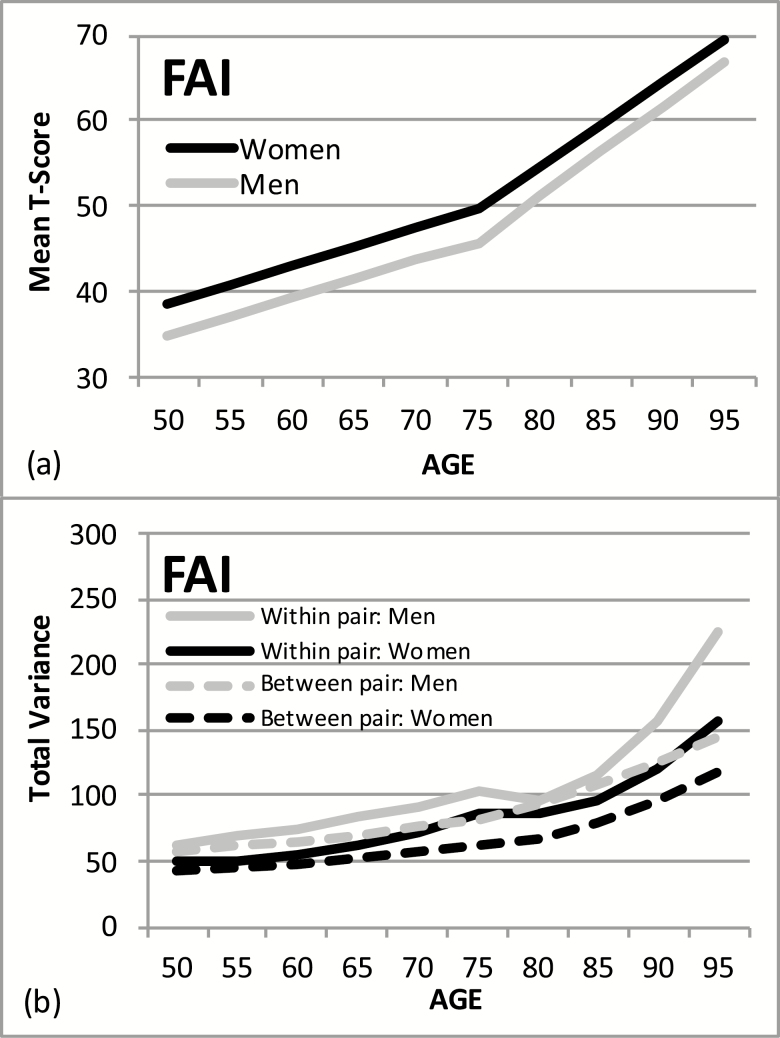
Results: The rate of change in FAI was twice as fast after age 75 as before, women demonstrated higher mean FAI, but no sex differences in rates of change with chronological age were identified. FAI predicted entry into care and mortality, even when chronological age and a frailty index were included in the models. Hazard ratios indicated that FAI was a more important predictor of entry into care for men than women, whereas it was a stronger predictor of mortality for men than women.
Conclusions: Measures of biological aging and functional aging differ in their predictive value for entry into care and mortality for men and women, suggesting that both are necessary for a complete picture of the aging process across genders.
Keywords: Gender; Latent growth curve; Survival analysis.
© The Author(s) 2019. Published by Oxford University Press on behalf of The Gerontological Society of America. All rights reserved. For permissions, please e-mail: journals.permissions@oup.com.
Figures
References
Publication types
MeSH terms
LinkOut - more resources
Full Text Sources
Medical
