


Fine-Tuned Multilayered Transparent Electrode for Highly Transparent Perovskite Light-Emitting Devices
- PMID: 31223558
- PMCID: PMC6586238
- DOI: 10.1002/aelm.201700285
Fine-Tuned Multilayered Transparent Electrode for Highly Transparent Perovskite Light-Emitting Devices
Abstract
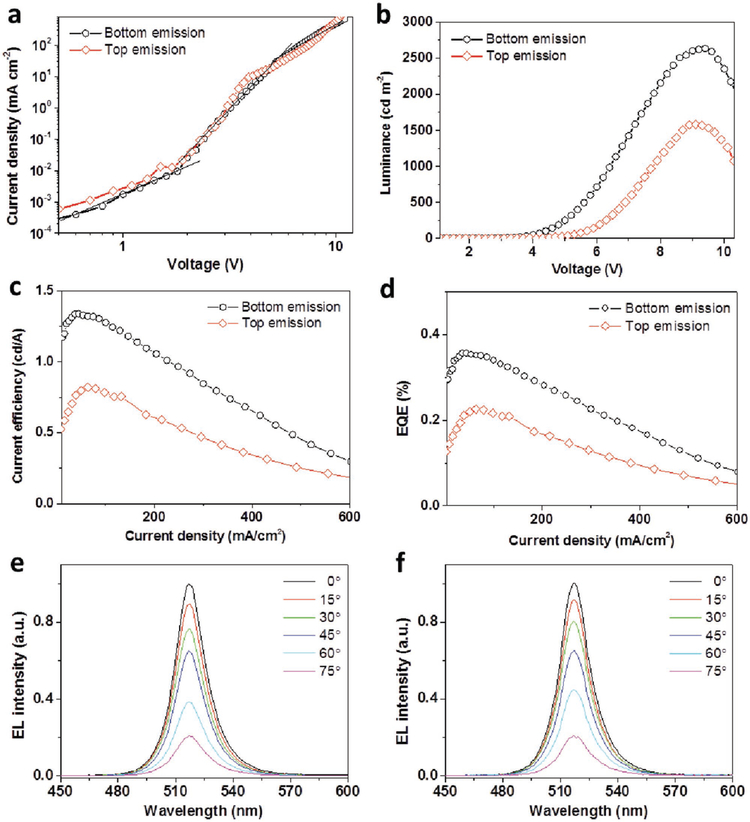
The high photoluminescence quantum yield, wide color tunability and narrow bandwidth of perovskite nanocrystals make them favorable for light source and display applications. Here, highly transparent green-light-emitting devices (LEDs) using inorganic cesium lead halide perovskite nanocrystal films as the emissive layer are reported. The effect of multilayered nanostructured transparent electrode on optical properties and performance within the LEDs is investigated by fine tuning layer thickness. The results show that the light transmission in visible region can be enhanced with this nanostructured film. These LEDs exhibited a high transmittance (average 73% over 400-700 nm) and high brightness of 2640 and 1572 cd m-2 for indium-doped tin oxide (ITO) cathode and MoO x /Au/MoO x anode sides, respectively.
Keywords: capping layer; charge injection; light-emitting device; perovskite nanocrystal; transparent.
Conflict of interest statement
Conflict of Interest The authors declare no conflict of interest.
Figures



References
-
- Saliba M, Matsui T, Domanski K, Seo J-Y, Ummadisingu A, Zakeeruddin SM, Correa-Baena J-P, Tress WR, Abate A, Hagfeldt A, Grätzel M, Science 2016, 354, 206; - PubMed
- Yuan Y, Huang J, Acc. Chem. Res 2016, 49, 286; - PubMed
- McMeekin DP, Sadoughi G, Rehman W, Eperon GE, Saliba M, Hörantner MT, Haghighirad A, Sakai N, Korte L, Rech B, Johnston MB, Herz LM, Snaith HJ, Science 2016, 351, 151; - PubMed
- Kulbak M, Cahen D, Hodes G, J. Phys. Chem. Lett 2015, 6, 2452. - PubMed
-
- Cho H, Jeong S-H, Park M-H, Kim Y-H, Wolf C, Lee C-L, Heo JH, Sadhanala A, Myoung N, Yoo S, Im SH, Friend RH, Lee T-W, Science 2015, 350, 1222; - PubMed
- Wang J, Wang N, Jin Y, Si J, Tan Z-K, Du H, Cheng L, Dai X, Bai S, He H, Ye Z, Lai ML, Friend RH, Huang W, Adv. Mater 2015, 27, 2311; - PubMed
- Tan Z-K, Moghaddam RS, Lai ML, Docampo P, Higler R, Deschler F, Price M, Sadhanala A, Pazos LM, Credgington D, Hanusch F, Bein T, Snaith HJ, Friend RH, Nat. Nanotechnol 2014, 9, 687; - PubMed
- Li J, Bade SGR, Shan X, Yu Z, Adv. Mater 2015, 27, 5196; - PubMed
- Cho H, Wolf C, Kim JS, Yun HJ, Bae JS, Kim H, Heo J-M, Ahn S, Lee T-W, Adv. Mater 2017, 29, 1700579; - PubMed
- Kim Y-H, Cho H, Heo JH, Kim T-S, Myoung N, Lee C-L, Im SH, Lee T-W, Adv. Mater 2015, 27, 1248. - PubMed
-
- Xing G, Mathews N, Lim SS, Yantara N, Liu X, Sabba D, Grätzel M, Mhaisalkar S, Sum TC, Nat. Mater 2014, 13, 476; - PubMed
- Zhu H, Fu Y, Meng F, Wu X, Gong Z, Ding Q, Gustafsson MV, Trinh MT, Jin S, Zhu XY, Nat. Mater 2015, 14, 636; - PubMed
- Deschler F, Price M, Pathak S, Klintberg LE, Jarausch D-D, Higler R, Hüttner S, Leijtens T, Stranks SD, Snaith HJ, Atatüre M, Phillips RT, Friend RH, J. Phys. Chem. Lett 2014, 5, 1421; - PubMed
- Xu Y, Chen Q, Zhang C, Wang R, Wu H, Zhang X, Xing G, Yu WW, Wang X, Zhang Y, Xiao M, J. Am. Chem. Soc 2016, 138, 3761. - PubMed
-
- Sutherland BR, Sargent EH, Nat. Photonics 2016, 10, 295;
- Hu F, Yin C, Zhang H, Sun C, Yu WW, Zhang C, Wang X, Zhang Y, Xiao M, Nano Lett. 2016, 16, 6425; - PubMed
- Protesescu L, Yakunin S, Bodnarchuk MI, Krieg F, Caputo R, Hendon CH, Yang RX, Walsh A, Kovalenko MV, Nano Lett. 2015, 15, 3692; - PMC - PubMed
- Li J, Xu L, Wang T, Song J, Chen J, Xue J, Dong Y, Cai B, Shan Q, Han B, Zeng H, Adv. Mater 2017, 29, 1603885. - PubMed
Grants and funding
LinkOut - more resources
Full Text Sources