


Voice Tremor Response to Deep Brain Stimulation in Relation to Electrode Location in the Posterior Subthalamic Area
- PMID: 31225518
- PMCID: PMC6584456
- DOI: 10.1016/j.wnsx.2019.100024
Voice Tremor Response to Deep Brain Stimulation in Relation to Electrode Location in the Posterior Subthalamic Area
Abstract
Background: Deep brain stimulation of the motor thalamus or the posterior subthalamic area (PSA) shows promising results for patients with voice tremor, although only for about 50% of patients. There are indications that voice tremor requires more focused stimulation within the target area compared with hand tremor. The objective of the present study was to determine the most efficient location for reducing voice tremor within the PSA.
Methods: Thirty-seven patients with essential tremor were evaluated off stimulation and in a set of experimental conditions with unilateral stimulation at increasing amplitude levels. Two listeners performed blinded assessments of voice tremor from recordings of sustained vowel productions.
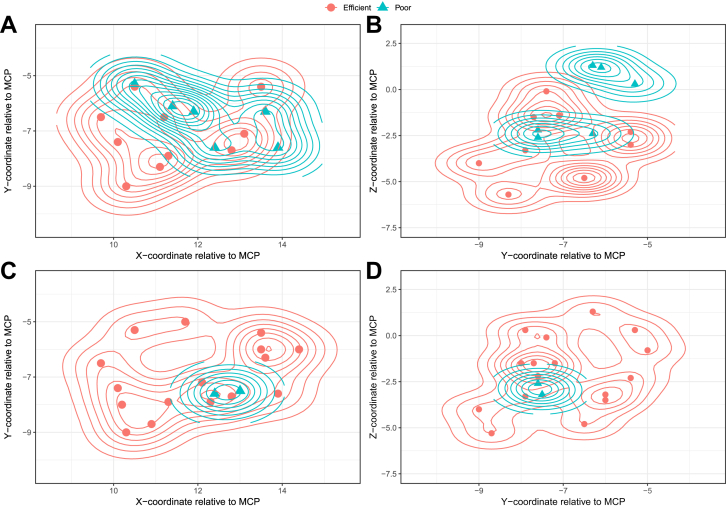
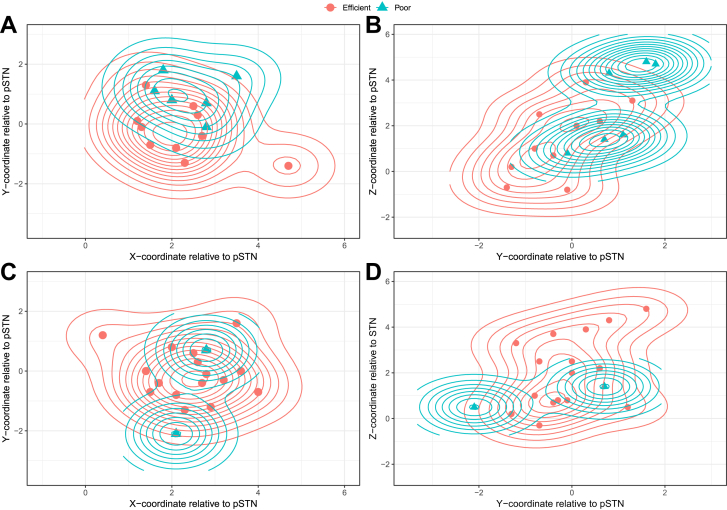
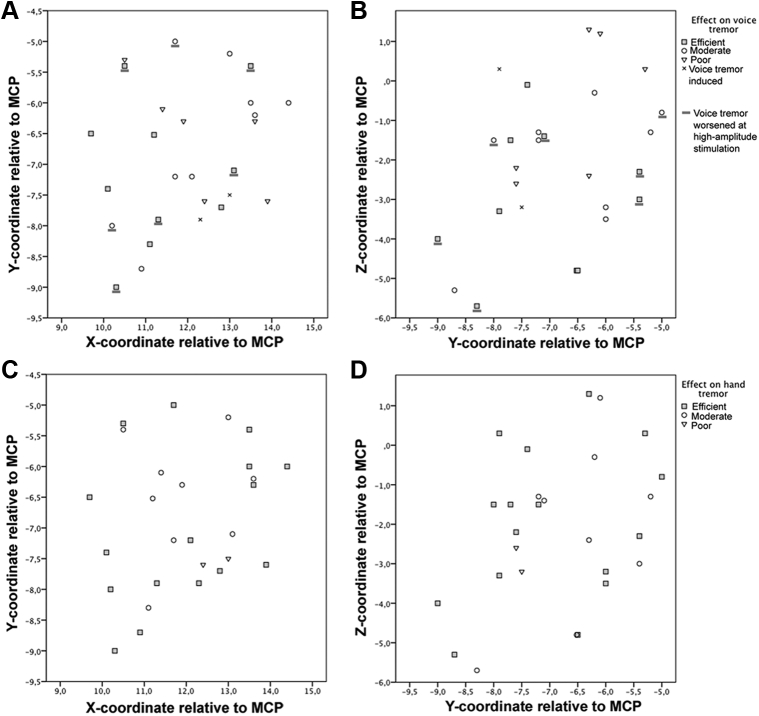
Results: Twenty-five patients (68%) had voice tremor. Unilateral stimulation reduced voice tremor for the majority of patients, and only 6 patients had poor outcomes. Contacts yielding efficient voice tremor reduction were deeper relative to the midcommissural point (MCP) and more posterior relative to the posterior tip of the subthalamic nucleus (pSTN) (zMCP = -3.1, ypSTN = -0.2) compared with poor contacts (zMCP = -0.7, ypSTN = 1.0). High-amplitude stimulation worsened voice tremor for 7 patients and induced voice tremor in 2 patients. Hand tremor improved to a greater extent than voice tremor, and improvements could be seen throughout the target area.
Conclusions: Our results indicate that efficient voice tremor reduction can be achieved by stimulating contacts located in the inferior part of the PSA, close or slightly posterior to the pSTN. We observed cases in which voice tremor was induced by high-amplitude stimulation.
Keywords: AC-PC, Anterior and posterior commissures; Caudal zona incerta; DBS, Deep brain stimulation; Deep brain stimulation; ET, Essential tremor; Electrode location; Essential tremor; ICC, Intraclass correlation coefficient; M, Mean; MCP, Mid-commissural point; PSA, Posterior subthalamic area; Posterior subthalamic area; SD, Standard deviation; Vim, Ventral intermediate nucleus of the thalamus; Voice tremor; cZi, Caudal zona incerta; pSTN, Posterior tail of the subthalamic nucleus.
Figures
References
-
- Deuschl G., Raethjen J., Hellriegel H., Elble R.J. Treatment of patients with essential tremor. Lancet Neurol. 2011;10:148–161. - PubMed
-
- Hägglund P., Sandström L., Blomstedt P., Karlsson F. Voice tremor in patients with essential tremor: effects of deep brain stimulation of caudal zona incerta. J Voice. 2016;30:228–233. - PubMed
-
- Matsumoto J.Y., Fossett T., Kim M. Precise stimulation location optimizes speech outcomes in essential tremor. Parkinsonism Relat Disord. 2016;32:60–65. - PubMed
-
- Carpenter M.A., Pahwa R., Miyawaki K.L., Wilkinson S.B., Searl J.P., Koller W.C. Reduction in voice tremor under thalamic stimulation. Neurology. 1998;50:796–798. - PubMed
-
- Sandström L., Karlsson F., Blomstedt P. Unilateral left deep brain stimulation of the caudal zona incerta is equally effective on voice tremor as bilateral stimulation: evidence from 7 patients with essential tremor. Stereotact Funct Neurosurg. 2018;96:157–161. - PubMed
LinkOut - more resources
Full Text Sources
Research Materials
Miscellaneous
