


Indicators of cigarette smoking dependence and relapse in former smokers who vape compared with those who do not: findings from the 2016 International Tobacco Control Four Country Smoking and Vaping Survey
- PMID: 31225672
- PMCID: PMC7065300
- DOI: 10.1111/add.14722
Indicators of cigarette smoking dependence and relapse in former smokers who vape compared with those who do not: findings from the 2016 International Tobacco Control Four Country Smoking and Vaping Survey
Abstract
Background and aims: It has been proposed that many smokers switch to vaping because their nicotine addiction makes this their only viable route out of smoking. We compared indicators of prior and current cigarette smoking dependence and of relapse in former smokers who were daily users of nicotine vaping products ('vapers') or who were not vaping at the time of survey ('non-vapers').
Design: Cross-sectional survey-based comparison between vaping and non-vaping former smokers, including a weighted logistic regression of vaping status onto predictor variables, adjusting for covariates specified below.
Setting: United States, Canada, Australia and England.
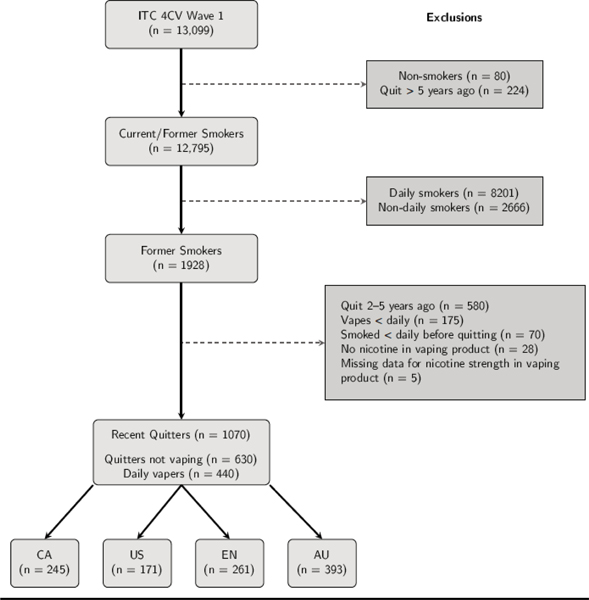
Participants: A total of 1070 people aged 18+ years from the 2016 International Tobacco Control (ITC) Four Country Smoking and Vaping Wave 1 Survey who reported having ever been daily smokers but who stopped less than 2 years ago and who were currently vapers or non-vapers.
Measurements: Dependent variable was current vaping status. Predictor variables were self-reported: (1) smoking within 5 minutes of waking and usual daily cigarette consumption, both assessed retrospectively; (2) current perceived addiction to smoking, urges to smoke and confidence in staying quit. Covariates: country, sample sources, sex, age group, ethnicity, income, education, current nicotine replacement therapy use and time since quitting.
Findings: Vapers were more likely than non-vapers to report: (1) having smoked within 5 minutes of waking [34.3 versus 15.9%, adjusted odds ratio (aOR) = 3.74, 95% confidence interval (CI) = 1.99, 7.03), χ2 = 16.92, P < 0.001]; having smoked > 10 cigarettes/day (74.4 versus 47.2%, aOR = 4.39, 95% CI = 2.22, 8.68), χ2 = 18.18, P < 0.001); (2) perceiving themselves to be still very addicted to smoking (41.3 versus 26.2%, aOR = 2.89, 95% CI = 1.58, 5.30, χ2 = 11.87, P < 0.001) and feeling extremely confident about staying quit (62.1 versus 36.6%, aOR = 3.22, 95% CI = 1.86, 5.59, χ2 = 17.36, P < 0.001). Vapers were not more likely to report any urges to smoke than non-vapers (27.7 versus 38.8%, aOR = 0.86, 95% CI = 0.44, 1.65, χ2 = 0.21, P = 0.643).
Conclusions: While former smokers who currently vape nicotine daily report higher levels of cigarette smoking dependence pre- and post-cessation compared with former smokers who are current non-vapers, they report greater confidence in staying quit and similar strength of urges to smoke.
Keywords: Former smokers; nicotine; non-vaping; relapse prevention; vapers; vaping.
© 2019 Society for the Study of Addiction.
Conflict of interest statement
References
-
- Royal College of Physicians. Nicotine without smoke. A report of the Tobacco Advisory Group of the Royal College of Physicians; London, UK; 2016.
-
- National Academies of Sciences Engineering and Medicine. Public health consequences of e-cigarettes Washington DC; 2018.
-
- McNeill A, Brose LS, Calder R, Bauld L, Robson D. Evidence review of e-cigarettes and heated tobacco products 2018. A report commissioned by Public Health England; London; 2018.
-
- Beard E, West R, Michie S, Brown J. Association between electronic cigarette use and changes in quit attempts, success of quit attempts, use of smoking cessation pharmacotherapy, and use of stop smoking services in England: time series analysis of population trends British Medical Journal. 2016;354:i4645. - PubMed
Publication types
MeSH terms
Grants and funding
LinkOut - more resources
Full Text Sources
Medical
