Atg7 Knockdown Reduces Chemerin Secretion in Murine Adipocytes
- PMID: 31225870
- PMCID: PMC7453040
- DOI: 10.1210/jc.2018-01980
Atg7 Knockdown Reduces Chemerin Secretion in Murine Adipocytes
Abstract
Context: In individuals with obesity, adipocyte endocrine function is affected by altered autophagy. Genetic variants in autophagy-related gene 7 (ATG7) correlated with serum chemerin (RARRES2) concentrations.
Objectives: To investigate a functional interplay between chemerin and ATG7, how it may relate to autophagy-mediated adipocyte dysfunction in obesity, and the relevance of genetic ATG7 variants in chemerin physiology.
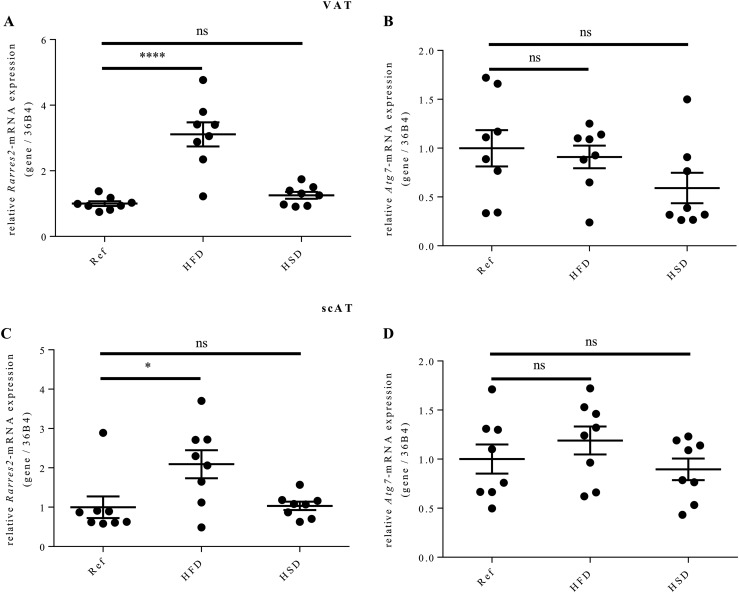
Design: Adipose ATG7 mRNA expression and adiposity measures were available in two human study cohorts. The effect of a high-calorie diet on adipose Rarres2 and Atg7 expression was investigated in mice. In 3T3-L1 adipocytes, the effect of Atg7 knockdown on chemerin expression and secretion was studied. The influence of single nucleotide polymorphisms on ATG7 transcription and chemerin physiology was investigated using a luciferase assay.
Setting: Mouse model, clinical trials, in vitro studies.
Participants: Native American (n = 83) and white (n = 100) cohorts.
Main outcome measure: Adipocyte chemerin expression and secretion.
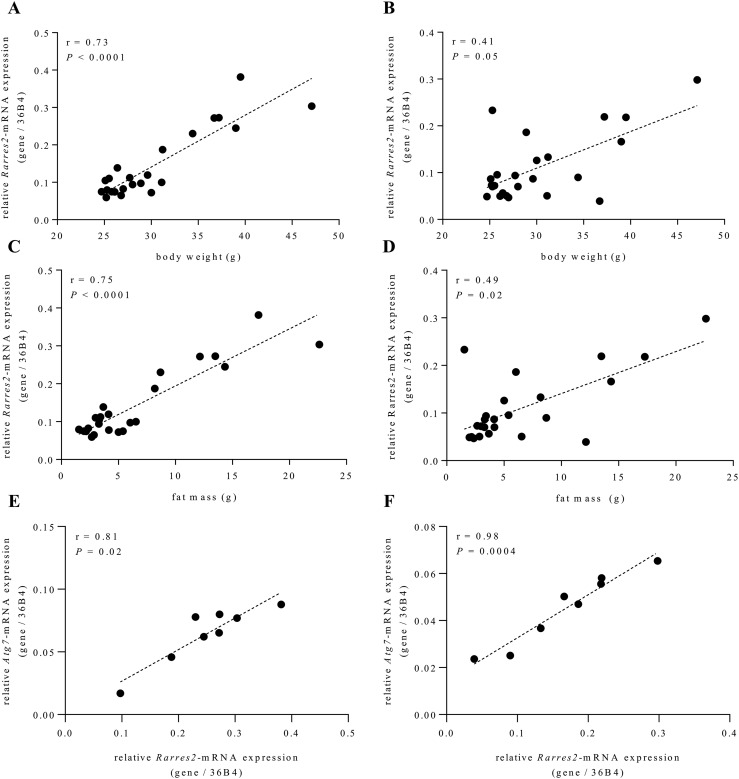
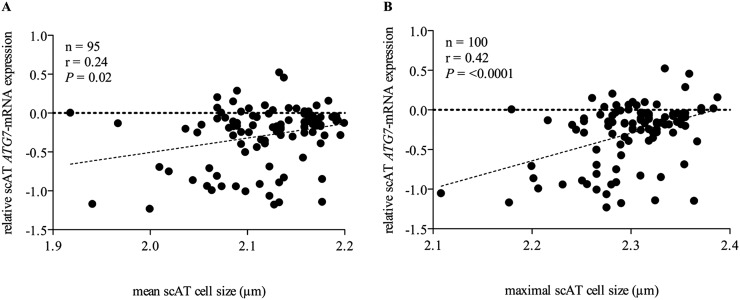
Results: In mice fed a high-calorie diet, adipose Atg7 mRNA expression did not parallel an increase in Rarres2 mRNA expression. ATG7 mRNA expression in human subcutaneous adipose tissue correlated with body mass index, fat mass (r > 0.27; P < 0.01), and adipocyte cell size (r > 0.24; P < 0.02). Atg7 knockdown in 3T3-L1 adipocytes decreased chemerin secretion by 22% (P < 0.04). Rs2606729 in ATG7 was predicted to alter ATG7 transcription and induced higher luciferase activity in vitro (P < 0.0001).
Conclusions: Human adipose ATG7 mRNA expression relates to measures of adiposity. Atg7 knockdown reduces chemerin secretion from adipocytes in vitro, supportive of a functional interplay between ATG7 and chemerin in autophagy-mediated adipocyte dysfunction.
Trial registration: ClinicalTrials.gov NCT00340132.
Copyright © 2019 Endocrine Society.
Figures



References
-
- Klöting N, Blüher M. Adipocyte dysfunction, inflammation and metabolic syndrome. Rev Endocr Metab Disord. 2014;15(4):277–287. - PubMed
-
- Blüher M. Adipose tissue dysfunction contributes to obesity related metabolic diseases. Best Pract Res Clin Endocrinol Metab. 2013;27(2):163–177. - PubMed
-
- Haim Y, Blüher M, Slutsky N, Goldstein N, Klöting N, Harman-Boehm I, Kirshtein B, Ginsberg D, Gericke M, Guiu Jurado E, Kovsan J, Tarnovscki T, Kachko L, Bashan N, Gepner Y, Shai I, Rudich A. Elevated autophagy gene expression in adipose tissue of obese humans: a potential non-cell-cycle-dependent function of E2F1. Autophagy. 2015;11(11):2074–2088. - PMC - PubMed
-
- Slutsky N, Vatarescu M, Haim Y, Goldstein N, Kirshtein B, Harman-Boehm I, Gepner Y, Shai I, Bashan N, Blüher M, Rudich A. Decreased adiponectin links elevated adipose tissue autophagy with adipocyte endocrine dysfunction in obesity. Int J Obes. 2016;40(6):912–920. - PubMed
-
- Bozaoglu K, Segal D, Shields KA, Cummings N, Curran JE, Comuzzie AG, Mahaney MC, Rainwater DL, VandeBerg JL, MacCluer JW, Collier G, Blangero J, Walder K, Jowett JB. Chemerin is associated with metabolic syndrome phenotypes in a Mexican-American population. J Clin Endocrinol Metab. 2009;94(8):3085–3088. - PMC - PubMed
Publication types
MeSH terms
Substances
Associated data
LinkOut - more resources
Full Text Sources
Medical
Miscellaneous