. 2019 Aug:183:14-21.
doi: 10.1016/j.pbb.2019.06.008. Epub 2019 Jun 18.

Methylphenidate increases willingness to perform effort in adults with ADHD

Affiliations

Methylphenidate increases willingness to perform effort in adults with ADHD

Merideth A Addicott et al. Pharmacol Biochem Behav. 2019 Aug.

Abstract

Background: A reduced willingness to perform effort based on the magnitude and probability of potential rewards has been associated with diminished dopamine function and may be relevant to attention-deficit/hyperactivity disorder (ADHD). Here, we investigated the influence of ADHD status and methylphenidate on effort-based decisions. We hypothesized that ADHD participants would make fewer high-effort selections than non-ADHD subjects, and that methylphenidate would increase the number of high-effort selections. Furthermore, we hypothesized there would be associations among ADHD severity and methylphenidate-related changes in effort-based and attentional performance across all participants.

Methods and participants: ADHD (n = 23) and non-ADHD (n = 23) adults completed the Effort Expenditure for Rewards Task in which participants select between low-effort and high-effort options to receive monetary rewards at varying levels of reward magnitude and probability. A test of attentional performance was also completed.

Results: Overall, participants made more high-effort selections as potential reward magnitude and probability increased. ADHD participants did not make fewer high-effort selections than non-ADHD participants, but ADHD participants showed greater methylphenidate-related increases in high-effort selections. ADHD participants had worse attentional performance than non-ADHD participants. ADHD severity was associated with methylphenidate-related changes in high-effort selections, but not changes in attentional performance.

Conclusions: These results indicate that methylphenidate increases the willingness to perform effort in individuals with ADHD, possibly due to disorder-related motivational deficits. This provides support for theories of insufficient effort allocation among individuals with ADHD.

Trial registration: Clinicaltrials.gov Identifier, NCT02630017.

Keywords: Attention; Attention-deficit/hyperactivity disorder; Effort; Methylphenidate.


Conflict of interest statement

Conflict of Interest: All authors declare that they have no conflict of interest pertaining to this manuscript.

Figures

Figure 1.
Figure 1.
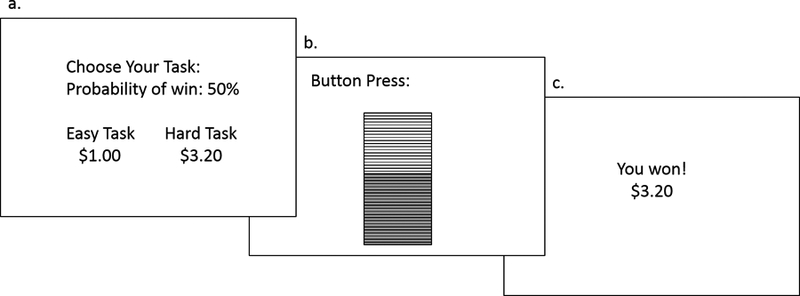
Representation of a single trial of the Effort Expenditure for Rewards Task (EEfRT). a) Participants are shown information about the reward magnitude of the high-effort task and the probability of receiving the reward for that trial. b) Participants made button presses to complete the chosen task for 7 sec (low-effort task) or 21 sec (high-effort task). c) Participants received feedback indicating whether and how much reward was received for that trial.
Figure 2.
Figure 2.
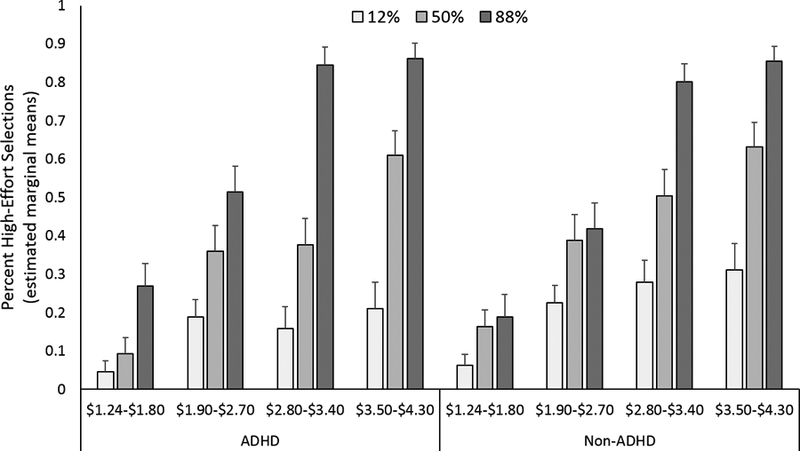
The percent high-effort selections made across reward magnitude (x-axis) and reward probability (different colored bars) in ADHD (on the left) and non-ADHD (on the right) groups. Across all participants and drug conditions, high-effort selections increased as reward magnitude and probability increased (p’s < .05). Shown are the estimated marginal means (including age as a covariate of no interest). Error bars are S.E.M.
Figure 3.
Figure 3.
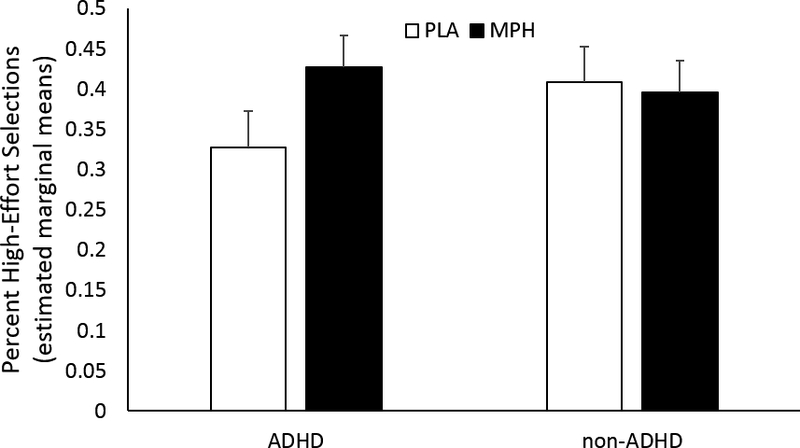
The percent high-effort selections among ADHD and non-ADHD groups after placebo (PLA, white bars) and methylphenidate (MPH, black bars). MPH had a greater effect in the ADHD group than the non-ADHD group (Group × Drug interaction effect, p = .001). Shown are the estimated marginal means (including age as a covariate of no interest). Error bars are S.E.M.
Figure 4.
Figure 4.
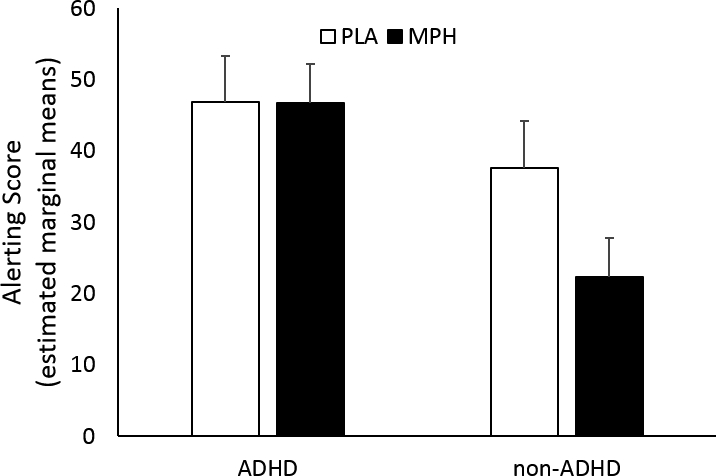
The alerting score from the Attention Network Test (ANT) among ADHD and non-ADHD groups after placebo (PLA, white bars) and methylphenidate (MPH, black bars). Across both groups, the alerting score was smaller after MPH, and between groups, the alerting score was larger among the ADHD group than the non-ADHD group (p’s < .05). Shown are the estimated marginal means (including age as a covariate of no interest). Error bars are S.E.M.

References

    1. APA (2013). Diagnostic and statistical manual of mental disorders: DSM-5. Washington, DC, American Psychiatric Association.
    1. Barch DM, Treadway MT, Schoen N (2014). Effort, Anhedonia, and Function in Schizophrenia: Reduced Effort Allocation Predicts Amotivation and Functional Impairment. J Abnorm Psychol 123: 387–397. DOI: 10.1037/a0036299. - DOI - PMC - PubMed
    1. Beierholm U, Guitart-Masip M, Economides M, Chowdhury R, Duzel E, Dolan R, Dayan P (2013). Dopamine Modulates Reward-Related Vigor. Neuropsychopharmacol 38: 1495–1503. DOI: 10.1038/npp.2013.48. - DOI - PMC - PubMed
    1. Biederman J, Mick E, Faraone SV (2000). Age-dependent decline of symptoms of attention deficit hyperactivity disorder: Impact of remission definition and symptom type. Am J Psychiat 157: 816–818. DOI: DOI 10.1176/appi.ajp.157.5.816. - DOI - PubMed
    1. Boonstra AM, Oosterlaan J, Sergeant JA, Buitelaar JK (2005). Executive functioning in adult ADHD: a meta-analytic review. Psychol Med 35: 1097–1108. DOI: 10.1017/S003329170500499x. - DOI - PubMed

Publication types

MeSH terms

Substances

Associated data