. 2019 Aug:114:104547.
doi: 10.1016/j.yhbeh.2019.06.011. Epub 2019 Jul 19.

Gonadal hormones in female rats protect against dehydration-induced memory impairments in the novel object recognition paradigm

Affiliations

Gonadal hormones in female rats protect against dehydration-induced memory impairments in the novel object recognition paradigm

Jessica Santollo et al. Horm Behav. 2019 Aug.

Abstract

Dehydration impairs cognitive performance in humans and rodents, although studies in animal models are limited. Estrogens have both protective effects on fluid regulation and improve performance in certain cognitive tasks. We, therefore, tested whether sex and gonadal hormones influence object recognition memory during dehydration. Because past studies used fluid deprivation to induce dehydration, which is a mixture of intracellular and extracellular fluid loss, we tested the effects of osmotic (loss of intracellular fluid) and hypovolemic (loss of extracellular fluid) dehydration on object recognition memory. After training trials consisting of exposure to two identical objects, rats were either treated with hypertonic saline to induce osmotic dehydration, furosemide to induce hypovolemic dehydration, or received a control injection and then object recognition memory was tested by presenting the original and a novel object. After osmotic dehydration, regardless of group or treatment, all rats spent significantly more time investigating the novel object. After hypovolemic dehydration, regardless of treatment, both the males and estrous females spent significantly more time investigating the novel object. While the control-treated diestrous females also spent significantly more time investigating the novel object, the furosemide-treated diestrous females spent a similar amount of time investigating the novel and original object. Follow up studies determined that loss of ovarian hormones after ovariectomy, but not loss of testicular hormones after castration, resulted in impaired memory performance in the object recognition test after hypovolemic dehydration. This series of experiments provides evidence for a protective role of ovarian hormones on dehydration-induced memory impairments.

Keywords: Castration; Hypovolemia; Osmotic dehydration; Ovariectomy.


Figures

Figure 1.
Figure 1.
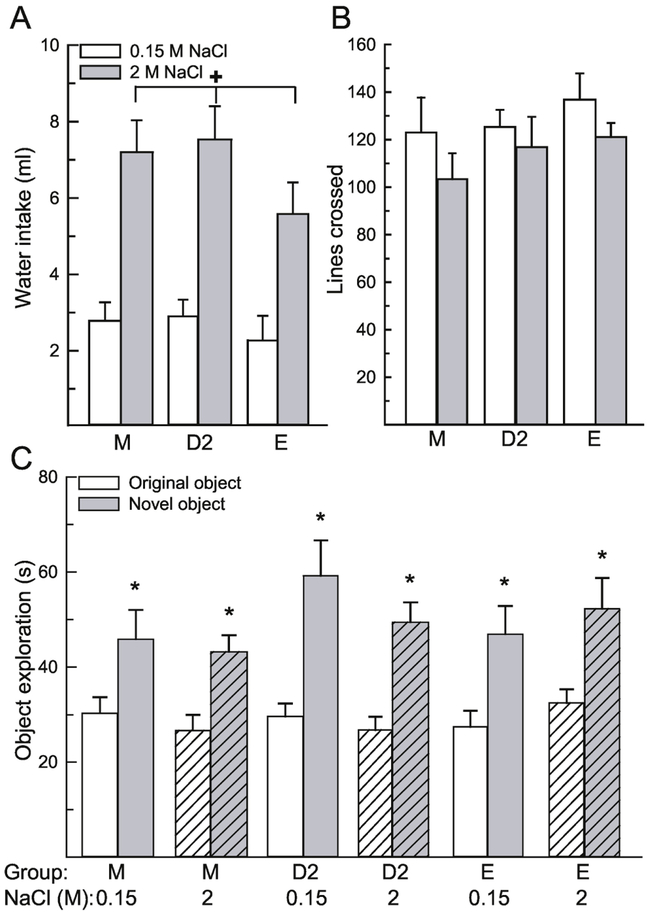
Osmotic dehydration did not influence performance in the novel object recognition task. (A) Rats treated with 2 M NaCl consumed significantly more water compared to rats treated with 0.15 M NaCl, which confirmed that the treatment induced dehydration. (B) General activity, measured by the number of grid lines crossed in the open field, did not differ between any group. (C) All groups, regardless of treatment and sex/hormone status, spent significantly more time investigating the novel object, compared to the original object. Abbreviations: males (M), diestrous 2 females (D2), estrous females (E). Hashed bars denote the treatment groups. +Greater than control, p < 0.001. *Greater than time investigating original object, p < 0.001.
Figure 2.
Figure 2.
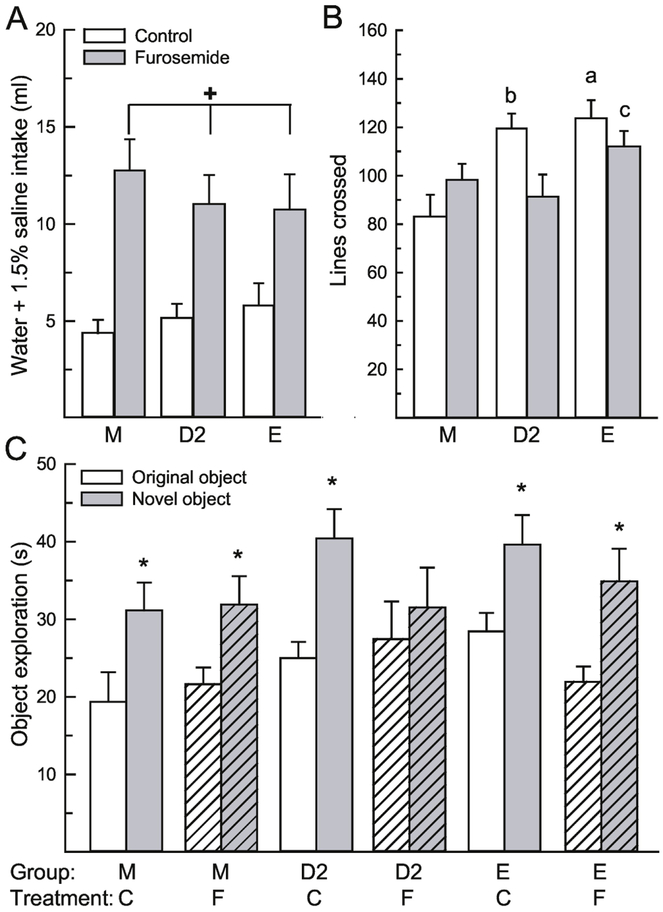
Hypovolemic dehydration impaired performance in the novel object recognition task in a sex/hormone dependent manner. (A) Rats treated with furosemide consumed significantly more water and 1.5% saline compared to rats treated with saline control, which confirmed that the treatment induced dehydration. (B) General activity was influenced by group and treatment. E and saline-treated D2 rats were more active than male and furosemide-treated D2 rats. (C) Regardless of treatment, both groups of males and E rats spent significantly more time investigating the novel, compared to the original object. In D2 rats, however, only the control-treated group spent more time investigating the novel object. Abbreviations: males (M), diestrous 2 females (D2), estrous females (E), saline control (C), furosemide (F). Hashed bars denote the treatment groups. +Greater than control-treated, p < 0.001. aGreater than control and furosemide-treated males and furosemide-treated D2 females, p < 0.05. bGreater than control males and furosemide-treated D2 females, p < 0.05. cGreater than control males, p < 0.01. *Greater than time investigating original object, p < 0.001.
Figure 3.
Figure 3.
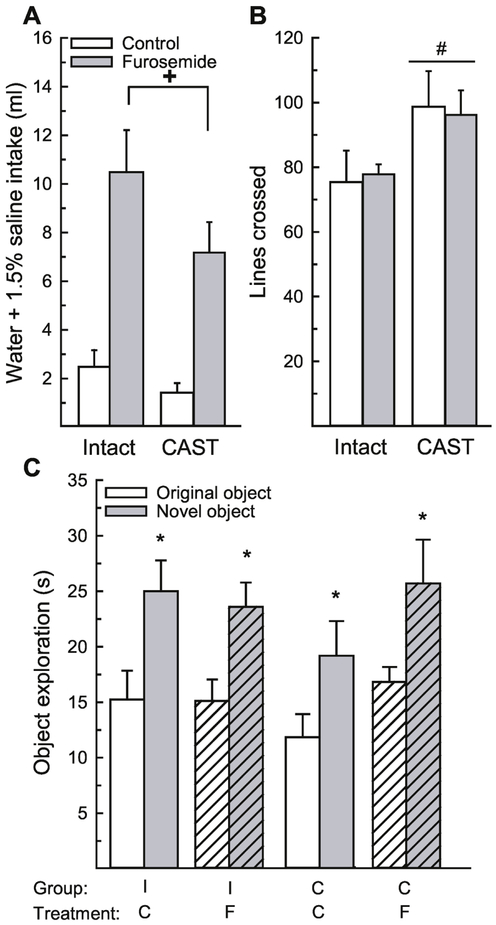
Loss of testicular hormones did not influence performance in the novel object recognition paradigm during dehydration. (A) Rats treated with furosemide consumed significantly more water and 1.5% saline compared to rats treated with saline control, which confirmed that the treatment induced dehydration. (B) Castrated rats were significantly more active in the open field compared to intact rats. (C) Regardless of surgery status or treatment, all groups spent significantly more time investigating the novel object, compared to the control object. Abbreviations: intact (I), castration (C), saline control (C), furosemide (F). Hashed bars denote the treatment groups. +Greater than control-treated rats, p < 0.001. #Greater than intact rats, p = 0.02. *Greater than time investigating original object, p < 0.001.
Figure 4.
Figure 4.
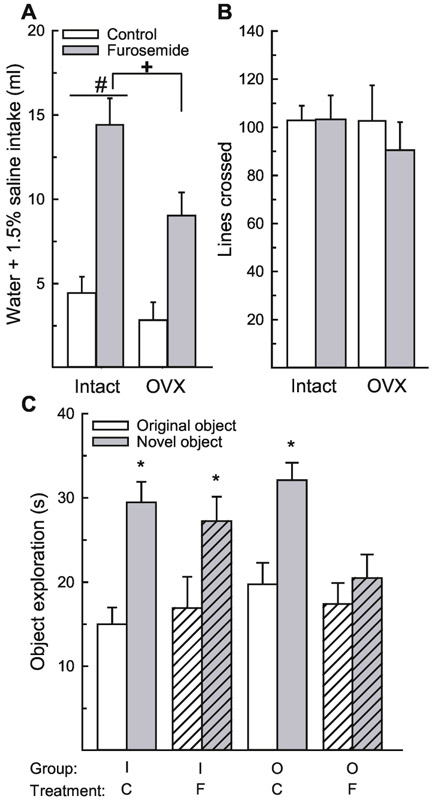
Ovarian hormones protect against hypovolemic dehydration-induced memory impairments in the novel object recognition paradigm. (A) Rats treated with furosemide consumed significantly more water and 1.5% saline compared to rats treated with saline control, which confirmed that the treatment induced dehydration. In addition, intact rats consumed more than OVX rats. (B) There was no difference in activity between any group. (C) Both groups of intact rats and control-treated OVX rats spent significantly more time investigating the novel, compared to the original object. Furosemide-treated OVX rats spent a similar amount of time investigating the novel and original object. Abbreviations: intact (I), ovariectomized (O), saline control (C), furosemide (F). Hashed bars denote the treatment groups. +Greater than control-treated rats, p < 0.001. #Greater than OVX rats, p = 0.009. *Greater than time investigating original object, p < 0.001.

References

    1. Adan A, 2012. Cognitive performance and dehydration. J Am Coll Nutr 31, 71–78. - PubMed
    1. Antunes M, Biala G, 2012. The novel object recognition memory: neurobiology, test procedure, and its modifications. Cogn Process 13, 93–110. - PMC - PubMed
    1. Aubele T, Kaufman R, Montalmant F, Kritzer MF, 2008. Effects of gonadectomy and hormone replacement on a spontaneous novel object recognition task in adult male rats. Horm Behav 54, 244–252. - PMC - PubMed
    1. Becker JB, Arnold AP, Berkley KJ, Blaustein JD, Eckel LA, Hampson E, Herman JP, Marts S, Sadee W, Steiner M, Taylor J, Young E, 2005. Strategies and methods for research on sex differences in brain and behavior. Endocrinology 146, 1650–1673. - PubMed
    1. Begg DP, Sinclair AJ, Weisinger RS, 2012. Reductions in water and sodium intake by aged male and female rats. Nutr Res 32, 865–872. - PubMed

Publication types

Substances