


Toward Understanding the Relationship Between Prioritized Values and Preferences for Cardiopulmonary Resuscitation Among Seriously Ill Adults
- PMID: 31228534
- PMCID: PMC6754772
- DOI: 10.1016/j.jpainsymman.2019.06.011
Toward Understanding the Relationship Between Prioritized Values and Preferences for Cardiopulmonary Resuscitation Among Seriously Ill Adults
Abstract
Context: Prioritizing among potentially conflicting end-of-life values may help patients discriminate among treatments and allow clinicians to align treatments with values.
Objectives: To investigate end-of-life values that patients prioritize when facing explicit trade-offs and identify predictors of patients whose values and treatment preferences seem inconsistent.
Methods: Analysis of surveys from a multi-center cluster-randomized trial of patients with serious illness. Respondents prioritized end-of-life values and identified cardiopulmonary resuscitation (CPR) preferences in two health states.
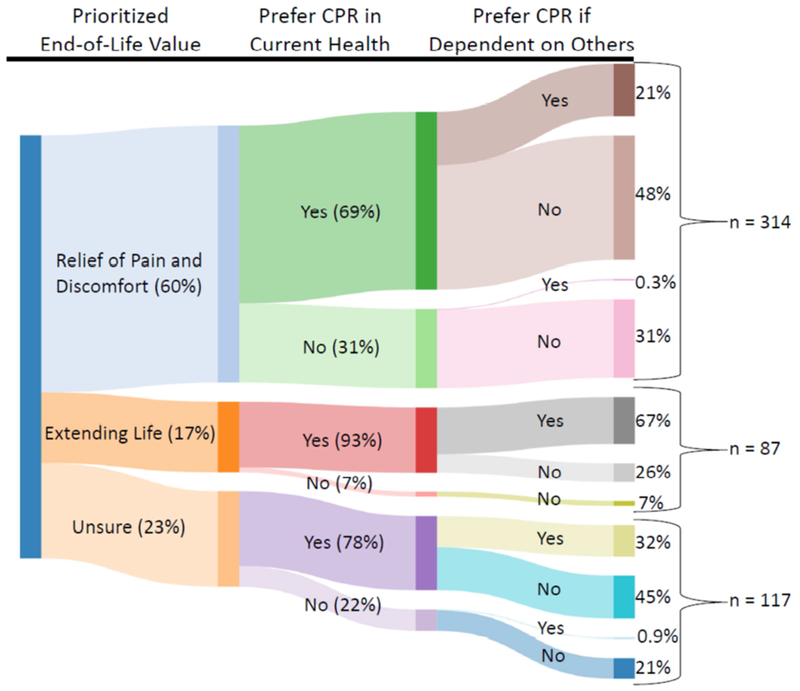
Results: Of 535 patients, 60% prioritized relief of discomfort over extending life, 17% prioritized extending life over relief of discomfort, and 23% were unsure. Patients prioritizing extending life were most likely to prefer CPR, with 93% preferring CPR in current health and 67% preferring CPR if dependent on others, compared with 69% and 21%, respectively, for patients prioritizing relief of discomfort, and 78% and 33%, respectively, for patients unsure of their prioritized value (P < 0.001 for all comparisons). Among patients prioritizing relief of discomfort, preference for CPR in current health was less likely among older patients (odds ratio 0.958 per year; 95% CI 0.935, 0.981) and more likely with better self-perceived health (odds ratio 1.402 per level of health; 95% CI 1.090, 1.804).
Conclusion: Clinicians face challenges as they clarify patient values and align treatments with values. Patients' values predicted CPR preferences, but a substantial proportion of patients expressed CPR preferences that appeared potentially inconsistent with their primary value. Clinicians should question assumptions about relationships between values and CPR preferences. Further research is needed to identify ways to use values to guide treatment decisions.
Keywords: Goals-of-care; advance care planning (ACP); cardiopulmonary resuscitation (CPR); end-of-life; palliative care; preferences; values.
Copyright © 2019 American Academy of Hospice and Palliative Medicine. Published by Elsevier Inc. All rights reserved.
Conflict of interest statement
CONFLICTS OF INTEREST
There are no conflicts of interest from any of the authors.
Matthew E. Modes, MD, MPP = no conflicts of interest
Ruth A. Engelberg, PhD = no conflicts of interest
Lois Downey, MA = no conflicts of interest
Elizabeth L. Nielsen, MPH = no conflicts of interest
Robert Y. Lee, MD = no conflicts of interest
J. Randall Curtis, MD, MPH = no conflicts of interest
Erin K. Kross, MD = no conflicts of interest
Figures
References
-
- Schenker Y, White DB, Arnold RM. What should be the goal of advance care planning? JAMA Intern Med. 2014. July;174(7):1093–4. - PubMed
-
- Heyland DK, Heyland R, Dodek P, You JJ, Sinuff T, Hiebert T, Jiang X, Day AG, ACCEPT Study Team and the Canadian Researchers at the End of Life Network (CARENET). Discordance between patients’ stated values and treatment preferences for end-of-life care: results of a multicentre survey. BMJ Support Palliat Care. 2017. September;7(3):292–299. - PubMed
Publication types
MeSH terms
Grants and funding
LinkOut - more resources
Full Text Sources
Medical
