. 2019 Jun 22;18(1):110.
doi: 10.1186/s12943-019-1036-9.

METTL3 promote tumor proliferation of bladder cancer by accelerating pri-miR221/222 maturation in m6A-dependent manner

Affiliations

METTL3 promote tumor proliferation of bladder cancer by accelerating pri-miR221/222 maturation in m6A-dependent manner

Jie Han et al. Mol Cancer. .

Abstract

Background: METTL3 is known to be involved in all stages in the life cycle of RNA. It affects the tumor formation by the regulation the m6A modification in the mRNAs of critical oncogenes or tumor suppressors. In bladder cancer, METTL3 could promote the bladder cancer progression via AFF4/NF-κB/MYC signaling network by an m6A dependent manner. Recently, METTL3 was also found to affect the m6A modification in non-coding RNAs including miRNAs, lincRNAs and circRNAs. However, whether this mechanism is related to the proliferation of tumors induced by METTL3 is not reported yet.

Methods: Quantitative real-time PCR, western blot and immunohistochemistry were used to detect the expression of METTL3 in bladder cancer. The survival analysis was adopted to explore the association between METTL3 expression and the prognosis of bladder cancer. Bladder cancer cells were stably transfected with lentivirus and cell proliferation and cell cycle, as well as tumorigenesis in nude mice were performed to assess the effect of METTL3 in bladder cancer. RNA immunoprecipitation (RIP), co-immunoprecipitations and RNA m6A dot blot assays were conducted to confirm that METTL3 interacted with the microprocessor protein DGCR8 and modulated the pri-miR221/222 process in an m6A-dependent manner. Luciferase reporter assay was employed to identify the direct binding sites of miR221/222 with PTEN. Colony formation assay and CCK8 assays were conducted to confirm the function of miR-221/222 in METTL3-induced cell growth in bladder cancer.

Results: We confirmed the oncogenic role of METTL3 in bladder cancer by accelerating the maturation of pri-miR221/222, resulting in the reduction of PTEN, which ultimately leads to the proliferation of bladder cancer. Moreover, we found that METTL3 was significantly increased in bladder cancer and correlated with poor prognosis of bladder cancer patients.

Conclusions: Our findings suggested that METTL3 may have an oncogenic role in bladder cancer through interacting with the microprocessor protein DGCR8 and positively modulating the pri-miR221/222 process in an m6A-dependent manner. To our knowledge, this is the first comprehensive study that METTL3 affected the tumor formation by the regulation the m6A modification in non-coding RNAs, which might provide fresh insights into bladder cancer therapy.

Keywords: Bladder cancer; METTL3; PTEN; m6A; miR221/222.


Conflict of interest statement

The authors declare that they have no competing interests.

Figures

Fig. 1
Fig. 1
METTL3 was up-regulated in bladder cancer tissues and cell lines and served as a prognostic factor for bladder cancer patients. a. Relative expression of METTL3 mRNA in 56 paired fresh bladder cancer tissues (Tumor) and matched adjacent normal tissues (Normal) quantified by qRT-PCR. METTL3 was expressed significantly higher in bladder cancer tissues compared with that in adjacent normal tissues (P < 0.01). b. The expression of METTL3 protein in 8 paired bladder cancer tissues (T) and adjacent normal tissues (N) by western blot. c and d. Relative expression level of METTL3 in bladder cancer cell lines and SV-HUC cell was used as control used by qRT-PCR and western blot. e. IHC analysis of METTL3 in bladder cancer tissue microarray at 200× and 400× magnification. Scale bars indicated 20 μm and 10 μm. f. Kaplan-Meier survival curves of overall survival in 180 bladder cancer patients based on METTL3 expression analyzed by IHC staining. The log-rank test was used to compare differences between two groups (P = 0.0128)
Fig. 2
Fig. 2
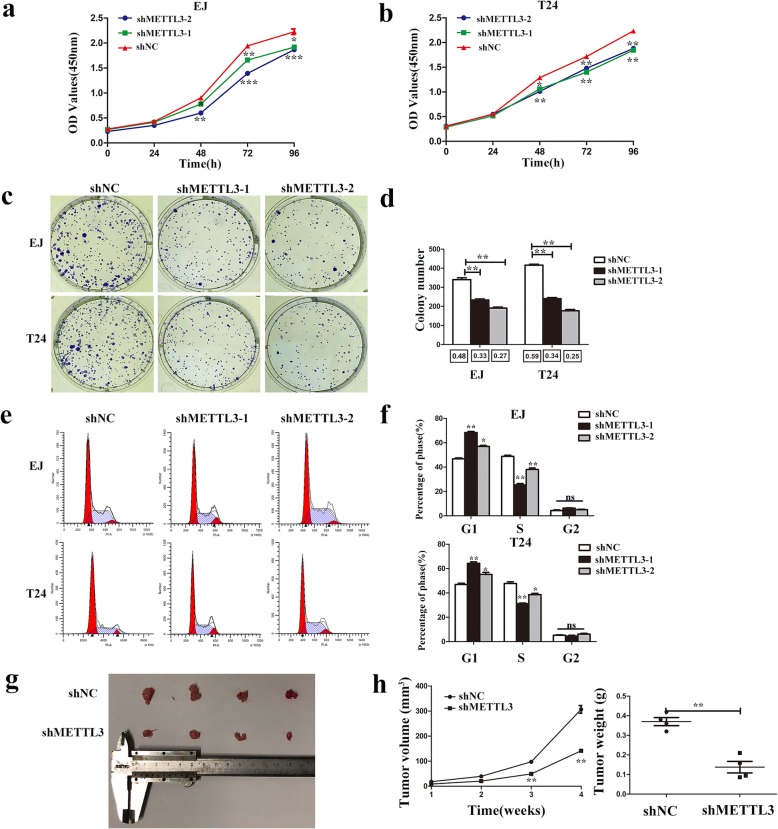
Knockdown of METTL3 inhibited bladder cancer proliferation in vitro and in vivo. a and b. Knockdown of METTL3 inhibited cell proliferation as indicated by CCK-8 assays in EJ and T24 cells. c and d. Colony formation assay showed that METTL3 knockdown significantly decreased the cloning number of T24 and EJ cells compared with control group. The colony formation rate (colony number/ cells per well) is shown below the histogram. e and f. Cell cycle analyzed by flow cytometry. Histogram showed that METTL3 knockdown arrested at G1 phase in T24 and EJ cells. g. Representative image of the nude mice injected with T24 cells. h. Tumor weight and the tumor growth curve were measured in METTL3 knockdown cell and its control group. Data represented the mean ± SD from three independent experiments, *P < 0.05, **P < 0.01
Fig. 3
Fig. 3
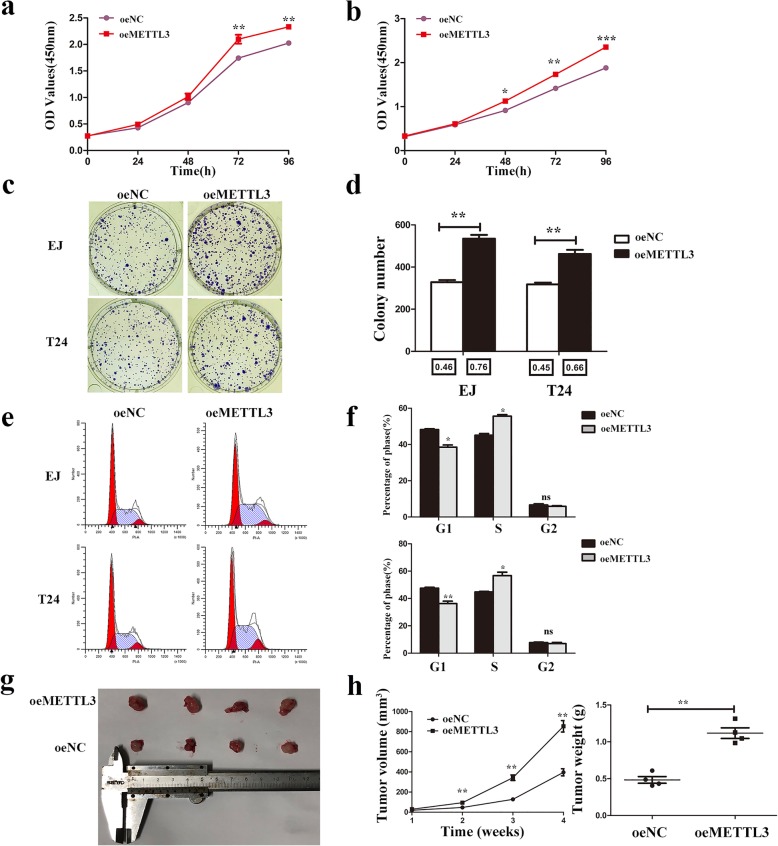
Overexpression of METTL3 promoted bladder cancer proliferation in vitro and in vivo. a and b. Overexpression of METTL3 promoted cell proliferation as indicated by CCK-8 assays in EJ and T24 cells. c and d. Colony formation assay showed that METTL3 overexpression significantly increased the cloning number of T24 and EJ cells compared with control group. The colony formation rate (colony number/ cells per well) is shown below the histogram. e and f. Cell cycle analyzed by flow cytometry. Histogram showed that METTL3 overexpression decreased the percentage of G1 phase and increased the percentage of S phase. Data represented the mean ± SD from three independent experiments, *P < 0.05, **P < 0.01. g. Representative image of the nude mice injected with T24 cells. h. Tumor weight and the tumor growth curve were measured in METTL3 overexpression cells and its control group. Data represented the mean ± SD from three independent experiments, *P < 0.05, **P < 0.01
Fig. 4
Fig. 4
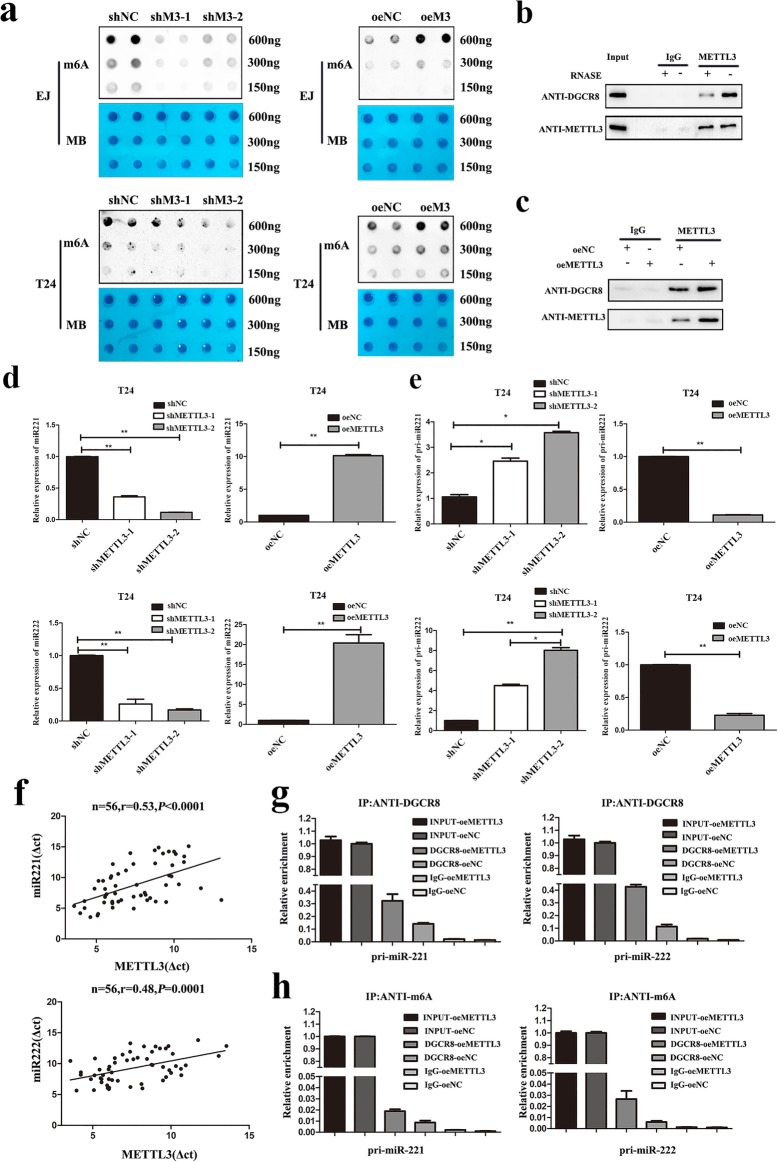
METTL3 interacted with the microprocessor protein DGCR8 and modulated the pri-miR221/222 process in an m6A-dependent manner. a. m6A dot blot assays of EJ and T24 cells with knockdown or overexpression of METTL3. Methylene blue (MB) stain as loading control. It was obvious that the methylation of RNA decreased significantly after METTL3 knockdown, while increased significantly after METTL3 overexpression. b. Co-immunoprecipitation of the METTL3-interacting protein DGCR8. Cells were UV-cross-linked before the immunoprecipitation. Western blot using the DGCR8 and METTL3 antibodies and IgG used as control for the IP. c. Immunoprecipitation of DGCR8, METTL3 and associated RNAs from control cells or METTL3 overexpression cells. Cells were UV-cross-linked before the immunoprecipitation. Western blot or Immunoblot were conducted using the antibodies described above. d. The expression of miR221/222 were verified by qRT-PCR in METTL3 knockdown and overexpression cells. e. The expression of pri-miR221/222 were verified by qRT-PCR in METTL3 knockdown and overexpression cells. f. A moderate positive correlation between the expression of METTL3 and miR221/222 was showed in bladder cancer tissues by qRT-PCR. g. Detection of pri-miRNA binding to DGCR8 by immunoprecipitation of DGCR8-associated RNA from control and METTL3 overexpression cells followed by qRT-PCR. h. The detection of pri-miRNAs m6A modification level by immunoprecipitation of m6A modified miRNA in control or METTL3 overexpression cells followed by qRT-PCR. Data represented the mean ± SD from three independent experiments, *P < 0.05, **P < 0.01
Fig. 5
Fig. 5
miR221 and miR222 rescued the proliferating function induced by METTL3 in bladder cancer cells. a and b. CCK8 assays were used to measure the effect of miR221/222 mimics or inhibitors on EJ and T24 cells with METTL3 knockdown and overexpression. miR221/222 mimics could rescue the cell growth inhibited by knockdown of METTL3 in EJ and T24 cells (a). The inhibitors of miR221/222 could partly reduced cell growth induced by overexpression of METTL3 in EJ and T24 cells (b). c and d. Colony formation assays showed that miR221/222 mimics could rescue the cell growth inhibited by knockdown of METTL3 in EJ and T24 cells. Data represented the mean ± SD from three independent experiments, *P < 0.05, **P < 0.01
Fig. 6
Fig. 6
miR221 and miR222 targeted PTEN in bladder cancer. a. Predictive miR221/miR222 binding sites in the 3′-UTR of PTEN mRNA. b. Dual luciferase reporter assays demonstrated that PTEN was direct target of miR221/222 (*P < 0.05). c and d. PCR and western blot analysis showed that knockdown of METTL3 increased the PTEN expression in T24 cells, while overexpression of METTL3 in T24 cells decreased the PTEN expression. e and f. Western blot analysis showed that miR221 and miR222 mimics could partly decrease the protein expression level of PTEN induced by knockdown of METTL3 (e), while miR221 and miR222 inhibitors could partly increase the protein expression level of PTEN induced by overexpression of METTL3 in EJ and T24 cells (f)
Fig. 7
Fig. 7
PTEN was negatively correlated with METTL3 expression in bladder cancer tissues. a. A moderate negative correlation between the expression of METTL3 and PTEN was showed in bladder cancer tissues by qRT-PCR. b, c, d and e. RNA and proteins was extracted from the tumors and the protein expression of METTL3/PTEN was measured using PCR and western blot. f. g. IHC analysis of ki-67, METTL3, and PTEN in xenografs (Magnification, × 400, scale bars indicated 10 μm). h. Mode pattern of the METTL3/miR221/222/PTEN regulatory network in bladder cancer

References

    1. Siegel RL, Miller KD, Jemal A. Cancer statistics, 2018. CA Cancer J Clin. 2018;68(1):7–30. doi: 10.3322/caac.21442. - DOI - PubMed
    1. Akhavan-Niaki H, Samadani AA. DNA methylation and cancer development: molecular mechanism. Cell Biochem Biophys. 2013;67(2):501–513. doi: 10.1007/s12013-013-9555-2. - DOI - PubMed
    1. Roignant JY, Soller M. M(6)a in mRNA: an ancient mechanism for fine-tuning gene expression. Trends Genet. 2017;33(6):380–390. doi: 10.1016/j.tig.2017.04.003. - DOI - PubMed
    1. Berger SL. Histone modifications in transcriptional regulation. Curr Opin Genet Dev. 2002;12(2):142–148. doi: 10.1016/S0959-437X(02)00279-4. - DOI - PubMed
    1. Barski A, et al. High-resolution profiling of histone methylations in the human genome. Cell. 2007;129(4):823–837. doi: 10.1016/j.cell.2007.05.009. - DOI - PubMed

Publication types

MeSH terms