


Opioid-related US hospital discharges by type, 1993-2016
- PMID: 31229192
- PMCID: PMC6592613
- DOI: 10.1016/j.jsat.2019.05.003
Opioid-related US hospital discharges by type, 1993-2016
Abstract
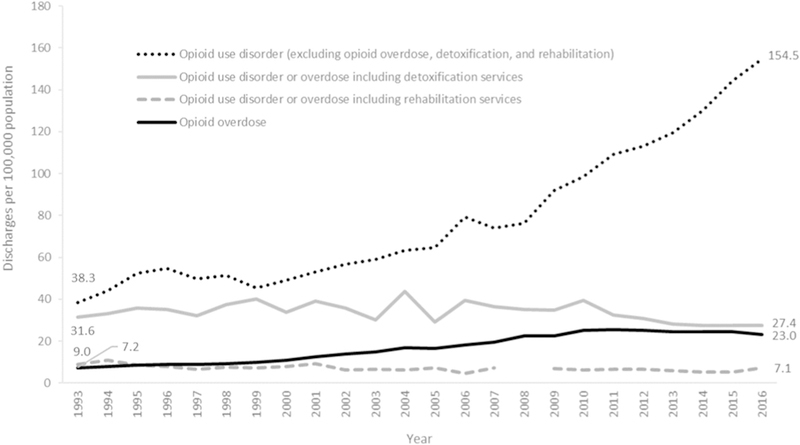
Objective: To classify and compare US nationwide opioid-related hospital inpatient discharges over time by discharge type: 1) opioid use disorder (OUD) diagnosis without opioid overdose, detoxification, or rehabilitation services, 2) opioid overdose, 3) OUD diagnosis or opioid overdose with detoxification services, and 4) OUD diagnosis or opioid overdose with rehabilitation services.
Methods: Survey-weighted national analysis of hospital discharges in the Healthcare Cost and Utilization Project National Inpatient Sample yielded age-adjusted annual rates per 100,000 population. Annual percentage change (APC) in the rate of opioid-related discharges by type during 1993-2016 was assessed.
Results: The annual rate of hospital discharges documenting OUD without opioid overdose, detoxification, or rehabilitation services quadrupled during 1993-2016, and at an increased rate (8% annually) during 2003-2016. The discharge rate for all types of opioid overdose increased an average 5-9% annually during 1993-2010; discharges for non-heroin overdoses declined 2010-2016 (3-12% annually) while heroin overdose discharges increased sharply (23% annually). The rate of discharges including detoxification services among OUD and overdose patients declined (-4% annually) during 2008-2016 and rehabilitation services (e.g., counselling, pharmacotherapy) among those discharges decreased (-2% annually) during 1993-2016.
Conclusions: Over the past two decades, the rate of both OUD diagnoses and opioid overdoses increased substantially in US hospitals while rates of inpatient detoxification and rehabilitation services identified by diagnosis codes declined. It is critical that inpatients diagnosed with OUD or treated for opioid overdose are linked effectively to substance use disorder treatment at discharge.
Keywords: Analgesics; Health services research; Opioid; Substance-related disorders.
Copyright © 2019 Elsevier Inc. All rights reserved.
Conflict of interest statement
Financial disclosures
The authors have no relevant financial relationships interest to disclose.
Figures
References
-
- Centers for Disease Control and Prevention. (2017, Jun 26, 2017). Bridged-race population estimates -Data files and documentation Retrieved from https://www.cdc.gov/nchs/nvss/bridged_race/data_documentation.htm
-
- Florida Alcohol & Drug Abuse Association Cost-benefit analyses: Substance abuse treatment is a sound investment. Retrieved from https://www.fadaa.org/.
MeSH terms
Grants and funding
LinkOut - more resources
Full Text Sources
Medical
Miscellaneous
