


Differences in presentation and survival of Asians compared to Caucasians with ovarian cancer: An NRG Oncology/GOG Ancillary study of 7914 patients
- PMID: 31229298
- PMCID: PMC6941471
- DOI: 10.1016/j.ygyno.2019.05.013
Differences in presentation and survival of Asians compared to Caucasians with ovarian cancer: An NRG Oncology/GOG Ancillary study of 7914 patients
Abstract
Purpose: To compare patient/tumor characteristics and outcomes of Asians to Caucasian patients with epithelial ovarian cancer.
Methods: Ancillary data were pooled and analyzed from ten prospective randomized front-line Gynecologic Oncology Group clinical trials from 1996 to 2011. Demographic, clinicopathologic features, disease-specific and all-cause survival were analyzed.
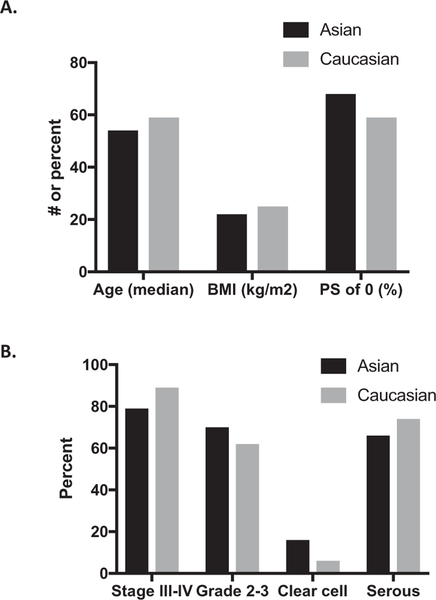
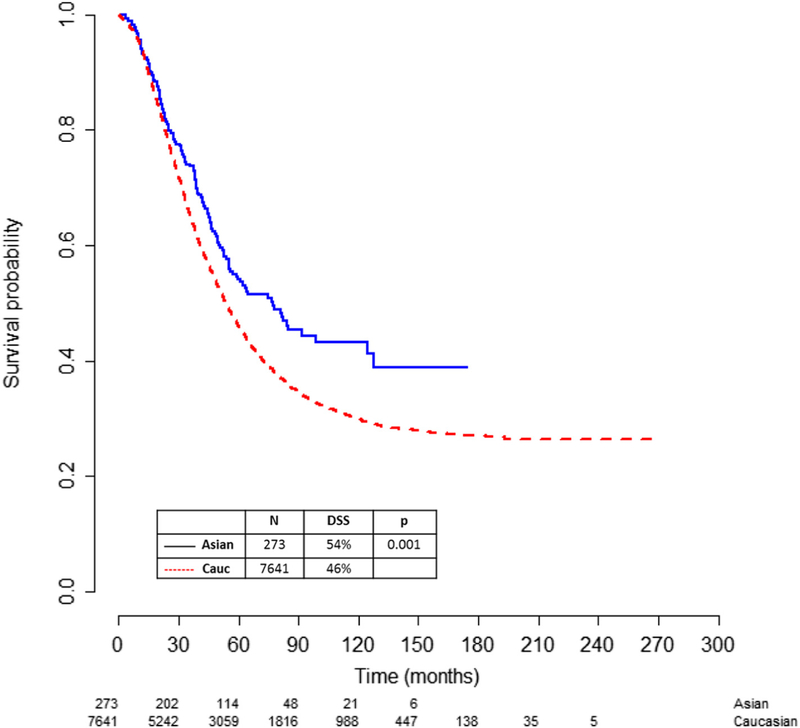
Results: Of 7914 patients, 7641 were Caucasian and 273 Asian. When compared to Caucasians, Asians were younger at trial enrollment, had a better performance status, earlier-stage cancers (17.2% vs. 8.1% with stage I; p < 0.001), and were more likely to be of clear cell (15.8% vs. 6.2%, p < 0.001) and mucinous (3.3% vs. 1.9%, p < 0.001) histology. Asians had an improved 5-year disease-specific survival of 54.1% compared to 46.1% for Caucasians, p = 0.001. In multivariate analysis, the Asian race remained a significant prognostic factor for all-cause survival (HR: 0.84; 95% CI: 0.72-0.99; p = 0.04). Other factors predictive of improved survival included younger age, better performance status, optimal cytoreduction, earlier stage, non-clear cell histology, and lower grade tumors.
Conclusion: Asians enrolled into phase III ovarian cancer clinical trials were younger, with better performance status, earlier-stage of disease, and have a greater number of clear cell and mucinous tumors. After adjusting for these prognostic factors, Asians have a better survival compared to Caucasians.
Keywords: Bevacizumab; Body mass index; Clear cell; Pharmacogenomics; Racial differences; Survival outcomes.
Copyright © 2019. Published by Elsevier Inc.
Figures
References
-
- Siegel RL, Miller KD, Jemal A, Cancer statistics, 2017, CA Cancer J. Clin 67 (2017) 7–30. - PubMed
-
- Fuh KC, Shin JY, Kapp DS, et al., Survival differences of Asian and Caucasian epithelial ovarian cancer patients in the United States, Gynecol. Oncol 136 (2015) 491–497. - PubMed
-
- Katsumata N, Yasuda M, Isonishi S, et al., Long-term results of dose-dense paclitaxel and carboplatin versus conventional paclitaxel and carboplatin for treatment of advanced epithelial ovarian, fallopian tube, or primary peritoneal cancer (JGOG 3016): a randomised, controlled, open-label trial, Lancet Oncol 14 (2013) 1020–1026. - PubMed
