


One-Year Mortality of Patients After Emergency Department Treatment for Nonfatal Opioid Overdose
- PMID: 31229387
- PMCID: PMC6920606
- DOI: 10.1016/j.annemergmed.2019.04.020
One-Year Mortality of Patients After Emergency Department Treatment for Nonfatal Opioid Overdose
Abstract
Study objective: Despite the increased availability of naloxone, death rates from opioid overdose continue to increase. The goal of this study is to determine the 1-year mortality of patients who were treated for a nonfatal opioid overdose in Massachusetts emergency departments (EDs).
Methods: This was a retrospective observational study of patients from 3 linked statewide Massachusetts data sets: a master demographics list, an acute care hospital case-mix database, and death records. Patients discharged from the ED with a final diagnosis of opioid overdose were included. The primary outcome measure was death from any cause within 1 year of overdose treatment.
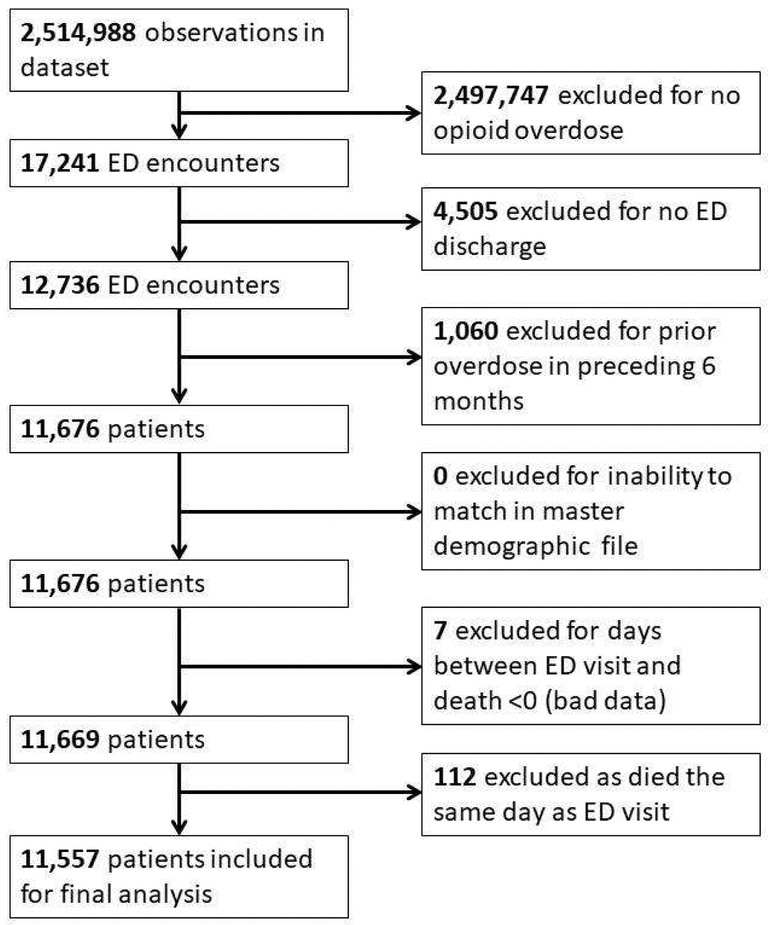
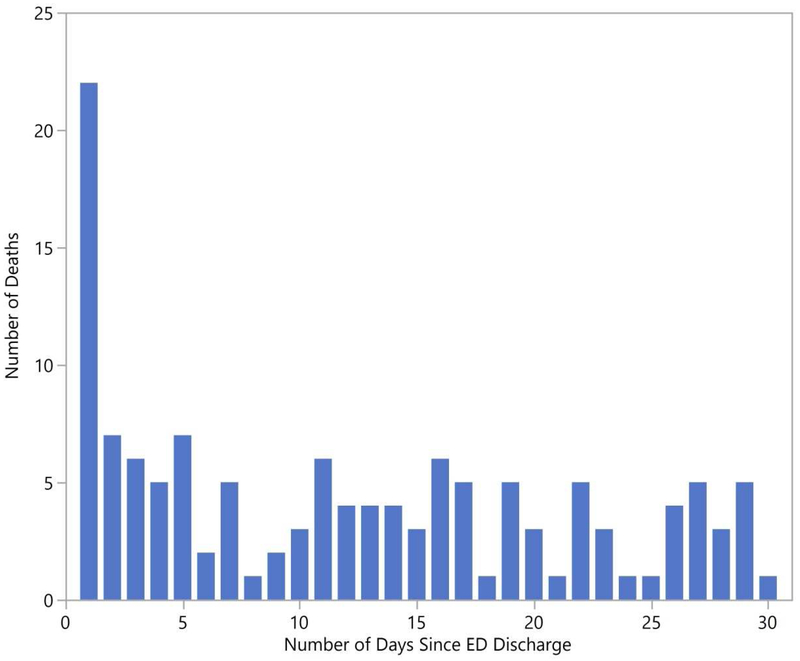
Results: During the study period, 17,241 patients were treated for opioid overdose. Of the 11,557 patients who met study criteria, 635 (5.5%) died within 1 year, 130 (1.1%) died within 1 month, and 29 (0.25%) died within 2 days. Of the 635 deaths at 1 year, 130 (20.5%) occurred within 1 month and 29 (4.6%) occurred within 2 days.
Conclusion: The short-term and 1-year mortality of patients treated in the ED for nonfatal opioid overdose is high. The first month, and particularly the first 2 days after overdose, is the highest-risk period. Patients who survive opioid overdose should be considered high risk and receive interventions such as being offered buprenorphine, counseling, and referral to treatment before ED discharge.
Copyright © 2019 American College of Emergency Physicians. Published by Elsevier Inc. All rights reserved.
Figures
References
-
- National Center for Health Statistics. CDC Wonder. Number of deaths involving opioids. Revised January 2019. Available at: https://www.drugabuse.gov/related-topics/trends-statistics/overdose-deat.... Accessed April 10, 2019.
-
- CDC. Annual surveillance report of drug-related risks and outcomes—United States, 2017. Atlanta, GA: US Department of Health and Human Services, CDC; 2017. Available at: https://www.cdc.gov/drugoverdose/pdf/pubs/2017-cdc-drug-surveillance-rep.... Accessed April 10, 2019.
-
- Massachusetts Department of Public Health. Data Brief: Opioid-Related Overdose Deaths Among Massachusetts Residents. November 2018. Available at: https://www.mass.gov/files/documents/2018/11/16/Opioid-related-Overdose-.... Accessed April 10, 2019.
-
- Massachusetts Chapter 52 of the Acts of 2016. An act relative to substance use, treatment, education and prevention. Available at: https://malegislature.gov/Laws/SessionLaws/Acts/2016/Chapter52. Accessed April 10, 2019.
Publication types
MeSH terms
Substances
Grants and funding
LinkOut - more resources
Full Text Sources
Miscellaneous
