Building Blocks for Healthy Children: Evaluation of a Child Care Center-Based Obesity Prevention Pilot Among Low-Income Children
- PMID: 31229396
- PMCID: PMC6736706
- DOI: 10.1016/j.jneb.2019.04.017
Building Blocks for Healthy Children: Evaluation of a Child Care Center-Based Obesity Prevention Pilot Among Low-Income Children
Abstract
Objective: To assess the impact of a multilevel nutrition intervention for low-income child care environments, staff, and center-enrolled children.
Design: A cluster-randomized, controlled trial conducted among eligible centers. Staff and parent self-report surveys and objective field observations at baseline and follow-up were conducted.
Setting: A total of 22 low-income child care centers (enrolling ≥ 25 2- to 5-year-old children).
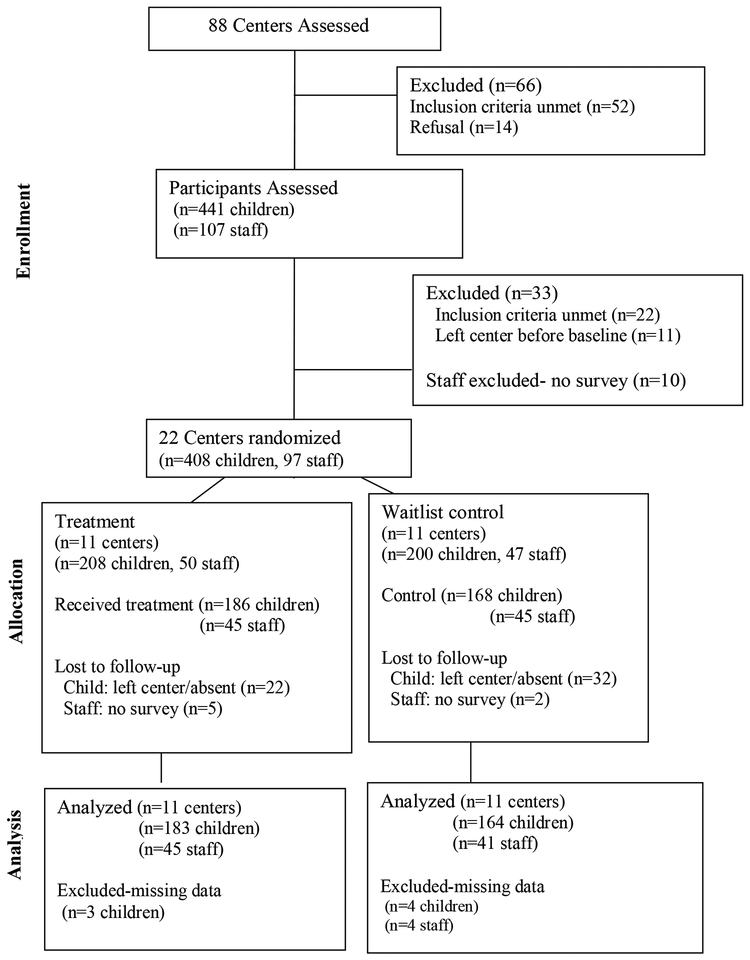
Participants: Children aged 18-71 months; 408 children and 97 staff were randomized into intervention (208 children and 50 staff) and waitlist-control groups (200 children and 45 staff). Retention rates were high (87% for children and 93% for staff).
Intervention(s): A 6-session, 6-month director's child nutrition course with on-site technical support for center teachers.
Main outcome measure(s): Center nutrition/physical activity environment; staff feeding styles, dietary patterns, and attitudes about food; child food preferences and dietary patterns.
Analysis: Covariance regression analyses to assess the intervention effect, adjusting for clustering within centers.
Results: Significant intervention effects were found for the center nutrition training/education environment (b = 3.01; P = .03), nutrition total scores (b = 1.29; P = .04), and staff-level prompting/encouraging feeding styles (b = 0.38; P = .04). No significant intervention effects were found for child-level measures.
Conclusions and implications: Curriculum-driven training and implementation support improved nutritional policies and practices and staff-child interactions during meals. Future research could extend the intervention to families and the evaluation to children's dietary behaviors and weight changes.
Keywords: child care center; health promotion; intervention; low-income; obesity.
Copyright © 2019 Society for Nutrition Education and Behavior. Published by Elsevier Inc. All rights reserved.
Figures