


Elevated FUS levels by overriding its autoregulation produce gain-of-toxicity properties that disrupt protein and RNA homeostasis
- PMID: 31230528
- PMCID: PMC6693452
- DOI: 10.1080/15548627.2019.1633162
Elevated FUS levels by overriding its autoregulation produce gain-of-toxicity properties that disrupt protein and RNA homeostasis
Abstract
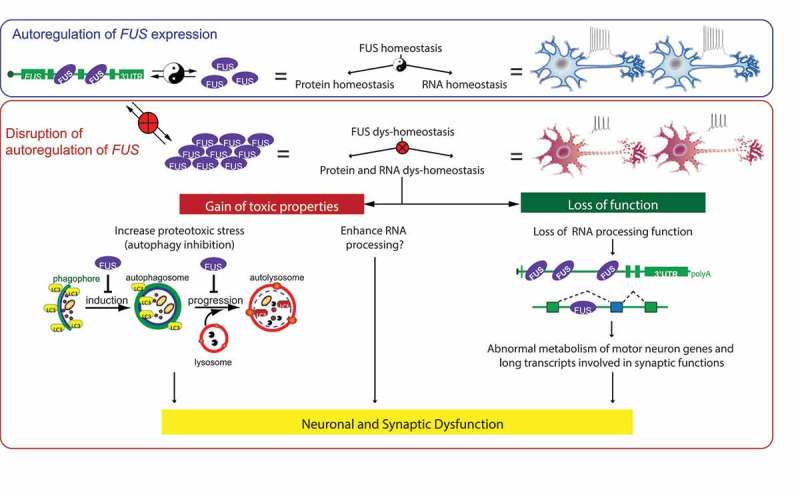
Coding or non-coding mutations in FUS (fused in sarcoma) cause amyotrophic lateral sclerosis (ALS) and frontotemporal dementia (FTD). In addition to familial ALS, abnormal aggregates of FUS are present in a portion of FTD and other neurodegenerative diseases independent of their mutations. Broad expression within the central nervous system of either wild-type or two ALS-linked human FUS mutants produces progressive motor phenotypes accompanied by characteristic ALS-like pathology. FUS levels are autoregulated to maintain an optimal steady-state level. Increasing FUS expression by saturating its autoregulatory mechanism results in rapidly progressive neurological phenotypes and dose-dependent lethality. Genome-wide expression analysis reveals genetic mis-regulations distinct from those via FUS reduction. Among these are increased expression of lysosomal proteins, suggestive of disruption in protein homeostasis as a potential gain-of-toxicity mechanism. Indeed, increased expression of wild-type FUS or ALS-linked mutant forms of FUS inhibit macroautophagy/autophagy. Collectively, our results demonstrate that: (1) mice expressing FUS develop progressive motor deficits, (2) increased FUS expression by overriding its autoregulatory mechanism accelerates neurodegeneration, providing a basis for FUS involvement without mutation, and (3) disruption in both protein homeostasis and RNA processing contribute to FUS-mediated toxicity.
Keywords: Amyotrophic lateral sclerosis (ALS); FUS; SQSTM1/p62; autophagy; frontotemporal dementia (FTD); lysosome; p62.
Figures
Comment on
-
Overriding FUS autoregulation in mice triggers gain-of-toxic dysfunctions in RNA metabolism and autophagy-lysosome axis.Elife. 2019 Feb 12;8:e40811. doi: 10.7554/eLife.40811. Elife. 2019. PMID: 30747709 Free PMC article.
References
Publication types
MeSH terms
Substances
LinkOut - more resources
Full Text Sources
Medical
Miscellaneous
