


Depression Severity Over 27 Months in Adolescent Girls Is Predicted by Stress-Linked Cortical Morphology
- PMID: 31230728
- PMCID: PMC6814528
- DOI: 10.1016/j.biopsych.2019.04.027
Depression Severity Over 27 Months in Adolescent Girls Is Predicted by Stress-Linked Cortical Morphology
Abstract
Background: Evidence supports the notion that early-life stress and trauma impact cortical development and increase vulnerability to depression. However, it remains unclear whether common stressful life events in community-dwelling adolescents have similar consequences for cortical development.
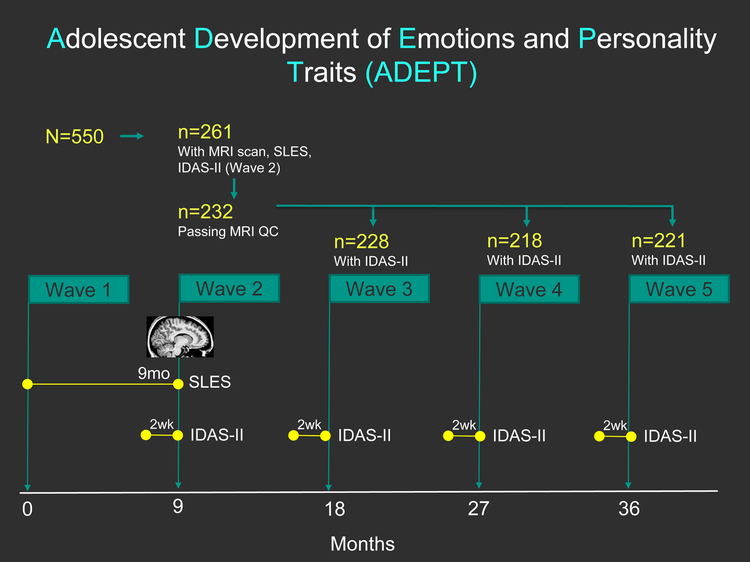
Methods: A total of 232 adolescent girls (mean age 15.29 ± 0.65 years) were assessed with the Stressful Life Events Schedule (a semistructured interview of stressors in the previous 9 months) and underwent a magnetic resonance imaging scan. FreeSurfer 5.3.0 was used to perform whole-brain surface-based morphometry. Dysphoria was assessed at the time of imaging and prospectively at three 9-month follow-up appointments using the Inventory of Depression and Anxiety Symptoms II.
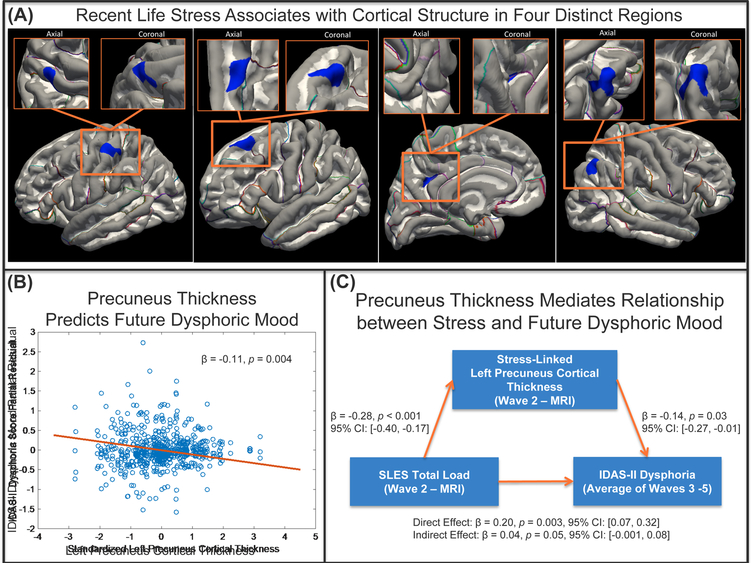
Results: At least one stressful life event was reported in 90% of the adolescent participants during the 9 months preceding imaging. Greater burden of recent life stress was associated with less left precuneus and left postcentral cortical thickness and smaller left superior frontal and right inferior parietal volume (all p < .05 after multiple comparisons correction). Left precuneus thickness in the stress-associated cluster significantly predicted dysphoria for 27 months after imaging controlling for prior dysphoria (β = -.11, p = .004). Left precuneus cortical thickness accounted for 17.0% of the association between stress and dysphoric mood for 27 months after imaging (β = .04, p = .05).
Conclusions: Consistent with evidence from imaging studies of trauma-exposed youths and preclinical stress models, a heavy burden of recent common life stress in community-dwelling adolescent girls was associated with altered frontal/parietal cortical morphology. Stress-linked precuneus cortical thickness represents a candidate prospective biomarker of adolescent depression.
Keywords: Adolescent development; Cortical thickness; Depression; Dysphoric mood; Life stress; Volume.
Copyright © 2019 Society of Biological Psychiatry. Published by Elsevier Inc. All rights reserved.
Conflict of interest statement
DISCLOSURES
The authors report no biomedical financial interests or potential conflicts of interest.
Figures
Comment in
-
Stress and Neurodevelopment in Adolescent Depression.Biol Psychiatry. 2019 Nov 15;86(10):e33-e35. doi: 10.1016/j.biopsych.2019.09.012. Biol Psychiatry. 2019. PMID: 31648684 Free PMC article. No abstract available.
References
-
- Hammen C (2006): Stress generation in depression: reflections on origins, research, and future directions. Journal of clinical psychology. 62:1065–1082. - PubMed
-
- Monroe SM, Simons AD (1991): Diathesis-stress theories in the context of life stress research: implications for the depressive disorders. Psychological bulletin. 110:406–425. - PubMed
-
- Abramson LY, Seligman ME, Teasdale JD (1978): Learned helplessness in humans: Critique and reformulation. Journal of abnormal psychology. 87:49. - PubMed
-
- Kendler KS, Karkowski LM, Prescott CA (1999): Causal relationship between stressful life events and the onset of major depression. The American journal of psychiatry. 156:837–841. - PubMed
Publication types
MeSH terms
Grants and funding
LinkOut - more resources
Full Text Sources
Medical
