Review
. 2019 Jun 5:13:576.
doi: 10.3389/fnins.2019.00576. eCollection 2019.

Regulation of Local Sleep by the Thalamic Reticular Nucleus

Affiliations
Review

Regulation of Local Sleep by the Thalamic Reticular Nucleus

Gil Vantomme et al. Front Neurosci. .

Abstract

In spite of the uniform appearance of sleep as a behavior, the sleeping brain does not produce electrical activities in unison. Different types of brain rhythms arise during sleep and vary between layers, areas, or from one functional system to another. Local heterogeneity of such activities, here referred to as local sleep, overturns fundamental tenets of sleep as a globally regulated state. However, little is still known about the neuronal circuits involved and how they can generate their own specifically-tuned sleep patterns. NREM sleep patterns emerge in the brain from interplay of activity between thalamic and cortical networks. Within this fundamental circuitry, it now turns out that the thalamic reticular nucleus (TRN) acts as a key player in local sleep control. This is based on a marked heterogeneity of the TRN in terms of its cellular and synaptic architecture, which leads to a regional diversity of NREM sleep hallmarks, such as sleep spindles, delta waves and slow oscillations. This provides first evidence for a subcortical circuit as a determinant of cortical local sleep features. Here, we review novel cellular and functional insights supporting TRN heterogeneity and how these elements come together to account for local NREM sleep. We also discuss open questions arising from these studies, focusing on mechanisms of sleep regulation and the role of local sleep in brain plasticity and cognitive functions.

Keywords: delta waves; neural circuit; sleep spindles; slow wave activity; thalamocortical.


Figures
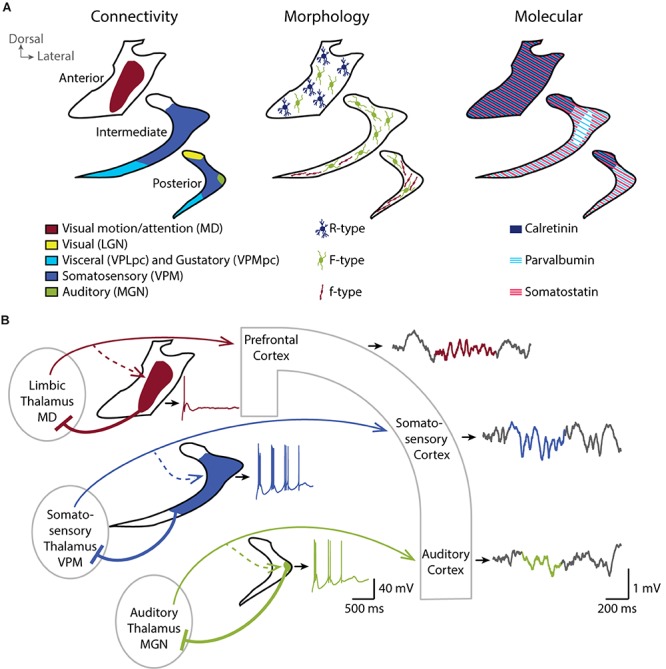
FIGURE 1
FIGURE 1
TheTRN is a heterogeneous nucleus and shapes local sleep through parallel thalamocortical loops. (A) Coronal schemes of the anterior, intermediate and posterior TRN showing the diversity of the connectivity (left), the repartition of TRN neurons with different morphological properties (middle), and the expression pattern of some of the major molecular markers (right). (B) Coronal scheme of three parallel thalamocortical loops showing the impact of distinct firing properties of TRN neurons in the different functional TRN sectors on the local activity of related cortices. Cortical inputs to the TRN are not depicted for clarity. In vitro whole-cell current-clamp traces of TRN neurons are shown next to the related TRN drawing (black outline). TRN neurons show rebound burst firing after a hyperpolarization step from –60 to –100 mV. Neurons in sensory sectors (green and blue) show more repetitive burst firing than the neuron in limbic sector (red). In vivo local field potentials simultaneously recorded in the different cortices during NREM sleep with detected spindle event (color highlighted) are shown on the right. Sensory cortices, in particular the somatosensory cortex in mice, are enriched in sleep spindles compared to prefrontal cortex. Whole-cell recording traces are adapted from Fernandez et al., 2018 (CC BY 4.0). MD, mediodorsal thalamic nucleus; VPLpc, Ventroposterolateral parvicellular thalamic nucleus; VPMpc, Ventroposteromedial parvicellular thalamic nucleus; LGN, Lateral geniculate thalamic nucleus; VPM, Ventroposteromedial thalamic nucleus; MGN, Medial geniculate thalamic nucleus.

References

    1. Abdel-Majid R. M., Leong W. L., Schalkwyk L. C., Smallman D. S., Wong S. T., Storm D. R., et al. (1998). Loss of adenylyl cyclase I activity disrupts patterning of mouse somatosensory cortex. Nat. Genet. 19 289–291. 10.1038/980 - DOI - PubMed
    1. Achermann P., Borbély A. A. (1997). Low-frequency (< 1 Hz) oscillations in the human sleep electroencephalogram. Neuroscience 81 213–222. 10.1016/s0306-4522(97)00186-3 - DOI - PubMed
    1. Astori S., Wimmer R. D., Luthi A. (2013). Manipulating sleep spindles—expanding views on sleep, memory, and disease. Trends Neurosci. 36 738–748. 10.1016/j.tins.2013.10.001 - DOI - PubMed
    1. Astori S., Wimmer R. D., Prosser H. M., Corti C., Corsi M., Liaudet N., et al. (2011). The CaV3.3 calcium channel is the major sleep spindle pacemaker in thalamus. Proc. Natl. Acad. Sci. U.S.A. 108 13823–13828. 10.1073/pnas.1105115108 - DOI - PMC - PubMed
    1. Bal T., McCormick D. A. (1993). Mechanisms of oscillatory activity in guinea-pig nucleus reticularis thalami in vitro: a mammalian pacemaker. J. Physiol. 468 669–691. 10.1113/jphysiol.1993.sp019794 - DOI - PMC - PubMed

LinkOut - more resources
