


Effect of Sex and Adaptation on Migraine Frequency and Perceived Stress: A Cross-Sectional Case-Control Study
- PMID: 31231306
- PMCID: PMC6560056
- DOI: 10.3389/fneur.2019.00598
Effect of Sex and Adaptation on Migraine Frequency and Perceived Stress: A Cross-Sectional Case-Control Study
Abstract
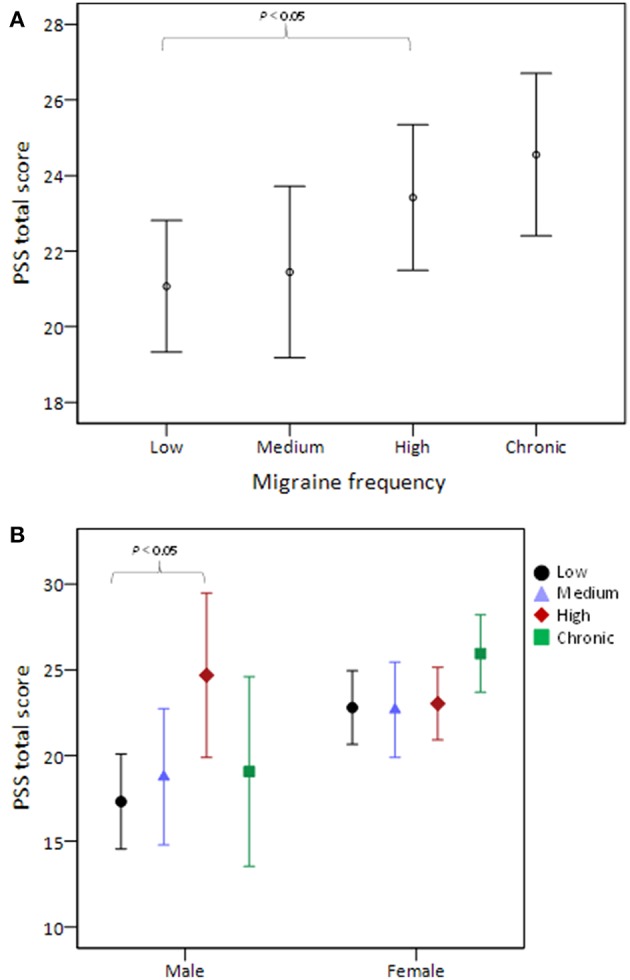
Background: Perceived stress has been related to migraine. The relationship between sex, migraine frequency, and severity of perceived stress remains unclear. We investigated perceived stress among migraineurs. Methods: This cross-sectional case-control study involved 577 clinical outpatients at a tertiary hospital in Taiwan. Demographic and clinical data, including migraine characteristics, were collected. Migraineurs were stratified by episode frequency, aura and sex, and analyses were controlled for confounding variables. Multivariable linear regressions were used to inspect whether migraine frequency (1-4, 5-8, 9-14, or ≥15 headache days per month) was associated with perceived stress as assessed by the Perceived Stress Scale (PSS). Results: Perceived stress was significantly higher in high frequency migraineurs (mean ± standard deviation (SD), 23.3 ± 8.7) than in low frequency migraineurs (mean ± SD, 21.9 ± 9.2; P < 0.05). After stratifying the analysis by sex, this result was observed in male subjects, but was insignificant in female subjects. In addition, the relationship between migraine frequency and perceived stress was not prominent in aura-present or -absent subgroups. Conclusions: Higher perceived stress was associated with higher migraine frequency, but not in chronic migraine and female subgroups. Adaptation to migraine and various psychiatric comorbidities may contribute to these associations.
Keywords: adaptation; frequency; headache; migraine; perceived stress; sex difference.
Figures
References
LinkOut - more resources
Full Text Sources
Miscellaneous
