Review
. 2019 May 22:10:1078.
doi: 10.3389/fimmu.2019.01078. eCollection 2019.

Cell Adhesion Molecules and Their Roles and Regulation in the Immune and Tumor Microenvironment

Affiliations
Review

Cell Adhesion Molecules and Their Roles and Regulation in the Immune and Tumor Microenvironment

Heidi Harjunpää et al. Front Immunol. .

Abstract

The immune system and cancer have a complex relationship with the immune system playing a dual role in tumor development. The effector cells of the immune system can recognize and kill malignant cells while immune system-mediated inflammation can also promote tumor growth and regulatory cells suppress the anti-tumor responses. In the center of all anti-tumor responses is the ability of the immune cells to migrate to the tumor site and to interact with each other and with the malignant cells. Cell adhesion molecules including receptors of the immunoglobulin superfamily and integrins are of crucial importance in mediating these processes. Particularly integrins play a vital role in regulating all aspects of immune cell function including immune cell trafficking into tissues, effector cell activation and proliferation and the formation of the immunological synapse between immune cells or between immune cell and the target cell both during homeostasis and during inflammation and cancer. In this review we discuss the molecular mechanisms regulating integrin function and the role of integrins and other cell adhesion molecules in immune responses and in the tumor microenvironment. We also describe how malignant cells can utilize cell adhesion molecules to promote tumor growth and metastases and how these molecules could be targeted in cancer immunotherapy.

Keywords: ICAM-1; LFA-1; VCAM-1; cell adhesion; dendritic cell (DC); immunotherapy; integrin.


Figures
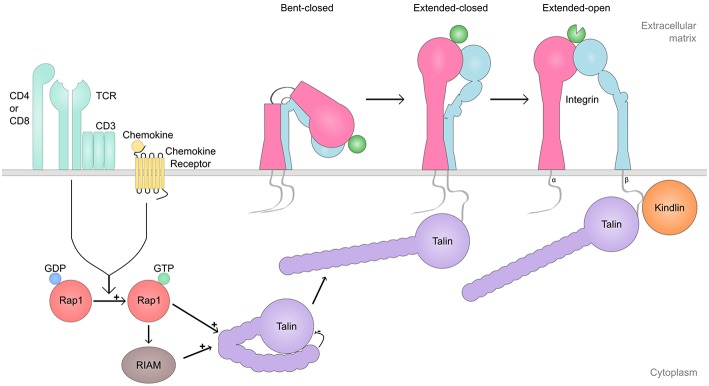
Figure 1
Figure 1
Integrin inside-out signaling. Shown is a simplified representation of the integrin inside-out process, which regulates integrin activation (i.e., integrin conformation switch from bent-closed or extended-closed to extended-open conformation). Cell signaling initiated by receptors such as chemokine receptors, T cell receptor (TCR), Toll-like receptors (TLR), and selectins, among others, trigger the switch from Rap1-GDP to Rap1-GTP which, either dependently of RIAM or not, activate Talin and enable its binding to the β-cytoplasmic tail of the integrin. Finally, Kindlin binds to the β-cytoplasmic tail of the integrin, and together with talin induces the separation of the cytoplasmic tails, and triggers the activation of the ligand-binding domain. The extended-open conformation of the integrin remains stable with Talin and Kindlin bound.
Figure 2
Figure 2
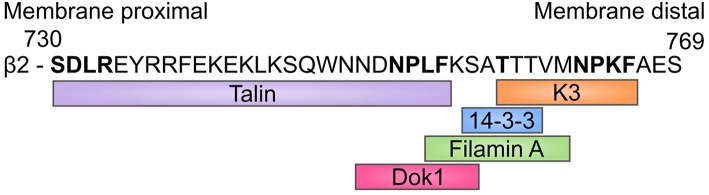
β2-integrin binding sites. Amino acid sequence of the β2-cytoplasmic tail where most of the main integrin binding proteins bind, and the sequences to which they bind. The amino acids highlighted in bold are of particular importance. 14-3-3 proteins only bind to Th758-phosphorylated integrin, whilst phosphorylation of this site inhibits Filamin A binding.
Figure 3
Figure 3
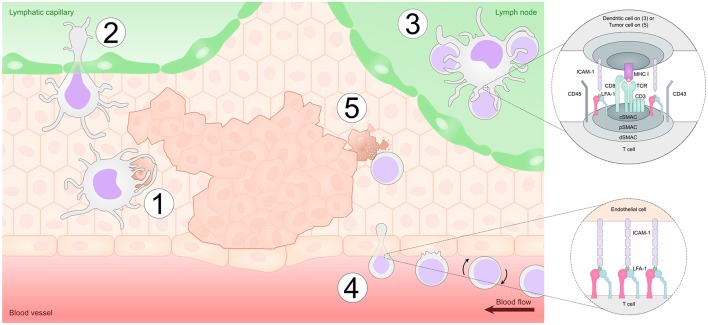
Integrins play a vital role in anti-tumor immunity. Dendritic cells (DCs) take up tumor antigens in the tumor microenvironment by phagocytosing dying tumor cells in a process mediated by adhesion molecules such as αvβ5 integrins (Step 1). DCs then enter the lymphatic vessels partly in an LFA-1/ICAM-1-dependent manner and migrate to the draining lymph node (Step 2). In the lymph node, DCs form an immunological synapse with CD8+ T cells in order to present the tumor antigen. LFA-1-ICAM interactions mediate adhesion in the immunological synapse and also provide an additional co-stimulatory signal to the T cells (Step 3). Once activated, T cells travel via the blood stream and enter the tumor site by interacting with adhesion molecules including E-selectin, ICAMs and VCAM-1 on endothelial cells in a process termed leukocyte adhesion cascade. This process is regulated by sequential expression of selectins (L-selectin) and integrins (LFA-1, VLA-4) on the migrating T cell (Step 4). Finally, after reaching the tumor microenvironment, CD8+ T cells form an immunological synapse with tumor cells and kill the malignant cells via the release of cytotoxic granules (Step 5).

References

    1. Grivennikov SI, Greten FR, Karin M. Immunity, inflammation, and cancer. Cell. (2010) 140:883–99. 10.1016/j.cell.2010.01.025 - DOI - PMC - PubMed
    1. Fridman WH, Pagès F, Sautès-Fridman C, Galon J. The immune contexture in human tumours: impact on clinical outcome. Nat Rev Cancer. (2012) 12:298. 10.1038/nrc3245 - DOI - PubMed
    1. Barnes TA, Amir E. HYPE or HOPE: the prognostic value of infiltrating immune cells in cancer. Br J Cancer. (2017) 117:451 10.1038/bjc.2017.220 - DOI - PMC - PubMed
    1. Shang B, Liu Y, Jiang S-J, Liu Y. Prognostic value of tumor-infiltrating FoxP3+ regulatory T cells in cancers: a systematic review and meta-analysis. Sci Rep. (2015) 5:15179. 10.1038/srep15179 - DOI - PMC - PubMed
    1. Zhang S, Ma X, Zhu C, Liu L, Wang G, Yuan X. The role of myeloid-derived suppressor cells in patients with solid tumors: a meta-analysis. PLoS ONE. (2016) 11:e0164514. 10.1371/journal.pone.0164514 - DOI - PMC - PubMed

Publication types

Substances