Review
. 2019 May 29:10:1166.
doi: 10.3389/fimmu.2019.01166. eCollection 2019.

Pregnancy Galectinology: Insights Into a Complex Network of Glycan Binding Proteins

Affiliations
Review

Pregnancy Galectinology: Insights Into a Complex Network of Glycan Binding Proteins

Sandra M Blois et al. Front Immunol. .

Abstract

Galectins are a phylogenetically conserved family of soluble β-galactoside binding proteins, consisting of 15 different types, each with a specific function. Galectins contribute to placentation by regulating trophoblast development, migration, and invasion during early pregnancy. In addition, galectins are critical players regulating maternal immune tolerance to the embedded embryo. Recently, the role of galectins in angiogenesis during decidualization and in placenta formation has gained attention. Altered expression of galectins is associated with abnormal pregnancies and infertility. This review focuses on the role of galectins in pregnancy-associated processes and discusses the relevance of galectin-glycan interactions as potential therapeutic targets in pregnancy disorders.

Keywords: galectins; glycans; placentation; preeclampsia; pregnancy.


Figures
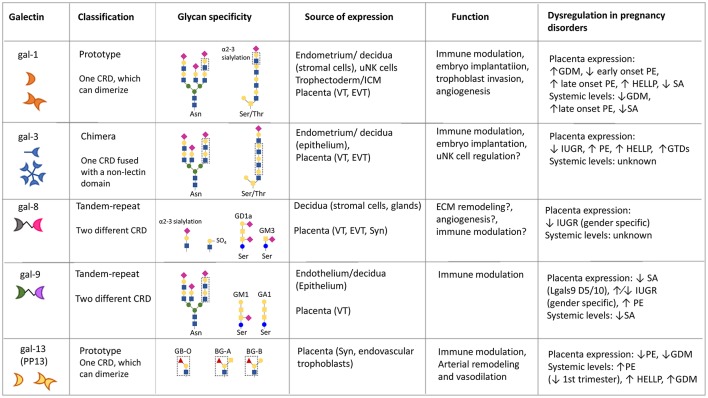
Figure 1
Figure 1
Summary of galectins' glycan specificity, functions and sources of expression in mammalian pregnancies. Question marks (?) denote putative functions (not yet experimentally confirmed in the context of pregnancy). BG, blood group; uNK, uterine natural killer; ICM, inner cell mass; VT, villous cytotrophoblast; EVT, extravillous trophoblast; Syn, syncytiotrophoblast; GDM, gestational diabetes mellitus; SA, spontaneous abortion; PE, preeclampsia; HELLP, hemolysis elevated liver enzymes and low platelet syndrome; GTD, gestational trophoblastic disease; IUGR, intrauterine growth restriction. ↑ and ↓ denote increased/peak and decreased expression, respectively. formula image Mannose formula image Galactose formula image N-acetylglucosamine formula image N-acetylgalactosamine formula image Sialic Acid formula image Fucose.
Figure 2
Figure 2
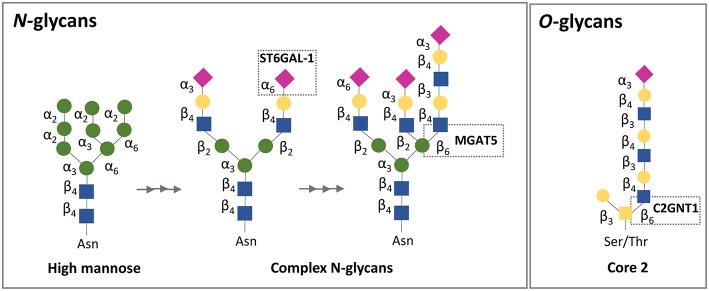
Simplified schematic representation of N-and O-glycan biosynthesis focusing on galectin-1 binding affinity. N-glycans are attached to asparagine (Asn) residues, whereas O-glycans are attached to either serine (Ser) or threonine (Thr) residues. Gal-1 recognizes galactose on complex N-glycans and sialylation on the terminal galactose in the α2,6-linkage, but not in the α2,3-linkage, prevents the binding of gal-l. Regarding O-glycans, gal-1 binds to the N-acetyllactosamine (LacNAc) motif in core 2 O-glycans. ST6GAL-1, β-galactoside α2,6-sialyltransferase 1; MGATS, α1,6-mannosylglycoprotein 6β-N-acetylglucosaminyltransferase; C2GnT, core 2 β1,6 N-acetylglucosaminyltransferase.
Figure 3
Figure 3
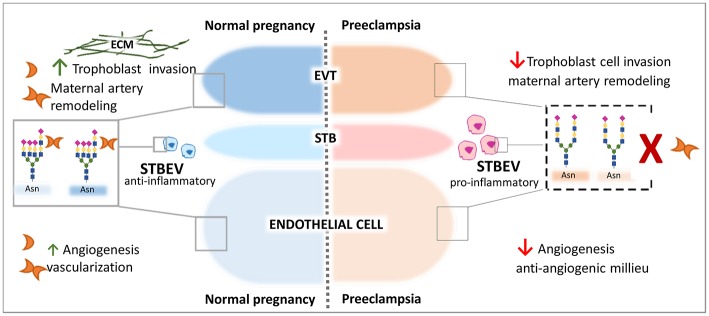
Galectin-1-Giycan axis in the control of pregnancy protective programs. Galectin-1 regulates key process during the course of normal gestation including trophoblast invasion, maternal immune regulation, and angiogenesis. Relevant examples are illustrated. During Preeclampsia an aberrant α2-6 sialylation decorates α5β1integrin on the cell surface of EVT trophoblast, cell surface of STVEV released from the STB trophoblast and on endothelial cells. The high expression of α2-6 sialylated N-glycans impairs gal-1-mediated trophoblast ETV cell migration process interfering with the binding to the ECM and subsequently invasion. High α2-6 sialylation on STBEV and impaired gal-l binding might contribute to the pro-inflammatory milieu in maternal circulation and endothelial dysfunction. On vascular endothelial cells, the aberrant α2-6 sialylation may disrupt gal-1-mediated angiogenesis and early vascularization promoting the anti-angiogenesis status typical of the syndrome.

References

    1. Hyde KJ, Schust DJ. Immunologic challenges of human reproduction: an evolving story. Fertil Steril. (2016) 106:499–510. 10.1016/j.fertnstert.2016.07.1073 - DOI - PubMed
    1. Cross JC, Hemberger M, Lu Y, Nozaki T, Whiteley K, Masutani M, et al. . Trophoblast functions, angiogenesis and remodeling of the maternal vasculature in the placenta. Mol Cell Endocrinol. (2002) 187:207–12. 10.1016/S0303-7207(01)00703-1 - DOI - PubMed
    1. Norwitz ER. Defective implantation and placentation: laying the blueprint for pregnancy complications. Reprod Biomed Online. (2007) 14:101–9. 10.1016/S1472-6483(10)61464-2 - DOI - PubMed
    1. Barker DJ. In utero programming of chronic disease. Clin Sci. (1998) 95:115–28. 10.1042/cs0950115 - DOI - PubMed
    1. Jansson T, Powell TL. Role of the placenta in fetal programming: underlying mechanisms and potential interventional approaches. Clin Sci. (2007) 113:1–13. 10.1042/CS20060339 - DOI - PubMed

Publication types

MeSH terms

LinkOut - more resources