


Electronic Effects of Substituents on fac-M(bpy-R)(CO)3 (M = Mn, Re) Complexes for Homogeneous CO2 Electroreduction
- PMID: 31231639
- PMCID: PMC6561311
- DOI: 10.3389/fchem.2019.00417
Electronic Effects of Substituents on fac-M(bpy-R)(CO)3 (M = Mn, Re) Complexes for Homogeneous CO2 Electroreduction
Abstract
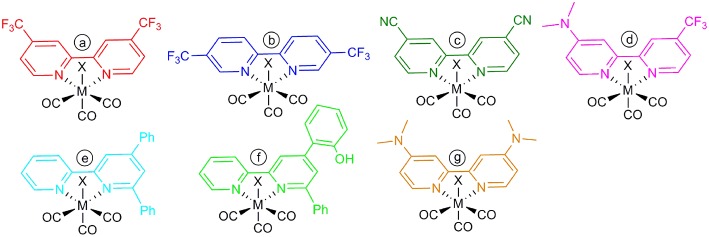
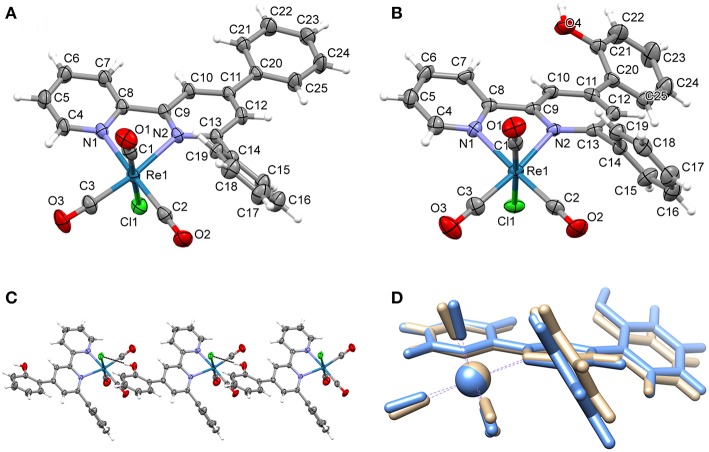
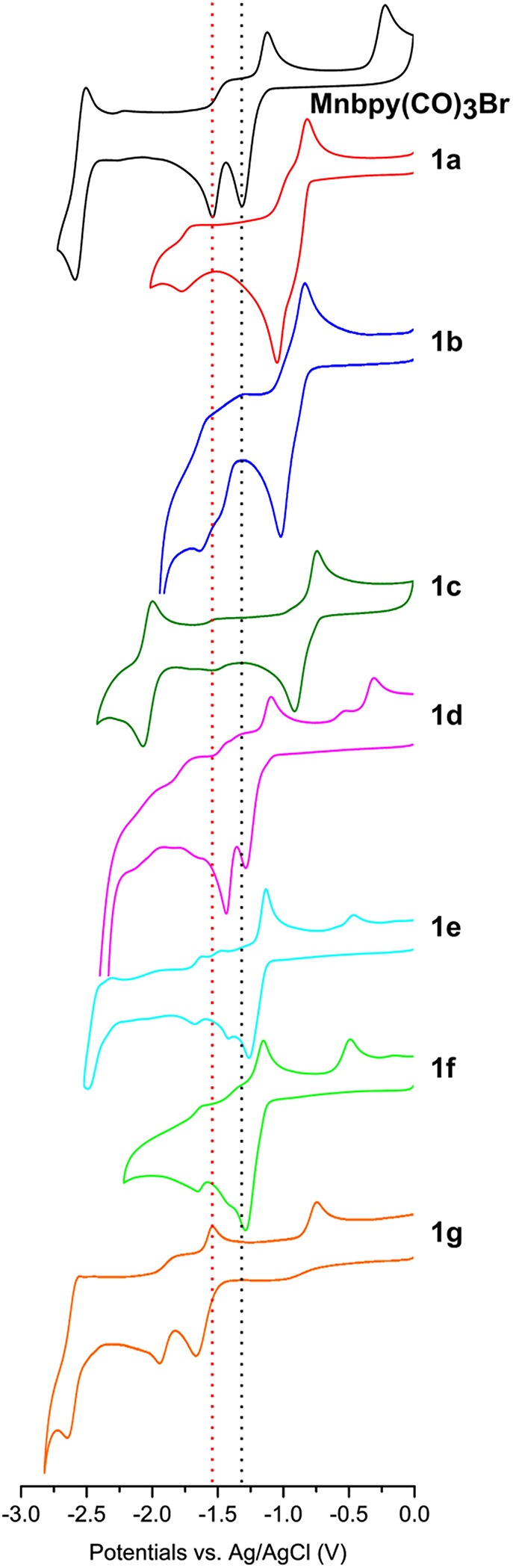
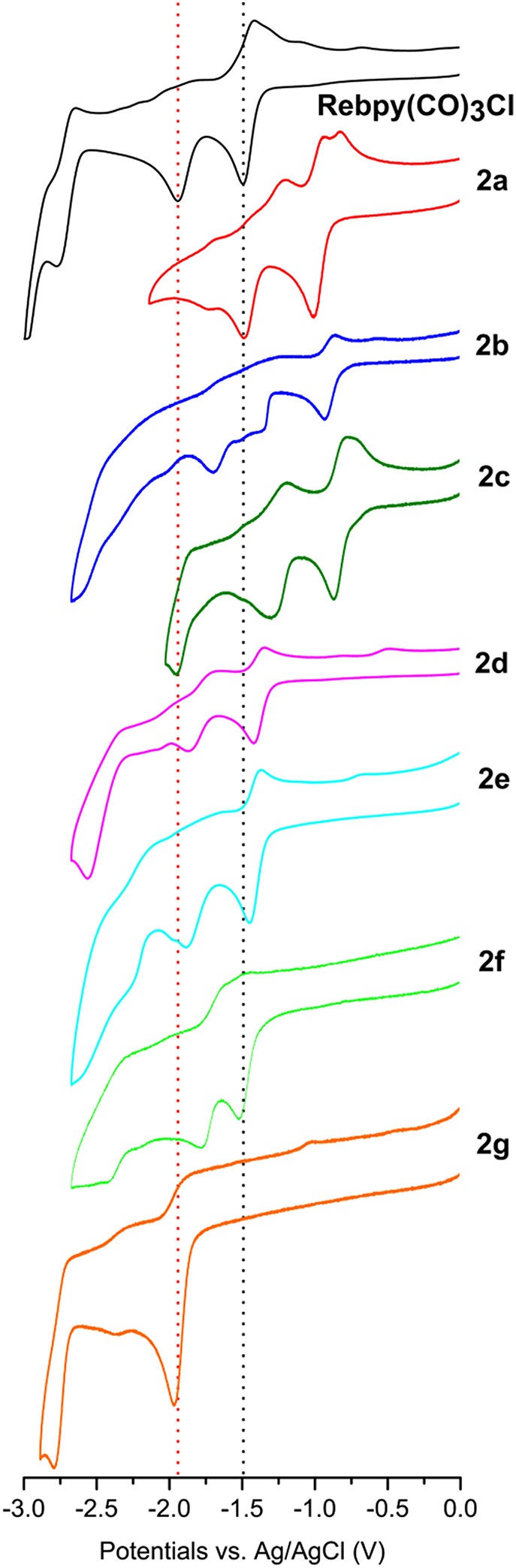
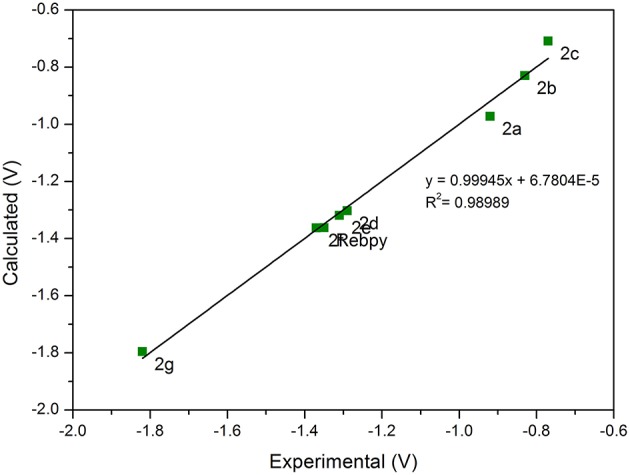
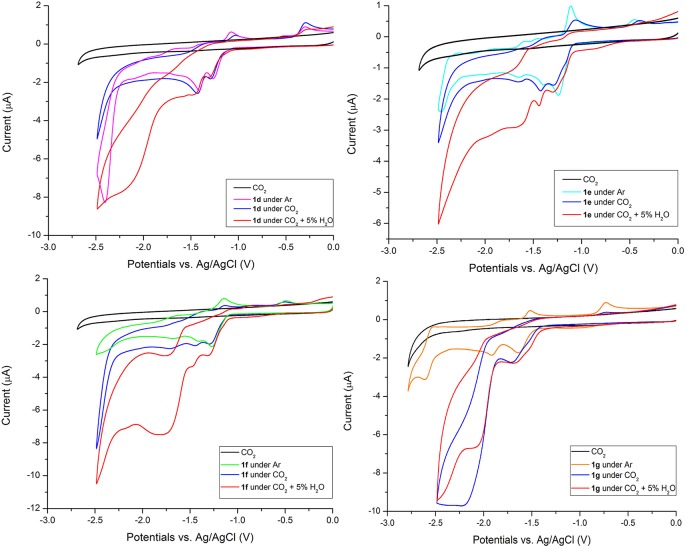
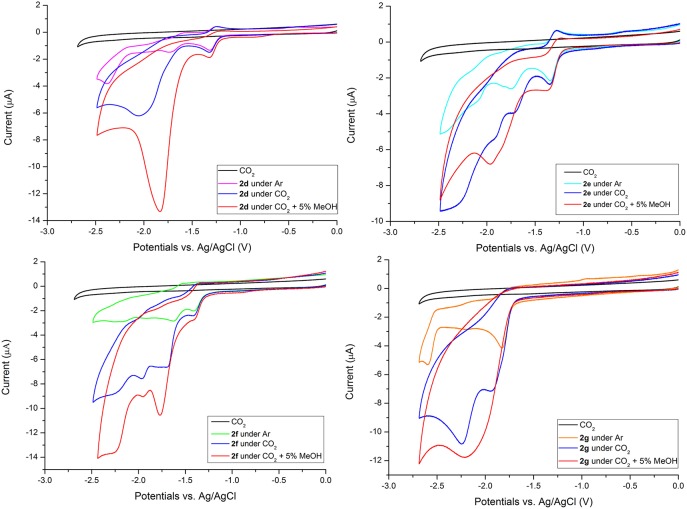
Synthesis and characterization of 14 new 2,2'-bipyridine metal complexes fac-M(bpy-R)(CO)3X (where M = Mn, X = Br or M = Re, X = Cl and R = -CF3, -CN, -Ph, -PhOH, -NMe2) are reported. The complexes have been characterized by NMR, IR spectroscopy and elemental analysis. Single crystal X-Ray diffraction structures have been solved for Re(dpbpy)(CO)3Cl (dpbpy = 4,6-diphenyl-2,2'-bipyridine) and Re(hpbpy)(CO)3Cl (hpbpy = 4-(2-hydroxy-phenyl)-6-phenyl-2,2'-bipyridine). Electrochemical behaviors of the complexes in acetonitrile under Ar and their catalytic performances for CO2 reduction with added water and MeOH have been investigated by cyclic voltammetry and controlled potential electrolysis. The role of the substituents on the electrochemical properties and the related over potentials required for CO2 transformation have been analyzed. The complexes carrying only electron withdrawing groups like -CF3, -CN totally lose their catalytic activities toward CO2 reduction, whereas the symmetric -NMe2 substituted and push-pull systems (containing both -NMe2 and -CF3) still display electrocatalytic current enhancement under CO2 atmosphere. The complexes carrying a phenyl or a phenol group in position 4 show catalytic behaviors similar to those of simple M-bpy systems. The only detected reduction product by GC analysis is CO: for example, fac-Re (bpy-4,4'-NMe2)(CO)3Cl gives CO with high faradic efficiency and a TON of 18 and 31, in absence of external proton source and with 5% MeOH, respectively. DFT calculations were carried out to highlight the electronic properties of the complexes; results are in agreement with experimental electrochemical data.
Keywords: CO2 electroreduction; DFT calculations; Mn complexes; Re complexes; bipy ligands; electron-donating; electron-withdrawing; homogeneous catalysis.
Figures
References
-
- Agilent (2015). CrysAlis PRO. Yarnton: Agilent Technologies Ltd.
-
- Anderson P. A., Keene F. R., Horn E., Tiekink E. R. T. (1990). Ambidentate coordination of the tripyridyl ligands 2,2': 6',2”-terpyridyl, tris(2-pyridyl)-amine, tris(2-pyridyl)methane, and tris(2-pyridyl)phosphine to carbonylrhenium centres: structural and spectroscopic studies. Appl. Organomet. Chem. 4, 523–533. 10.1002/aoc.590040514 - DOI
-
- Becke A. D. (1993). Density-functional thermochemistry. III. The role of exact exchange. J. Chem. Phys. 98, 5648–5652. 10.1063/1.464913 - DOI
LinkOut - more resources
Full Text Sources
Research Materials
Miscellaneous
