


Optimization of home care nurses in Canada: A scoping review
- PMID: 31231890
- PMCID: PMC6851676
- DOI: 10.1111/hsc.12797
Optimization of home care nurses in Canada: A scoping review
Abstract
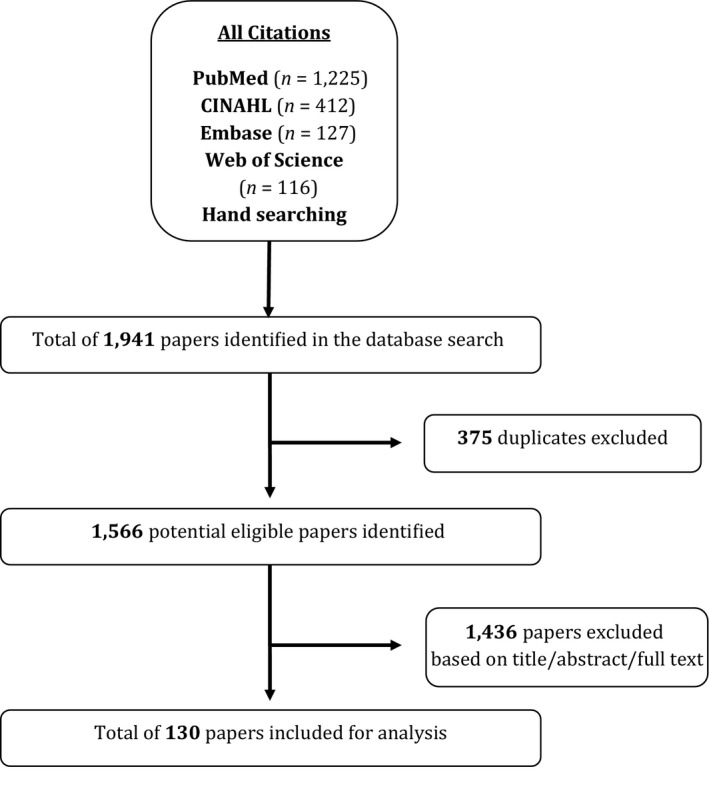
Nurses are among the largest providers of home care services thus optimisation of this workforce can positively influence client outcomes. This scoping review maps existing Canadian literature on factors influencing the optimisation of home care nurses (HCNs). Arskey and O'Malley's five stages for scoping literature reviews were followed. Populations of interest included Registered Nurses, Registered/Licensed Practical Nurses, Registered Nursing Assistants, Advanced Practice Nurses, Nurse Practitioners and Clinical Nurse Specialists. Interventions included any nurse(s), organisational and system interventions focused on optimising home care nursing. Papers were included if published between January 1, 2002 up to May 15, 2015. The review included 127 papers, including 94 studies, 16 descriptive papers, 6 position papers, 4 discussion papers, 3 policy papers, 2 literature reviews and 2 other. Optimisation factors were categorised under seven domains: Continuity of Care/Care; Staffing Mix and Staffing Levels; Professional Development; Quality Practice Environments; Intra-professional and Inter-professional and Inter-sectoral Collaboration; Enhancing Scope of Practice: and, Appropriate Use of Technology. Fragmentation and underfunding of the home care sector and resultant service cuts negatively impact optimisation. Given the fiscal climate, optimising the existing workforce is essential to support effective and efficient care delivery models. Many factors are inter-related and have synergistic impacts (e.g., recruitment and retention, compensation and benefits, professional development supports, staffing mix and levels, workload management and the use of technology). Quality practice environments facilitate optimal practice by maximixing human resources and supporting workforce stability. Role clarity and leadership supports foster more effective interprofessional team functioning that leverages expertise and enhances patient outcomes. Results inform employers, policy makers and relevant associations regarding barriers and enablers that influence the optimisation of home care nursing in nursing, intra- and inter-professional and inter-organisational contexts.
Keywords: community healthcare; community nursing; home care; nursing roles; workforce development; workforce issues.
© 2019 The Authors. Health and Social Care in the Community Published by John Wiley & Sons Ltd.
Figures
References
-
- Abelson, J. , Gold, S. T. , Woodward, C. , O'Connor, D. , & Hutchison, B. (2004). Managing under managed community care: The experiences of clients, providers and managers in Ontario's competitive home care sector. Health Policy, 68(3), 359–372. 10.1016/j.healthpol.2003.10.011; Evaluation Studies Research Support, Non‐U.S. Gov't - DOI - PubMed
-
- Accreditation Canada, & Canadian Home Care Association . (n.d.). Home care in Canada: Advancing Quality Improvement and Integrated Care. Ottawa, ON: Retrieved from http://www.cdnhomecare.ca/media.php?mxml:id=4328
-
- Agence d’évaluation des technologies et des modes d’intervention en santé (AETMIS) . (2004). Health Care Technology at Home: Issues in Organization and Delivery in Québec. Report prepared by Pascale Lehoux and Susan Law with the collaboration of Lucy Boothroyd. (AETMIS 04–06). (pp. xiv–102). Montreal, Quebec: AETMIS; Retrieved from https://www.inesss.qc.ca/fileadmin/doc/AETMIS/Rapports/SoinsDomicile/200...
Publication types
MeSH terms
LinkOut - more resources
Full Text Sources
Medical
