Review
. 2019 Dec;13(1):247-263.
doi: 10.1080/19336950.2019.1631107.

The role of oligodendrocyte gap junctions in neuroinflammation

Affiliations
Review

The role of oligodendrocyte gap junctions in neuroinflammation

Christos Papaneophytou et al. Channels (Austin). 2019 Dec.

Abstract

Gap junctions (GJs) provide channels for direct cell-to-cell connectivity serving the homeostasis in several organs of vertebrates including the central (CNS) and peripheral (PNS) nervous systems. GJs are composed of connexins (Cx), which show a highly distinct cellular and subcellular expression pattern. Oligodendrocytes, the myelinating cells of the CNS, are characterized by extensive GJ connectivity with each other as well as with astrocytes. The main oligodendrocyte connexins forming these GJ channels are Cx47 and Cx32. The importance of these channels has been highlighted by the discovery of human diseases caused by mutations in oligodendrocyte connexins, manifesting with leukodystrophy or transient encephalopathy. Experimental models have provided further evidence that oligodendrocyte GJs are essential for CNS myelination and homeostasis, while a strong inflammatory component has been recognized in the absence of oligodendrocyte connexins. Further studies revealed that connexins are also disrupted in multiple sclerosis (MS) brain, and in experimental models of induced inflammatory demyelination. Moreover, induced demyelination was more severe and associated with higher degree of CNS inflammation in models with oligodendrocyte GJ deficiency, suggesting that disrupted connexin expression in oligodendrocytes is not only a consequence but can also drive a pro-inflammatory environment in acquired demyelinating disorders such as MS. In this review, we summarize the current insights from human disorders as well as from genetic and acquired models of demyelination related to oligodendrocyte connexins, with the remaining challenges and perspectives.

Keywords: Gap junction; connexin; myelin; neuroinflammation; oligodendrocytes.


Figures
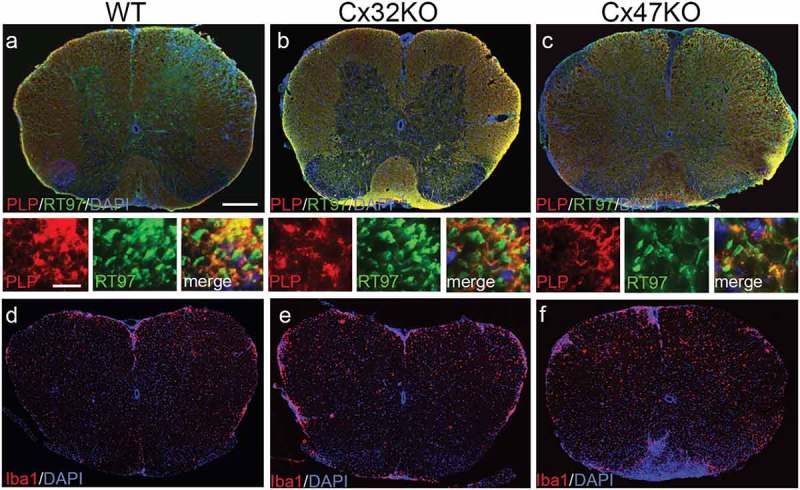
Figure 1.
Figure 1.
Pathological features of EAE in connexin mutants. These are representative images of whole lumbar spinal cord sections from EAE mice at 24 days post immunization (dpi), double stained as indicated with antibodies to myelin marker proteolipid protein (PLP) (red) to quantify demyelination, and axonal neurofilament marker RT97 (green) to quantify axonal loss (merged overview images and higher magnification images with separate channels underneath) (a-c), or for microglial marker Iba-1 (red) (d-f). Cell nuclei are stained with DAPI (blue). Areas of demyelination as well as diffuse microglia activation appear more extensive in connexin deficient mice, especially in the Cx47 KO. Scale bars in a= 100 μm; in insets = 10 μm.
Figure 2.
Figure 2.
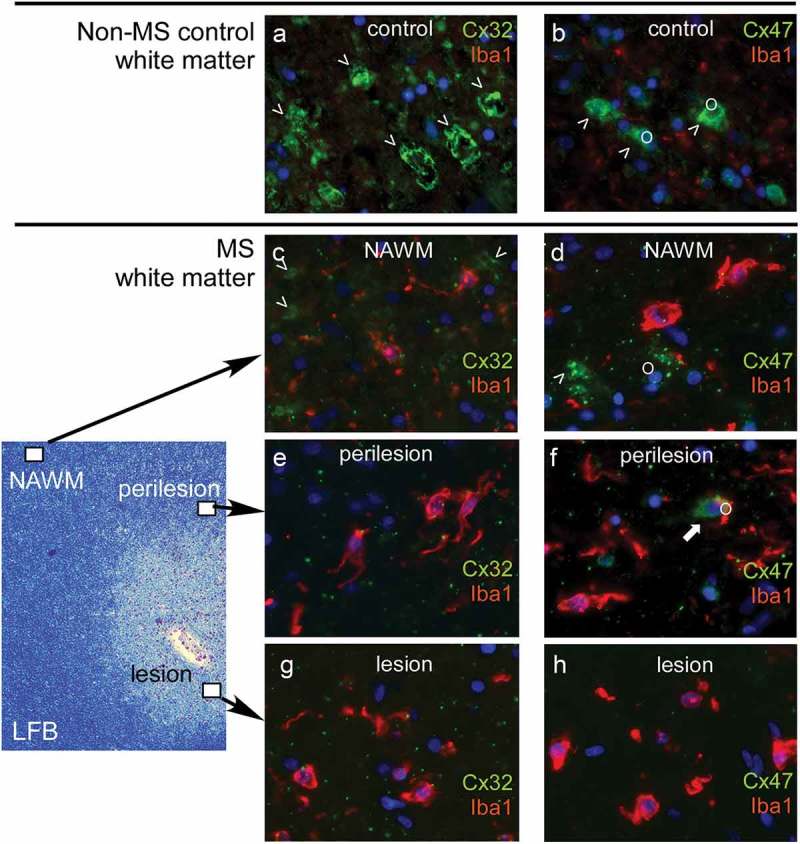
Expression of oligodendrocyte connexins in multiple sclerosis (MS) brain. Images of the white matter of a non-multiple sclerosis control (a- b) compared to a multiple sclerosis patient (c- h) are shown. Low magnification of MS brain white matter stained with Luxol fast blue (LFB) is shown on the left to indicate the location of the high magnification immunofluorescence pictures shown on the right. Antibodies to oligodendrocyte connexins as indicated (green) were combined with the Iba1 antibody labeling microglia (red). Cell nuclei are stained blue. The normal expression of Cx32 along large myelinated fibers in non-MS control brain (a) is significantly reduced, not only within and around lesions but also in NAWM in MS brain (c, e, g), associated with prominent microglia activation. Likewise, Cx47 expression mainly in cell bodies and proximal processes of oligodendrocytes (o) shown in non-MS brain (b) is reduced in and around MS lesions whereas, in contrast to Cx32, it appears preserved in NAWM (d, f, h).
Figure 3.
Figure 3.
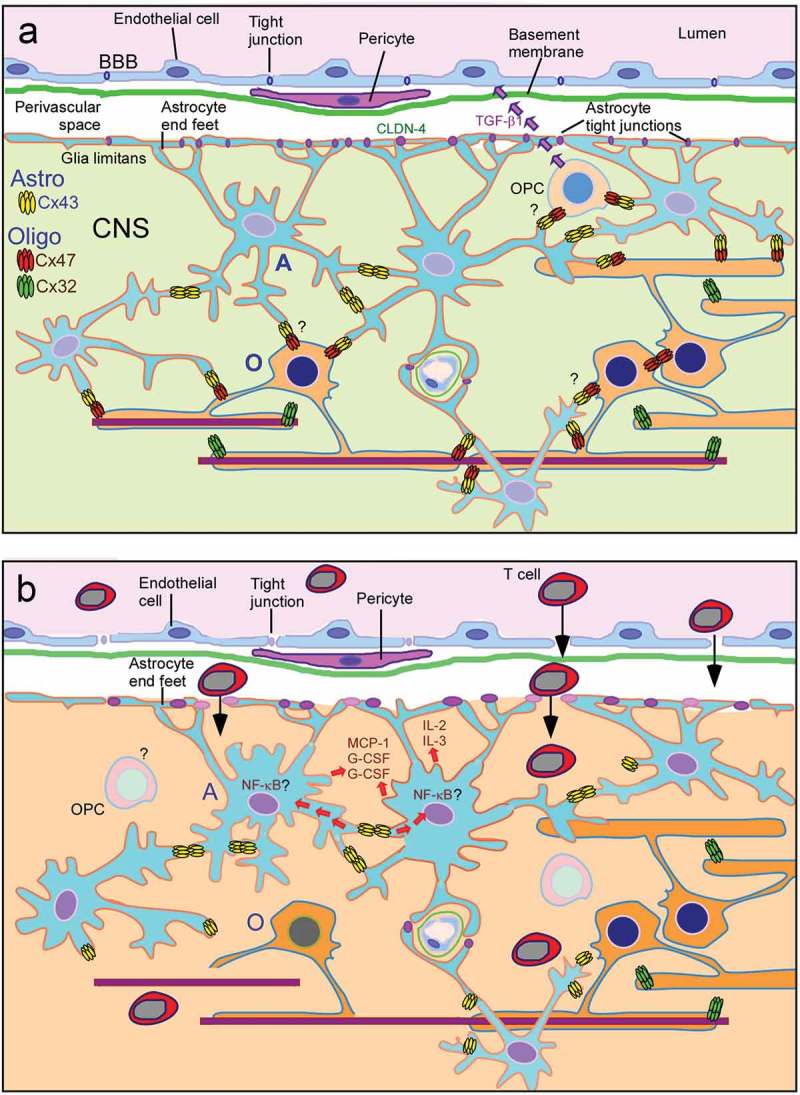
Diagram summarizing the role of glia connexin changes in demyelinating disorders. a. The top panel shows intracellular communication via connexin gap junctions between astrocytes and oligodendrocytes under normal conditions, and the possible effects of oligodendrocytes and their precursor cells (OPCs) on the blood-brain barrier (BBB) integrity, either directly through signaling or indirectly through the still to be clarified effects on astrocytes modifying their responses. b. The bottom panel demonstrates how the loss of oligodendrocyte and oligodendrocyte-astrocyte (O/A) GJs may result in the disruption of BBB and exacerbated neuroinflammatory response. Loss of the O/A Cx47-Cx43 channels is likely to lead on one hand to impaired homeostasis in oligodendrocytes and to accelerate demyelination and oligodendrocyte apoptosis under stress conditions. On the other hand, the disconnection of astrocytes from oligodendrocytes may alter the regulation of pro-inflammatory pathways within astrocytes, including the NFkB pathway, with further dysregulation of BBB and increased CNS inflammation and demyelination.

References

    1. Jäkel S, Dimou L.. Glial cells and their function in the adult brain: A journey through the history of their ablation. Front Cell Neurosci. 2017;11:24. - PMC - PubMed
    1. Bradl M, Lassmann H. Oligodendrocytes: biology and pathology. Acta Neuropathol. 2010;119:37–53. - PMC - PubMed
    1. Nave KA. Myelination and the trophic support of long axons. Nat Rev Neurosci. 2010;11:275–283. - PubMed
    1. Orthmann-Murphy JL, Abrams CK, Scherer SS. Gap junctions couple astrocytes and oligodendrocytes. J Mol Neurosci. 2008;35:101–116. - PMC - PubMed
    1. Giaume C, Koulakoff A, Roux L, et al. Astroglial networks: a step further in neuroglial and gliovascular interactions. Nat Rev Neurosci. 2010;11:87–99. - PubMed

Publication types

LinkOut - more resources