Prevalence, Patterns, and Cost of Care for Children with Cerebral Palsy Enrolled in Medicaid Managed Care
- PMID: 31232210
- PMCID: PMC10398069
- DOI: 10.18553/jmcp.2019.25.7.817
Prevalence, Patterns, and Cost of Care for Children with Cerebral Palsy Enrolled in Medicaid Managed Care
Abstract
Background: In the United States, many children with cerebral palsy (CP) obtain health care coverage through managed Medicaid, but little is known about the current demographics or management of this high-need, complex population.
Objective: To develop U.S. population-level information about the prevalence of CP, management patterns, and costs.
Methods: Data (2013-2015) were analyzed from a managed Medicaid database with coverage of children and adolescents in 15 states. Analyses included demographic information and use of 10 prespecified CP management options often used to manage spasticity. Code-based algorithms were applied to indicate presence of spasticity and determine the likely ambulatory status.
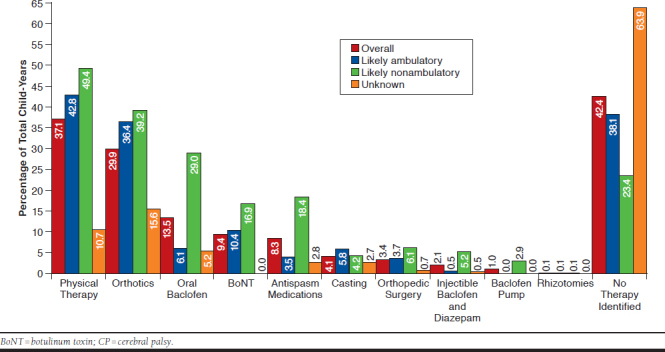
Results: In this claims analysis, the prevalence estimate of CP was 1.78 per 1,000 patients. Most (69.8%) children with CP had spasticity, of which 20.8% had hemiplegia, 15.6% diplegia, 32.9% quadriplegia, and 30.5% CP unspecified. Overall, 42.4% of children with CP were not treated with any of the 10 CP management options via Medicaid. Among treated children, the most common management options were physical therapy (37.1%), orthotics (29.9%), oral baclofen (13.5%) and botulinum toxins (9.4%). Overall annualized Medicaid costs were higher for children with CP versus children in the overall database population ($22,383 vs. $1,358). Within the CP population, costs were higher for those children who were likely nonambulatory than for those who were likely ambulatory ($43,687 vs. $10,368, respectively).
Conclusions: Most children with CP have spasticity, and the costs of care are high. This study highlights wide variation in the way CP is managed, with many young patients not receiving CP management options via Medicaid.
Disclosures: This analysis was funded by Ipsen Biopharmaceuticals and conducted by Milliman. Pulgar and Bains were employees of Ipsen Biopharmaceuticals during the conduct of this study. Chambers is a consultant for OrthoPediatrics and an employee of the University of California. Pyenson and Ferro are employees of Milliman, as was Sawhney during the analysis. Gooch, Noritz, and Wright report no conflicts of interest. Part of this work was presented as a poster at TOXINS 2017: Basic Science and Clinical Aspects of Botulinum and Other Neurotoxins, held January 18-21, 2017, in Madrid, Spain.
Conflict of interest statement
This analysis was funded by Ipsen Biopharmaceuticals and conducted by Milliman. Pulgar and Bains were employees of Ipsen Biopharmaceuticals during the conduct of this study. Chambers is a consultant for OrthoPediatrics and an employee of the University of California. Pyenson and Ferro are employees of Milliman, as was Sawhney during the analysis. Gooch, Noritz, and Wright report no conflicts of interest.
Part of this work was presented as a poster at TOXINS 2017: Basic Science and Clinical Aspects of Botulinum and Other Neurotoxins, held January 18-21, 2017, in Madrid, Spain.
Figures
References
-
- Christine C, Dolk H, Platt MJ, et al. . Recommendations from the SCPE collaborative group for defining and classifying cerebral palsy. Dev Med Child Neurol Suppl. 2007;109:35-38. - PubMed
-
- Bax M, Goldstein M, Rosenbaum P, et al. . Proposed definition and classification of cerebral palsy, April 2005. Dev Med Child Neurol. 2005;47(8):571-76. - PubMed
-
- Centers for Disease Control and Prevention . Data and statistics for cerebral palsy. Updated March 9, 2018. Available at: http://www.cdc.gov/ncbddd/cp/data.html. Accessed May 9, 2019.
-
- Sanger TD, Delgado MR, Gaebler-Spira D, Hallett M, Mink JW, Task Force on Childhood Motor D. Classification and definition of disorders causing hypertonia in childhood. Pediatrics. 2003;111(1):e89-97. - PubMed
MeSH terms
LinkOut - more resources
Full Text Sources
Medical
Miscellaneous