. 2019 Jun 24;14(6):e0218717.
doi: 10.1371/journal.pone.0218717. eCollection 2019.

A simplified workflow for monoclonal antibody sequencing

Affiliations

A simplified workflow for monoclonal antibody sequencing

Lena Meyer et al. PLoS One. .

Abstract

The diversity of antibody variable regions makes cDNA sequencing challenging, and conventional monoclonal antibody cDNA amplification requires the use of degenerate primers. Here, we describe a simplified workflow for amplification of IgG antibody variable regions from hybridoma RNA by a specialized RT-PCR followed by Sanger sequencing. We perform three separate reactions for each hybridoma: one each for kappa, lambda, and heavy chain transcripts. We prime reverse transcription with a primer specific to the respective constant region and use a template-switch oligonucleotide, which creates a custom sequence at the 5' end of the antibody cDNA. This template-switching circumvents the issue of low sequence homology and the need for degenerate primers. Instead, subsequent PCR amplification of the antibody cDNA molecules requires only two primers: one primer specific for the template-switch oligonucleotide sequence and a nested primer to the respective constant region. We successfully sequenced the variable regions of five mouse monoclonal IgG antibodies using this method, which enabled us to design chimeric mouse/human antibody expression plasmids for recombinant antibody production in mammalian cell culture expression systems. All five recombinant antibodies bind their respective antigens with high affinity, confirming that the amino acid sequences determined by our method are correct and demonstrating the high success rate of our method. Furthermore, we also designed RT-PCR primers and amplified the variable regions from RNA of cells transfected with chimeric mouse/human antibody expression plasmids, showing that our approach is also applicable to IgG antibodies of human origin. Our monoclonal antibody sequencing method is highly accurate, user-friendly, and very cost-effective.


Conflict of interest statement

The authors have declared that no competing interests exist.

Figures
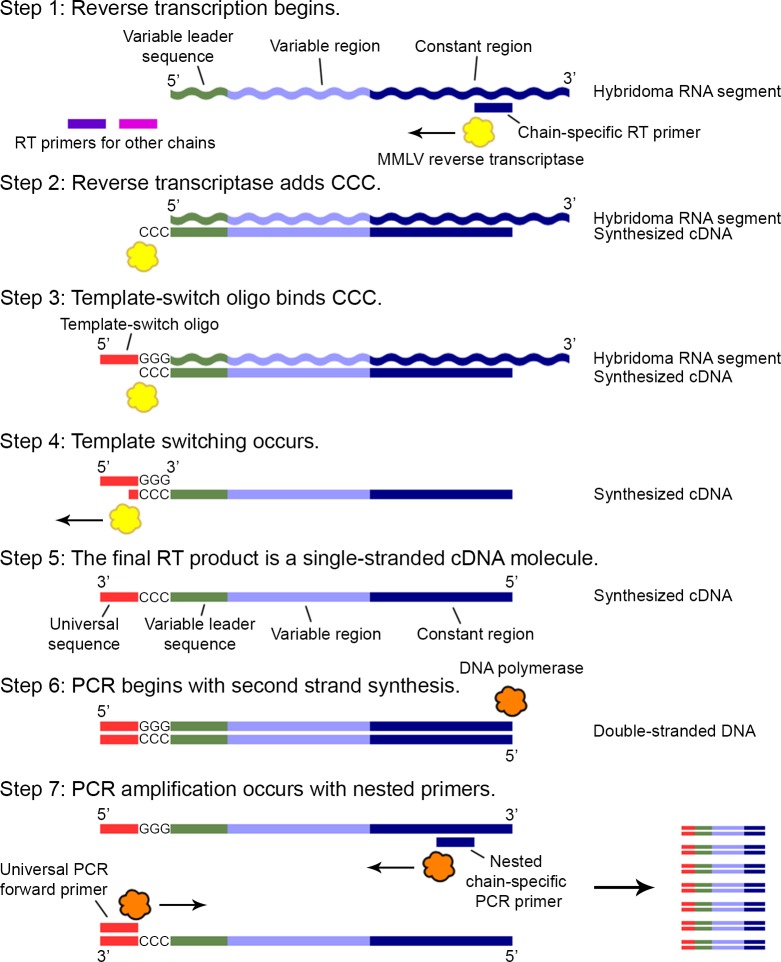
Fig 1
Fig 1. Schematic for cDNA synthesis by template-switching.
(Step 1) Primer binding and initiation of polymerization. (Step 2) MMLV reverse transcriptase adds deoxycytosines to the cDNA 3' end. (Step 3) Template-switch oligo binds the CCC overhang. (Step 4) Reverse transcriptase switches templates and continues polymerization using the template-switch oligo as the template. (Steps 5–7) The single-stranded cDNA product of reverse transcription becomes the template for second-strand synthesis primed by the universal PCR forward primer. Amplification follows using the universal PCR forward primer and nested chain-specific PCR reverse primers. Note that the lengths of the different antibody regions and primers are not drawn to scale.
Fig 2
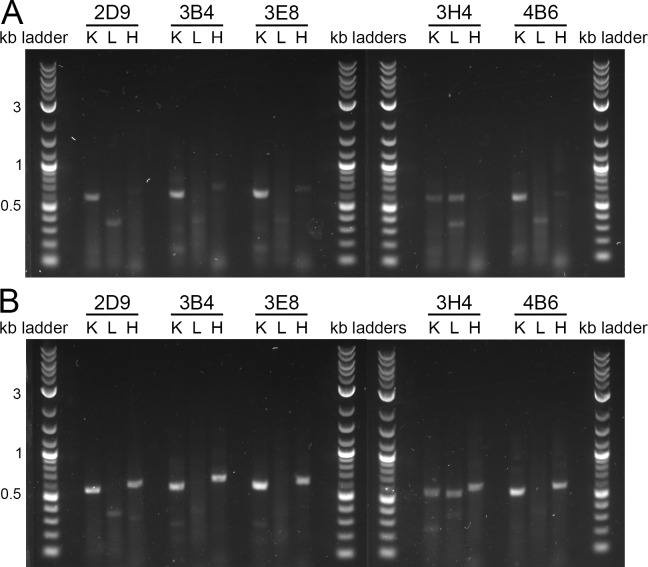
Fig 2. Comparison of primer sets for RT-PCR amplification of variable regions from 5 hybridoma mRNA samples.
K = kappa chain, L = lambda chain, H = heavy chain. (A) RT-PCR result using the same reverse primers for RT and for PCR. (B) RT-PCR result using a set of nested reverse primers for RT and for PCR.
Fig 3
Fig 3. Protein sequence comparison of variable regions for 3H4 kappa and 3H4 lambda.
Blue = Frame region, Orange = Complementarity-determining region, Red = J region out-of-frame, Green = J region in-frame 3H4 kappa (top) has an early stop codon due to a frameshift mutation. 3H4 lambda (bottom) is full-length.
Fig 4
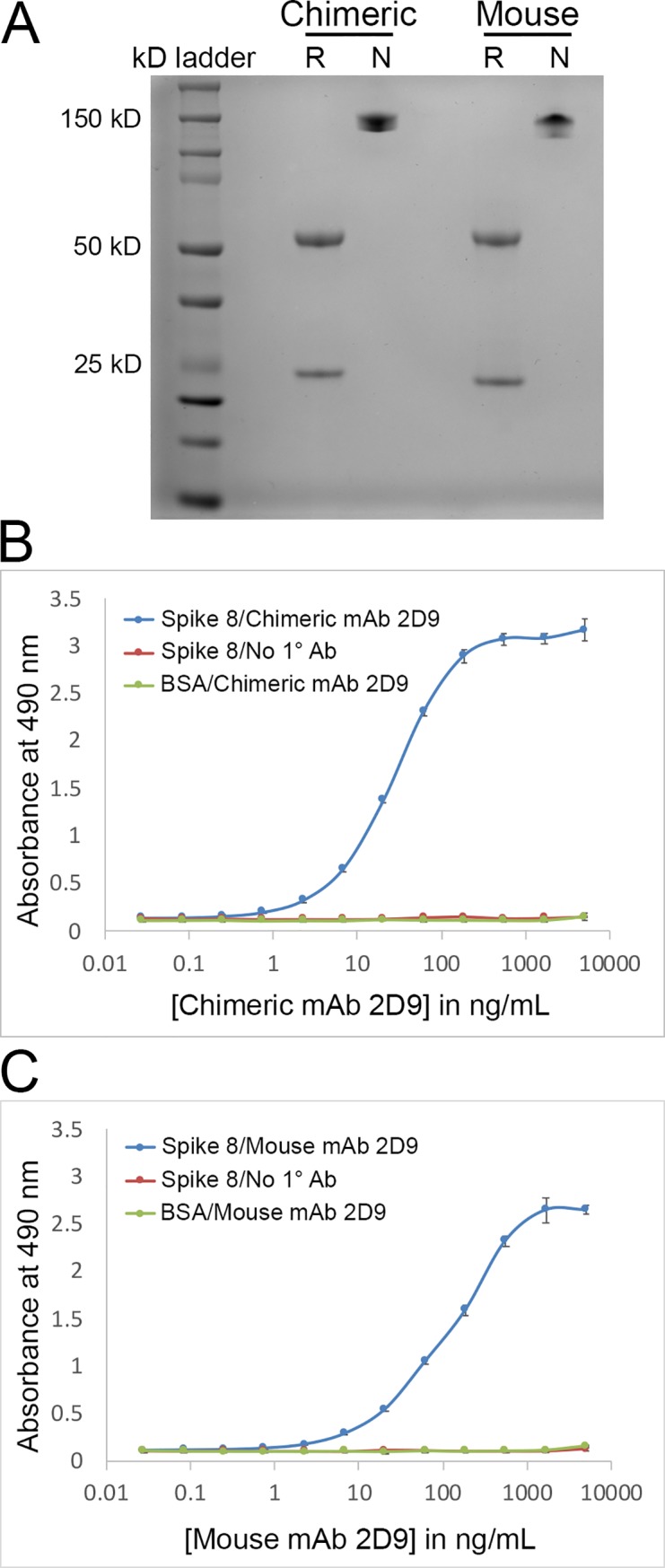
Fig 4. Comparison of chimeric mAb 2D9 and mouse mAb 2D9.
R = reducing gel sample, N = non-reducing gel sample (A) SDS-PAGE gel comparing chimeric mAb 2D9 (left) to mouse mAb 2D9 (right). A reducing (R) and a non-reducing (N) sample is shown for each mAb. (B) Indirect ELISA showing that chimeric mAb 2D9 binds the Spike 8 antigen. (C) Indirect ELISA showing that mouse mAb 2D9 binds the Spike 8 antigen.
Fig 5
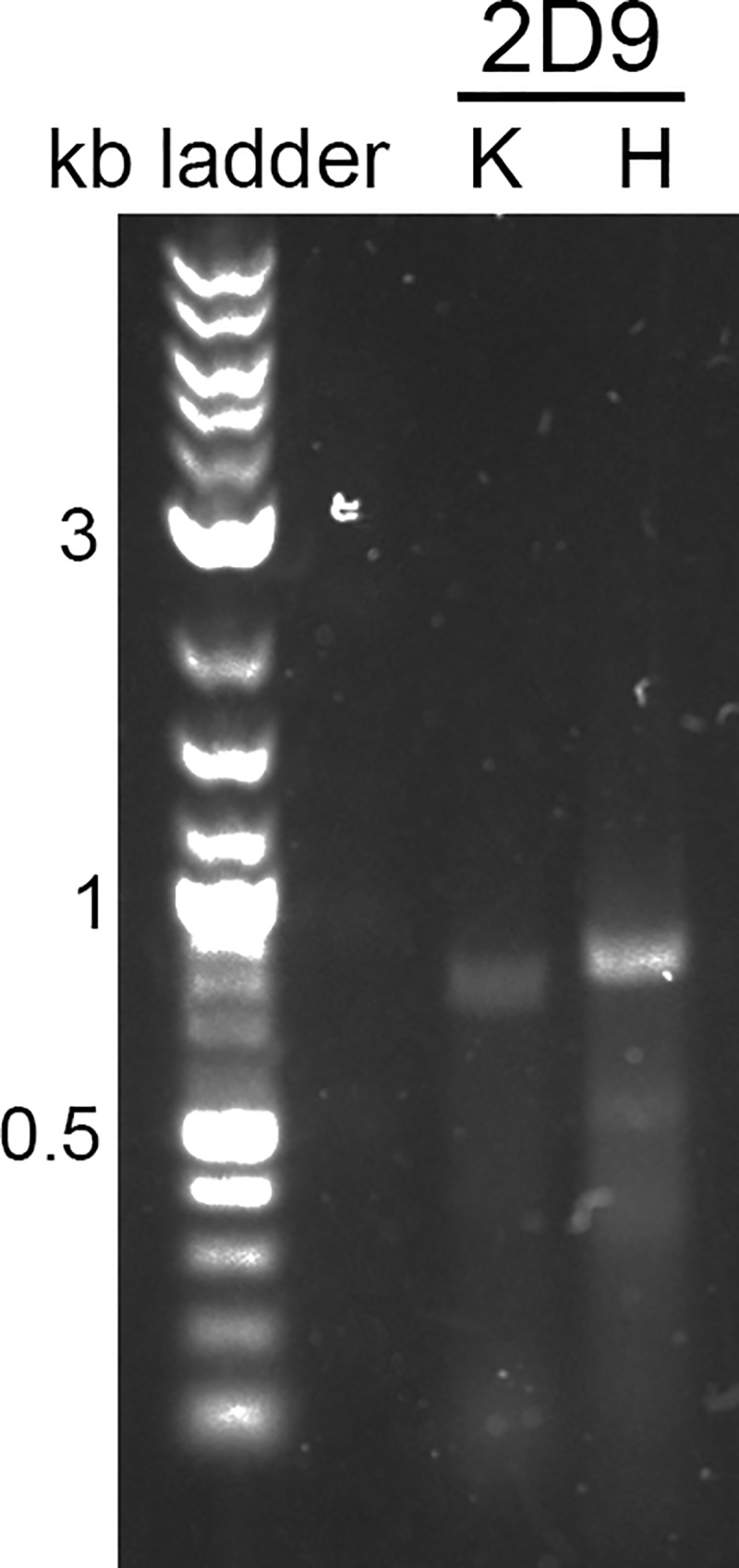
Fig 5. RT-PCR amplification of chimeric antibody variable regions.
K = kappa chain, H = heavy chain RT-PCR result with reverse primers designed for human constant regions and using as a template the RNA extracted from HEK 293F cells transiently transfected with chimeric mAb 2D9 constructs.

References

    1. Ecker DM, Jones SD, Levine HL. The therapeutic monoclonal antibody market. MAbs. 2015;7(1):9–14. 10.4161/19420862.2015.989042 . - DOI - PMC - PubMed
    1. Frenzel A, Hust M, Schirrmann T. Expression of recombinant antibodies. Front Immunol. 2013;4:217 Epub 07/29. 10.3389/fimmu.2013.00217 . - DOI - PMC - PubMed
    1. Coco-Martin JM, Oberink JW, van der Velden-de Groot TAM, Beuvery EC. Methods for studying the stability of antibody expression by hybridoma cells in homogeneous continuous culture systems. Analytica Chimica Acta. 1991;249(1):257–62. 10.1016/0003-2670(91)87031-2. - DOI
    1. Kuniyoshi Y, Maehara K, Iwasaki T, Hayashi M, Semba Y, Fujita M, et al. Identification of Immunoglobulin Gene Sequences from a Small Read Number of mRNA-Seq Using Hybridomas. PLoS One. 2016;11(10):e0165473 Epub 10/27. 10.1371/journal.pone.0165473 . - DOI - PMC - PubMed
    1. Schanz M, Liechti T, Zagordi O, Miho E, Reddy ST, Günthard HF, et al. High-throughput sequencing of human immunoglobulin variable regions with subtype identification. PLoS One. 2014;9(11):e111726 Epub 11/03. 10.1371/journal.pone.0111726 . - DOI - PMC - PubMed

Publication types

MeSH terms