


Assessing frontline HIV service provider efficiency using data envelopment analysis: a case study of Philippine social hygiene clinics (SHCs)
- PMID: 31234853
- PMCID: PMC6591825
- DOI: 10.1186/s12913-019-4163-5
Assessing frontline HIV service provider efficiency using data envelopment analysis: a case study of Philippine social hygiene clinics (SHCs)
Abstract
Background: Globally, local and frontline HIV service delivery units have been deployed to halt the HIV epidemic. However, with the limited resources, there is a need to understand how these units can deliver their optimum outputs/outcomes efficiently given the inputs. This study aims to determine the efficiency of the social hygiene clinics (SHC) in the Philippines as well as to determine the association of the meta-predictor to the efficiencies.
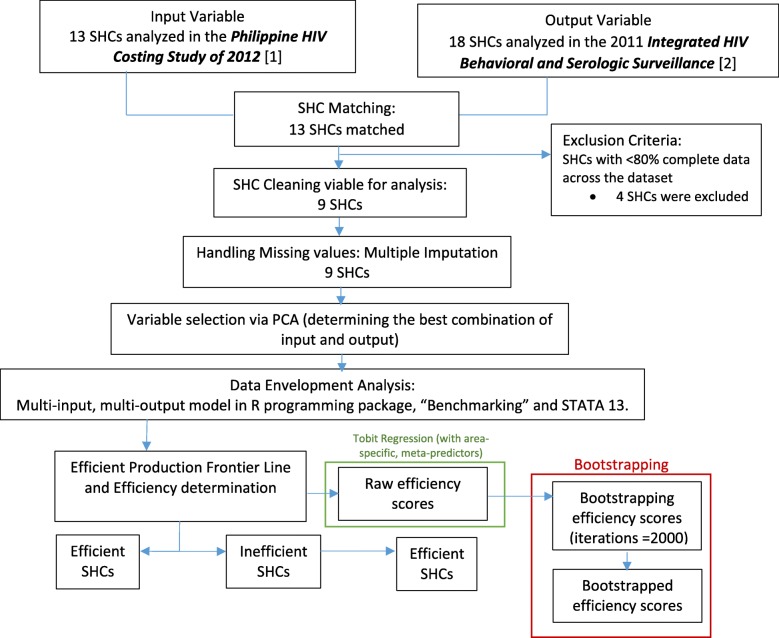
Methods: In determining efficiency, we used the variables from two data sources namely the 2012 Philippine HIV Costing study and 2011 Integrated HIV Behavioral and Serologic Surveillance, as inputs and outputs, respectively. Various data management protocols and initial assumptions in data matching, imputation and variable selection, were used to create the final dataset with 9 SHCs. We used data envelopment analysis (DEA) to analyse the efficiency, while variations in efficiencies were analysed using Tobit regression with area-specific meta-predictors.
Results: There were potentially inefficient use of limited resources among sampled SHC in both aggregate and key populations. Tobit regression results indicated that income was positively associated with efficiency, while HIV prevalence was negatively associated with the efficiency variations among the SHCs.
Conclusions: We were able to determine the inefficiently performing SHCs in the Philippines. Though currently inefficient, these SHCs may adjust their inputs and outputs to become efficient in the future. While there were indications of income and HIV prevalence to be associated with the efficiency variations, the results of this case study may only be limited in generalisability, thus further studies are warranted.
Keywords: Data envelopment analysis; Efficiency; HIV; Philippines; Social hygiene clinic.
Conflict of interest statement
The authors declare that they have no competing interests.
Figures
References
-
- UNAIDS. How AIDS changed everything. Geneva: Joint United Nations Programme on HIV/AIDS; 2014.
-
- UNAIDS. Global report: UNAIDS report on the global AIDS epidemic 2013. Geneva: Joint United Nations Programme on HIV/AIDS; 2013.
-
- Gupta GR, Parkhurst JO, Ogden JA, Aggleton P, Mahal A. Structural approaches to HIV prevention. Lancet. 2008;372(9640):764–775. - PubMed
-
- Bertozzi SM, Laga M, Bautista-Arredondo S, Coutinho A. Making HIV prevention programmes work. Lancet. 2008;372(9641):831–844. - PubMed
MeSH terms
LinkOut - more resources
Full Text Sources
Medical
Molecular Biology Databases
Miscellaneous
