Defining autoimmune hemolytic anemia: a systematic review of the terminology used for diagnosis and treatment
- PMID: 31235526
- PMCID: PMC6595261
- DOI: 10.1182/bloodadvances.2019000036
Defining autoimmune hemolytic anemia: a systematic review of the terminology used for diagnosis and treatment
Abstract
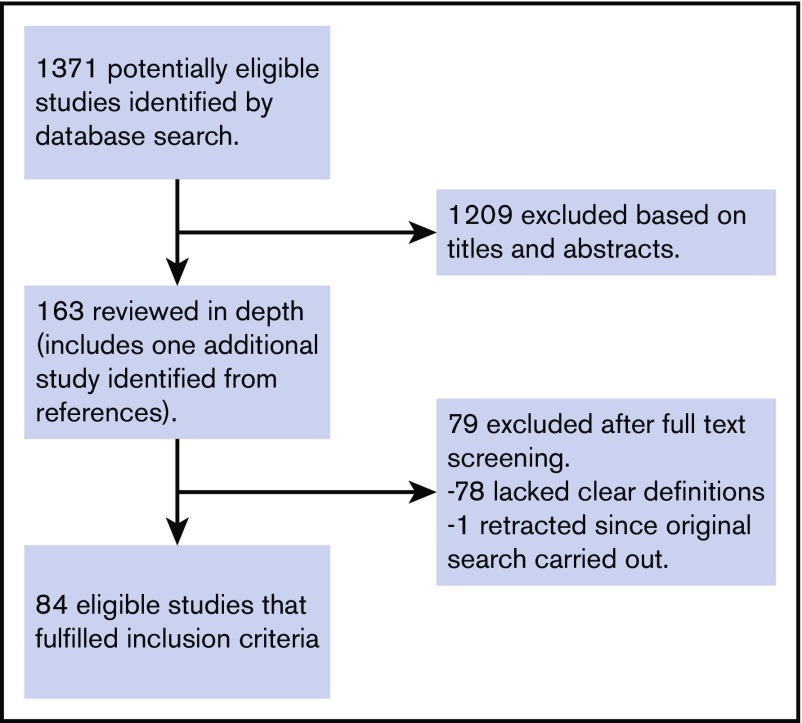
The terminology applied to autoimmune hemolytic anemia (AIHA) seems inconsistent. We aimed to evaluate the consistency of definitions used for diagnosis and treatment. In this systematic review of literature from January 2006 to December 2015, we assessed heterogeneity in the definition of AIHA and its subtypes, refractory disease, disease phase, severity, criteria for treatment response, and response durability. A Medline search for anemia, hemolytic, autoimmune was supplemented with keyword searches. Main exclusions were conference abstracts, animal and non-English studies, and studies with <10 cases. Of 1371 articles retrieved, 1209 were excluded based on titles and abstracts. Two authors independently reviewed 10% and 16% of abstracts and full papers, respectively. After full-paper review, 84 studies were included. AIHA was most frequently (32 [52%] of 61) defined as hemolytic anemia with positive direct antiglobulin test (DAT) and exclusion of alternatives, but 10 of 32 also recognized DAT-negative AIHA. A lower threshold for diagnosis of DAT-negative AIHA was observed in literature on chronic lymphocytic leukemia. Definitions of anemia, hemolysis, and exclusion criteria showed substantial variation. Definitions of primary/secondary cold agglutinin disease/syndrome were not consistent. Forty-three studies provided criteria for treatment response, and other than studies from 1 center, these were almost entirely unique. Other criteria were rarely defined. Only 7, 0, 3, 2, 2, and 3 studies offered definitions of warm AIHA, paroxysmal cold hemoglobinuria, mixed AIHA, AIHA severity, disease phase, and refractory AIHA, respectively. Marked heterogeneity in the time period sampled indicates the need to standardize AIHA terminology.
© 2019 by The American Society of Hematology.
Conflict of interest statement
Conflict-of-interest disclosure: Q.A.H. has received honoraria from Bioverativ and Apellis and research funding from Alexion. A.H. has received honoraria from Bioverativ, Apellis, and Alexion. S.B. has received research funding from Mundipharma and honoraria from Apellis, Bioverativ, Momenta Pharmaceuticals, and True North Therapeutics.
References
-
- Crowther M, Chan YL, Garbett IK, Lim W, Vickers MA, Crowther MA. Evidence-based focused review of the treatment of idiopathic warm immune hemolytic anemia in adults. Blood. 2011;118(15):4036-4040. - PubMed
-
- Hill QA, Stamps R, Massey E, Grainger JD, Provan D, Hill A; British Society for Haematology . The diagnosis and management of primary autoimmune haemolytic anaemia. Br J Haematol. 2017;176(3):395-411. - PubMed
-
- Reynaud Q, Durieu I, Dutertre M, et al. Efficacy and safety of rituximab in auto-immune hemolytic anemia: a meta-analysis of 21 studies. Autoimmun Rev. 2015;14(4):304-313. - PubMed
Publication types
MeSH terms
Substances
LinkOut - more resources
Full Text Sources
Medical
Molecular Biology Databases