


Context shapes early diversity in abstract thought
- PMID: 31235570
- PMCID: PMC6628784
- DOI: 10.1073/pnas.1818365116
Context shapes early diversity in abstract thought
Abstract
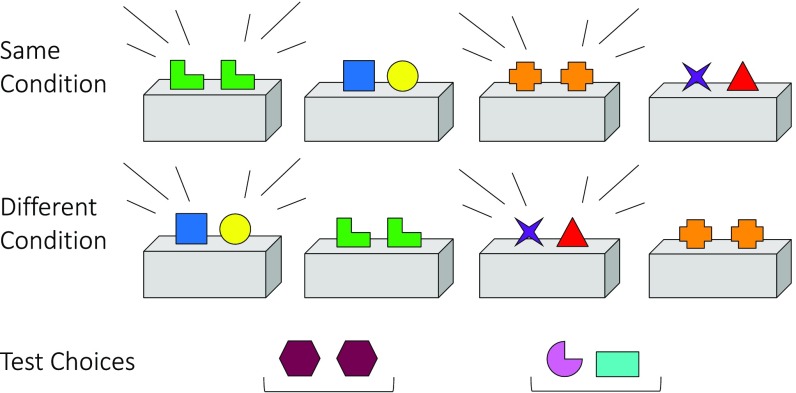
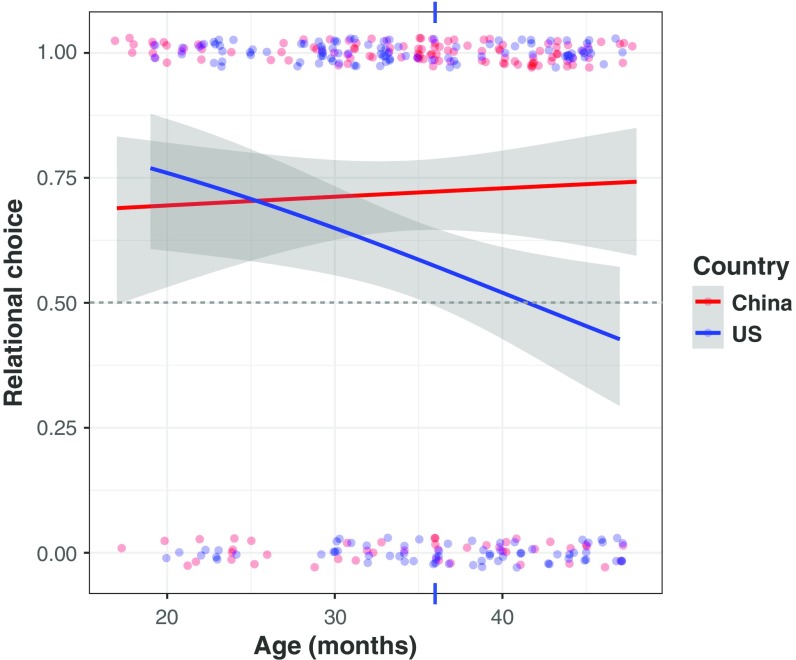
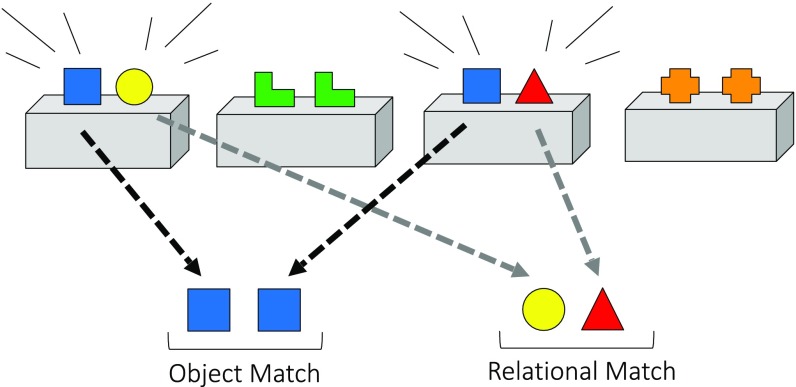
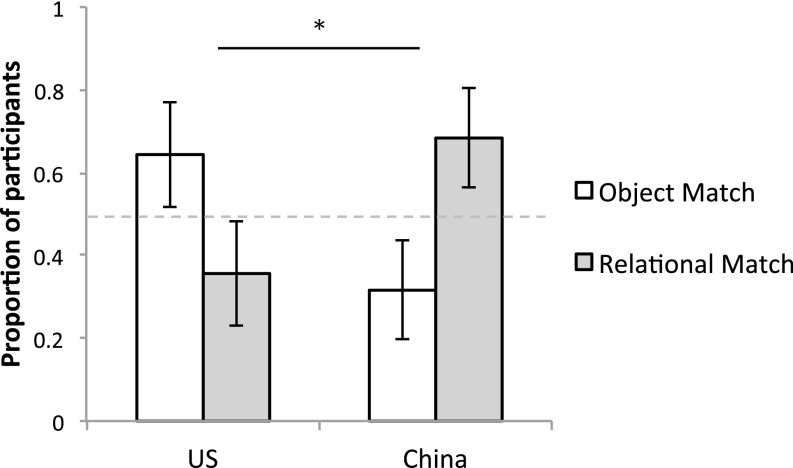
Early abstract reasoning has typically been characterized by a "relational shift," in which children initially focus on object features but increasingly come to interpret similarity in terms of structured relations. An alternative possibility is that this shift reflects a learned bias, rather than a typical waypoint along a universal developmental trajectory. If so, consistent differences in the focus on objects or relations in a child's learning environment could create distinct patterns of relational reasoning, influencing the type of hypotheses that are privileged and applied. Specifically, children in the United States may be subject to culture-specific influences that bias their reasoning toward objects, to the detriment of relations. In experiment 1, we examine relational reasoning in a population with less object-centric experience-3-y-olds in China-and find no evidence of the failures observed in the United States at the same age. A second experiment with younger and older toddlers in China (18 to 30 mo and 30 to 36 mo) establishes distinct developmental trajectories of relational reasoning across the two cultures, showing a linear trajectory in China, in contrast to the U-shaped trajectory that has been previously reported in the United States. In a third experiment, Chinese 3-y-olds exhibit a bias toward relational solutions in an ambiguous context, while those in the United States prefer object-based solutions. Together, these findings establish population-level differences in relational bias that predict the developmental trajectory of relational reasoning, challenging the generality of an initial object focus and suggesting a critical role for experience.
Keywords: cognitive development; culture; learning; relational reasoning.
Conflict of interest statement
The authors declare no conflict of interest.
Figures
References
-
- Penn D. C., Holyoak K. J., Povinelli D. J., Darwin’s mistake: Explaining the discontinuity between human and nonhuman minds. Behav. Brain Sci. 31, 109–130, discussion 130–178 (2008). - PubMed
-
- Gentner D., Toupin C., Systematicity and surface similarity in the development of analogy. Cogn. Sci. 10, 277–300 (1986).
-
- Gentner D., Metaphor as structure mapping: The relational shift. Child Dev. 59, 47–59 (1988).
-
- Gentner D., Rattermann M., Language and the Career of Similarity. Perspectives on Thought and Language: Interrelations in Development, Gelman S., Byrnes J., Eds. (Cambridge University Press, London, 1991), pp. 225–277.
-
- Gentner D., Rattermann M., Markman A., Kotovsky L., “Two forces in the development of relational similarity” in Developing Cognitive Competence: New Approaches to Process Modeling, Halford G., Simon T., Eds. (Psychology Press, New York, 1995), pp. 263–313.
