. 2019 Oct;13(10):2578-2588.
doi: 10.1038/s41396-019-0461-5. Epub 2019 Jun 24.

Recent mixing of Vibrio parahaemolyticus populations

Affiliations

Recent mixing of Vibrio parahaemolyticus populations

Chao Yang et al. ISME J. 2019 Oct.

Abstract

Humans have profoundly affected the ocean environment but little is known about anthropogenic effects on the distribution of microbes. Vibrio parahaemolyticus is found in warm coastal waters and causes gastroenteritis in humans and economically significant disease in shrimps. Based on data from 1103 genomes of environmental and clinical isolates, we show that V. parahaemolyticus is divided into four diverse populations, VppUS1, VppUS2, VppX and VppAsia. The first two are largely restricted to the US and Northern Europe, while the others are found worldwide, with VppAsia making up the great majority of isolates in the seas around Asia. Patterns of diversity within and between the populations are consistent with them having arisen by progressive divergence via genetic drift during geographical isolation. However, we find that there is substantial overlap in their current distribution. These observations can be reconciled without requiring genetic barriers to exchange between populations if long-range dispersal has increased dramatically in the recent past. We found that VppAsia isolates from the US have an average of 1.01% more shared ancestry with VppUS1 and VppUS2 isolates than VppAsia isolates from Asia itself. Based on time calibrated trees of divergence within epidemic lineages, we estimate that recombination affects about 0.017% of the genome per year, implying that the genetic mixture has taken place within the last few decades. These results suggest that human activity, such as shipping, aquatic products trade and increased human migration between continents, are responsible for the change of distribution pattern of this species.


Conflict of interest statement

The authors declare that they have no conflict of interest.

Figures
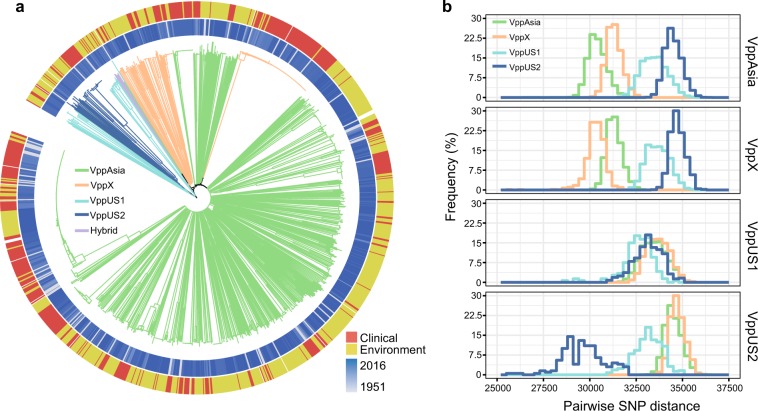
Fig. 1
Fig. 1
Population structure of V. parahaemolyticus and relationships within and between populations. a NJ tree of 1103V. parahaemolyticus stains based on 462,214 SNPs. Branch colors indicate populations defined by fineSTRUCTURE, green for VppAsia, orange for VppX, light blue for VppUS1, dark blue for VppUS2, purple for hybrid strains. The ring colors from inner to outer indicate isolation time and sample type, respectively. The blank indicates information not available. b SNP distance within and between populations based on 469 non-redundant strains. Colors indicate populations and are consistent with branch colors of (a)
Fig. 2
Fig. 2
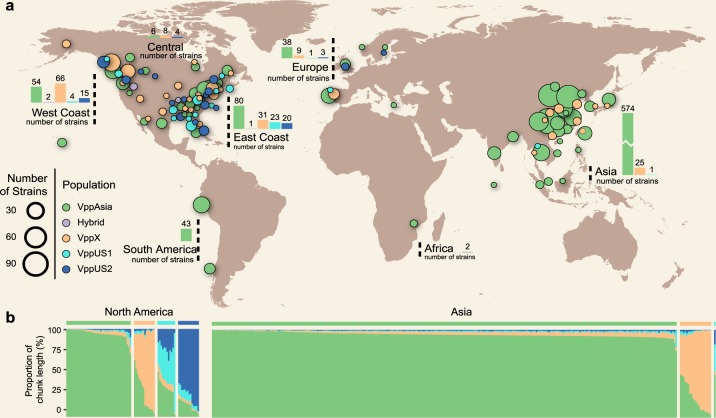
Geographical distribution and admixture of V. parahaemolyticus populations. Colors in circle and bar plot indicate populations and are as in Fig. 1. Each circle indicates the population composition of a city/country, with radius in proportion to the sample size. Bar plot indicates the ancestry composition inferred by chromosome painting of two geographical regions: Asia and North America. Each vertical bar represents one non-redundant strain and the proportion of color indicates the contribution of each population. Different populations are separated by blank vertical bar. Only strains with information of isolation location are included in (a) (n = 1008) and (b) (n = 422)
Fig. 3
Fig. 3
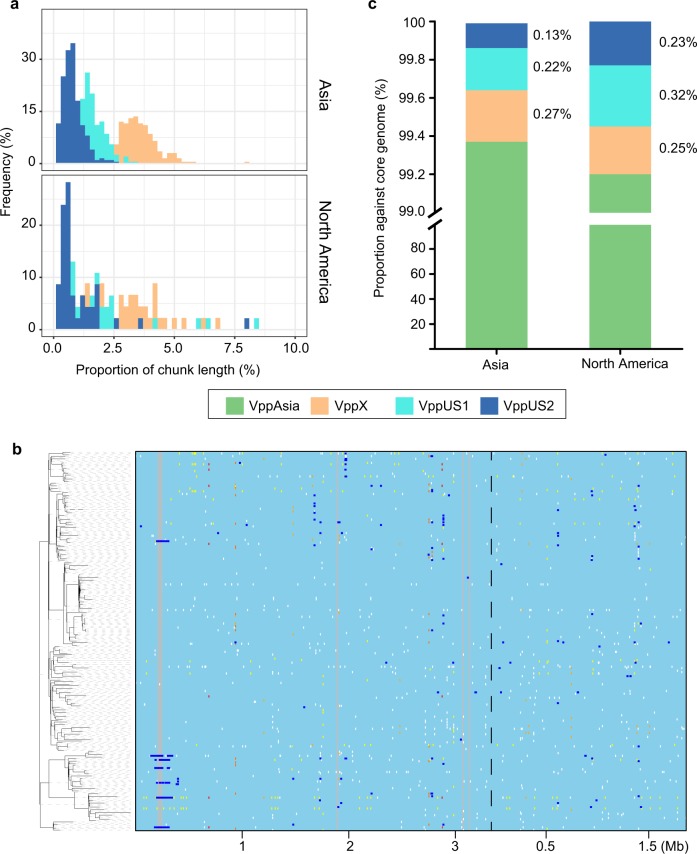
Recent mixing of V. parahaemolyticus populations. a Ancestry composition of three other V. parahaemolyticus populations in VppAsia strains in different geographical regions. The contribution from other populations to the VppAsia is inferred by chromosome painting. X axis indicates the proportion of contributed chunk length of a population in one strain and Y axis indicates the corresponding frequency. b ClonalFrameML recombination analysis of 141 CG1 strains. Left: ClonalFrameML reconstructed phylogeny. Right: dark blue horizontal bars indicate recombination events, grey areas indicate non-core regions. Two chromosomes are separated by dot line. (c) Source of recombination fragments of CG1 strains in different geographical regions. Y axis indicates the proportion of recombination fragments input from different population against core genome. Colors in (a) and (c) indicate four populations and are as in Fig. 1

References

    1. Brown MV, Ostrowski M, Grzymski JJ, Lauro FM. A trait based perspective on the biogeography of common and abundant marine bacterioplankton clades. Mar Genomics. 2014;15:17–28. doi: 10.1016/j.margen.2014.03.002. - DOI - PubMed
    1. Yilmaz P, Yarza P, Rapp JZ, Glockner FO. Expanding the world of marine bacterial and archaeal clades. Front Microbiol. 2015;6:1524. - PMC - PubMed
    1. Kent AG, Dupont CL, Yooseph S, Martiny AC. Global biogeography of Prochlorococcus genome diversity in the surface ocean. ISME J. 2016;10:1856–65. doi: 10.1038/ismej.2015.265. - DOI - PMC - PubMed
    1. Hellweger FL, van Sebille E, Calfee BC, Chandler JW, Zinser ER, Swan BK, et al. The role of ocean currents in the temperature selection of plankton: insights from an individual-based model. PLoS One. 2016;11:e0167010. doi: 10.1371/journal.pone.0167010. - DOI - PMC - PubMed
    1. Nair GB, Ramamurthy T, Bhattacharya SK, Dutta B, Takeda Y, Sack DA. Global dissemination of Vibrio parahaemolyticus serotype O3:K6 and its serovariants. Clin Microbiol Rev. 2007;20:39–48. doi: 10.1128/CMR.00025-06. - DOI - PMC - PubMed

Publication types

MeSH terms