. 2019 Aug;22(8):1269-1275.
doi: 10.1038/s41593-019-0424-1. Epub 2019 Jun 24.

Chondroitinase improves anatomical and functional outcomes after primate spinal cord injury

Affiliations

Chondroitinase improves anatomical and functional outcomes after primate spinal cord injury

Ephron S Rosenzweig et al. Nat Neurosci. 2019 Aug.

Abstract

Inhibitory extracellular matrices form around mature neurons as perineuronal nets containing chondroitin sulfate proteoglycans that limit axonal sprouting after CNS injury. The enzyme chondroitinase (Chase) degrades inhibitory chondroitin sulfate proteoglycans and improves axonal sprouting and functional recovery after spinal cord injury in rodents. We evaluated the effects of Chase in rhesus monkeys that had undergone C7 spinal cord hemisection. Four weeks after hemisection, we administered multiple intraparenchymal Chase injections below the lesion, targeting spinal cord circuits that control hand function. Hand function improved significantly in Chase-treated monkeys relative to vehicle-injected controls. Moreover, Chase significantly increased corticospinal axon growth and the number of synapses formed by corticospinal terminals in gray matter caudal to the lesion. No detrimental effects were detected. This approach appears to merit clinical translation in spinal cord injury.


Conflict of interest statement

COMPETING INTERESTS:

JFI, AOC and ARB are employees of Acorda Therapeutics, Inc., and JWF and MHT were members of the Acorda scientific advisory board at the time that these studies were performed. All other authors declare no competing interests.

Figures

Figure 1:
Figure 1:. Experimental Approach
(A) Timeline of Chase efficacy experiment. (B) Schematic of experimental approach. The right hemisection lesion at segment C7 severs 90% of CST axons originating in the left hemisphere (traced with BDA, blue), and 10% of CST axons originating in the right hemisphere (traced with A488, brown). Chase is injected into 10 sites (1.5 mm apart) in the gray matter below the lesion.
Figure 2:
Figure 2:. Intraparenchymal Chase Injections Degrade Chondroitin Sulfate Proteoglycans
(A-C) Comparison of Chase-treated (right) and untreated (left) sides of the spinal cord in a rhesus monkey 2 wk after Chase administration (1 mo after lesion). WFA labeling reveals CSPG degradation on the treated side. Boxed regions are shown at higher magnification in B,C. Zone of peri-neuronal net CSPG degradation indicated by dashed lines. (D) Tissue section from C7, above the lesion and the treated region, has intact CSPGs. (E) Series of tissue sections at 2 mm intervals moving caudally from lesion site reveals effective CSPG degradation from C7 through T1. Labeling experiment included 2 animals. Scale bars: A, 500 μm; B,C, 1 mm.
Figure 3:
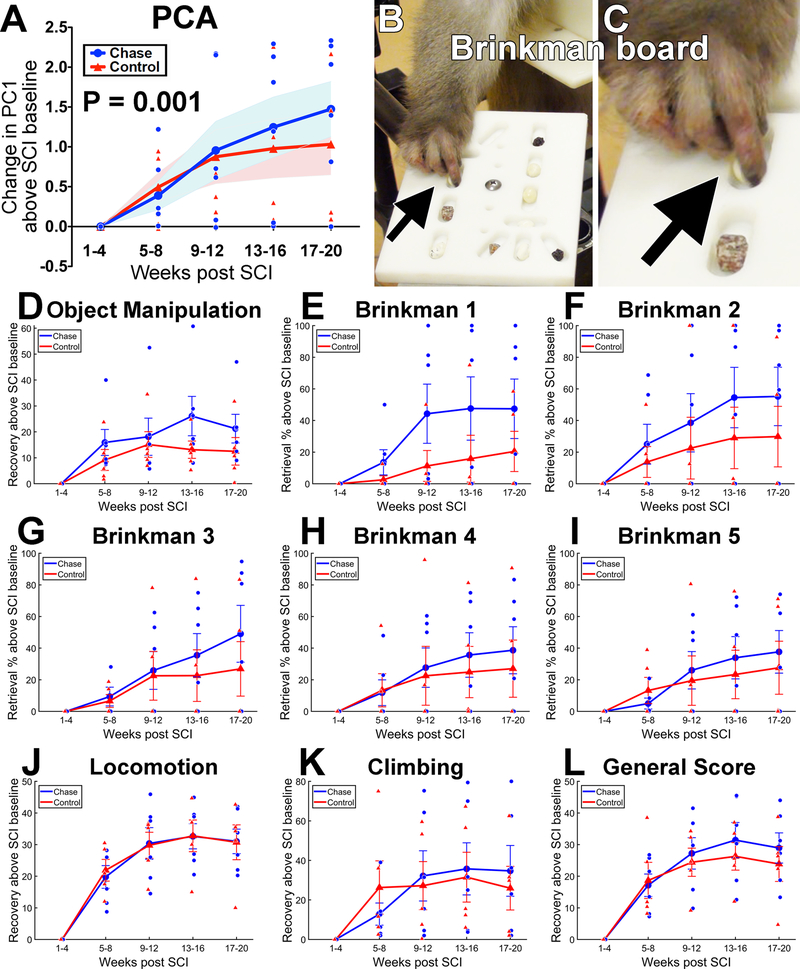
Figure 3:. Functional Outcomes
(A) Combining all behavioral data into a principal components analysis (PCA) demonstrates a significant interaction of Chase treatment with time on PC1 (LMM, P=0.001). Plot shows the change in PC1 scores over time. Shading represents SEM. PC1 explains 68% of the variance in the behavioral data (see Supp. Fig. 5 for loadings). (B-C) Example of food reward retrieval on one of the tasks comprising behavioral testing, Brinkman 5. Arrow indicates pincer motion used to retrieve food reward from well. (D-L) Recovery curves for the individual tasks that comprise PC1. These individual task plots show that, although single functional outcome metrics may not be sensitive on their own, combining all metrics in a PCA reveals a robust effect of chondroitinase treatment at the multivariate level. Object manipulation score (D) reflects use of the impaired forelimb to manipulate a large piece of fruit and retrieve food items from inside a “Kong” toy. Brinkman 1 through Brinkman 5 (E-I) indicates progressively more difficult versions of food retrieval (see Methods; raw Brinkman scores are reported in the text). Locomotion score (J) reflects use of the ipsilesional limbs for moving around the exercise enclosure. (K) Climbing score reflects use of ipsilesional limbs for vertical climbing in the exercise enclosure. (L) General Score is a composite of multiple measures that describe forelimb and hindlimb function, as described in [42,44]. Generally, the Chase group exhibited superior recovery on tasks reflecting hand use (the spinal cord region targeted with Chase injections), and no difference in measures that included hindlimb function (i.e., those not targeted by Chase treatment). N=6 Chase subjects and N=5 Control subjects. Large data points show group means, small data points are individual subjects, error bars represent SEM.
Figure 4:
Figure 4:. Effects of Chase on Corticospinal Axon and Synapse Density
(A) BDA-traced CST axons descending in the intact white matter (WM; left dorsolateral quadrant of spinal cord), crossing the spinal cord midline near the central canal (CC, dashed line in inset), and terminating in the gray matter (GM) on both sides of the spinal cord. Dashed line shows WM-GM boundary. Chase-treated subject, spinal level C8. (B) Representative images of gray matter from Chase-treated and control subjects at C8; note the qualitatively greater CST density in Chase-treated tissue. (C) Quantification of CST density in lesion-side gray matter indicates greater CST axon length per 40 μm tissue section in treated subjects (P=0.036, linear mixed model). (D) Two presumptive synapses in C8 gray matter. Top panel is a flattened z-stack of five 0.75 μm confocal optical sections, and shows two presynaptic boutons (arrows). Bottom panels are higher magnifications of single optical sections, demonstrating co-localization of synaptophysin in a bouton-like CST axon. (E) Quantification of synaptophysin bouton-like density identifies significantly more synapses per mm3 in Chase-treated subjects (P=0.001, linear mixed model). N=6 Chase subjects and N=5 Control subjects. Bar graphs show means, data points are individual subjects, error bars represent linear mixed model SEM. Scale bars: A, 1 mm; B, 100 μm; D, 10 μm.

References

    1. Schwab ME. Nogo and axon regeneration. Curr. Opin. Neurobiol 2004;14:118–24. - PubMed
    1. Fitch MT, Silver J. CNS injury, glial scars, and inflammation: Inhibitory extracellular matrices and regeneration failure. Exp. Neurol 2008;209:294–301. - PMC - PubMed
    1. Kwok JCF, Afshari F, García-Alías G, Fawcett JW. Proteoglycans in the central nervous system: plasticity, regeneration and their stimulation with chondroitinase ABC. Restor. Neurol. Neurosci 2008;26:131–45. - PubMed
    1. Tran AP, Warren PM, Silver J. The Biology of Regeneration Failure and Success After Spinal Cord Injury. Physiol. Rev 2018;98:881–917. - PMC - PubMed
    1. Dou CL, Levine JM. Inhibition of neurite growth by the NG2 chondroitin sulfate proteoglycan. J. Neurosci 1994;14:7616–28. - PMC - PubMed

Publication types

MeSH terms

Substances