


Working memory training involves learning new skills
- PMID: 31235992
- PMCID: PMC6591133
- DOI: 10.1016/j.jml.2018.10.003
Working memory training involves learning new skills
Abstract
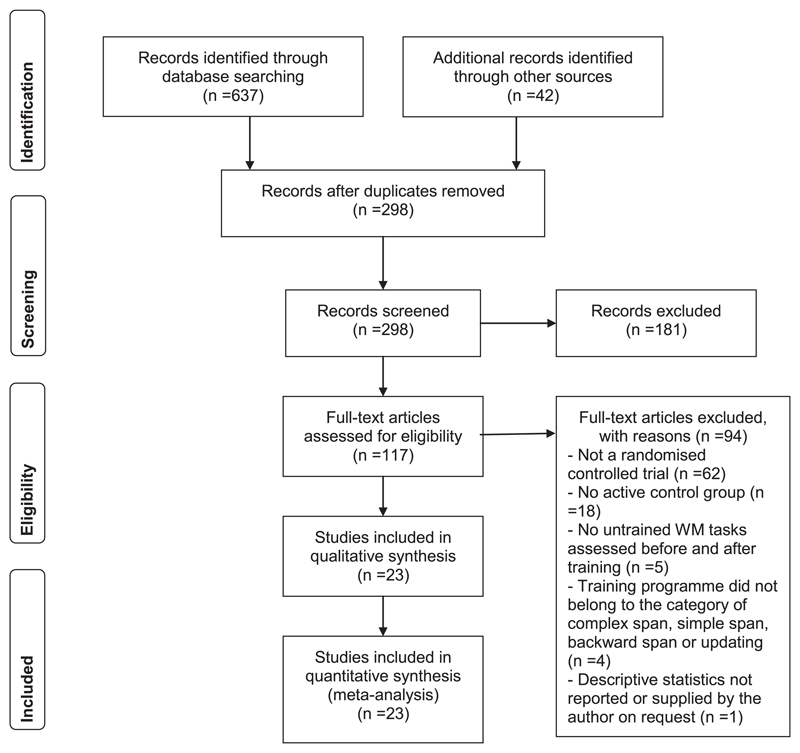
We present a new framework characterizing training-induced changes in WM as the acquisition of novel cognitive routines akin to learning a new skill. Predictions were tested in three studies analyzing the transfer between WM tasks following WM training. Study 1 reports a meta-analysis establishing substantial transfer when trained and untrained tasks shared either a serial recall, complex span or backward span paradigm. Transfer was weaker for serial recall of verbal than visuo-spatial material, suggesting that this paradigm is served by an existing verbal STM system and does not require a new routine. Re-analysis of published WM training data in Study 2 showed that transfer was restricted to tasks sharing properties proposed to require new routines. In a re-analysis of data from four studies, Study 3 demonstrated that transfer was greatest for children with higher fluid cognitive abilities. These findings suggest that development of new routines depends on general cognitive resources and that they can only be applied to other similarly-structured tasks.
Keywords: Cognitive routine; Training; Transfer; Working memory.
Conflict of interest statement
Declaration of interests None.
Figures
References
-
- Åkerlund E, Esbjörnsson E, Sunnerhagen KS, Björkdahl A. Can computerized working memory training improve impaired working memory, cognition and psychological health. Brain Injury. 2013;27(13–14):1649–1657. - PubMed
-
- Alloway TP. Automated working memory assessment. Pearson Publishing; 2007.
-
- Anders TR, Lillyquist TD. Retrieval time in forward and backward recall. Psychonomic Science. 1971;22(4):205–206.
Grants and funding
LinkOut - more resources
Full Text Sources