


Time to Recovery of Feeding After Alveolar Bone Graft Is Associated With Postoperative Nausea and Vomiting Within 2 Hours in Children
- PMID: 31236013
- PMCID: PMC6572887
- DOI: 10.1177/1179556519855387
Time to Recovery of Feeding After Alveolar Bone Graft Is Associated With Postoperative Nausea and Vomiting Within 2 Hours in Children
Abstract
Objective: To examine the relationship between the method of anesthesia for alveolar bone graft surgery and postoperative nausea and vomiting (PONV) based on the difference in surgical timing and to assess factors related to the postoperative quality of life.
Design: Retrospective observational study.
Setting: Hospital.
Participants: Patients with cleft lip and palate who underwent alveolar bone graft surgery under general anesthesia. The subjects were divided into two groups based on surgical timing: secondary bone graft (SBG) and late secondary bone graft (LSBG) groups.
Main outcome measures: Relationship between time to recovery of feeding and the types of anesthesia, PONV, and postoperative pain period.
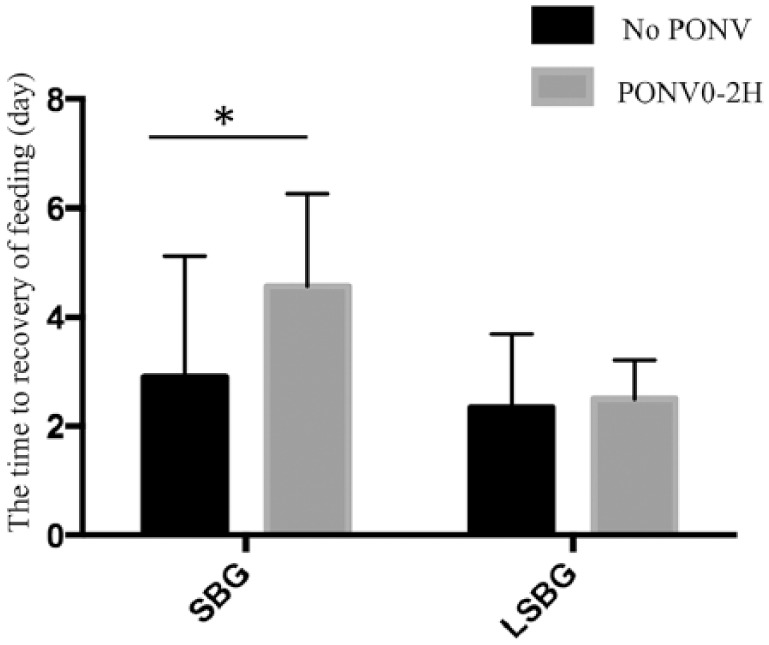
Results: The mean patient age was 9.97 ± 1.33 years in the SBG group and 15.39 ± 0.31 years in the LSBG group. In the SBG group, patients who were administered fentanyl or remifentanil had significantly higher incidence of PONV than those who were not administered these drugs. In the SBG group, the time to recovery of feeding was significantly longer in patients experiencing PONV within 2 hours or that lasted for 24 hours than in those without PONV. In the LSBG group, there was no significant difference regarding any of the above factors.
Conclusions: Our results suggest that the occurrence of PONV within 2 hours or lasting for 24 hours postoperatively in school-age children prolonged the time to recovery of feeding. This indicates that the time to recovery of feeding can be predicted based on the occurrence of PONV within the first 2 hours.
Keywords: alveolar bone graft; children; postoperative nausea and vomiting; time to recovery after feeding.
Conflict of interest statement
Declaration of Conflicting Interests:The author(s) declared no potential conflicts of interest with respect to the research, authorship, and/or publication of this article.
Figures
References
-
- Bergland O, Semb G, Abyholm FE. Elimination of the residual alveolar cleft by secondary bone grafting and subsequent orthodontic treatment. Cleft Palate J. 1986;23:175–205. - PubMed
-
- Kazemi A, Stearns JW, Fonseca RJ. Secondary grafting in the alveolar cleft patient. Oral Maxillofac Surg Clin North Am. 2002;14:477–490. - PubMed
-
- Elhaddaoui R, Bahije L, Zaoui F, Rerhrhaye W. Timing of alveolar bone graft and sequences of canine eruption in cases of cleft lip and palate: a systematic review. Orthod Fr. 2017;88:193–198. - PubMed
-
- Bordes M, Cros AM. Inhalation induction with sevoflurane in paediatrics: what is new? Ann Fr Anesth Reanim. 2006;25:413–416. - PubMed
LinkOut - more resources
Full Text Sources
