


Interbreeding between local and translocated populations of a cleaner fish in an experimental mesocosm predicts risk of disrupted local adaptation
- PMID: 31236251
- PMCID: PMC6580302
- DOI: 10.1002/ece3.5246
Interbreeding between local and translocated populations of a cleaner fish in an experimental mesocosm predicts risk of disrupted local adaptation
Abstract
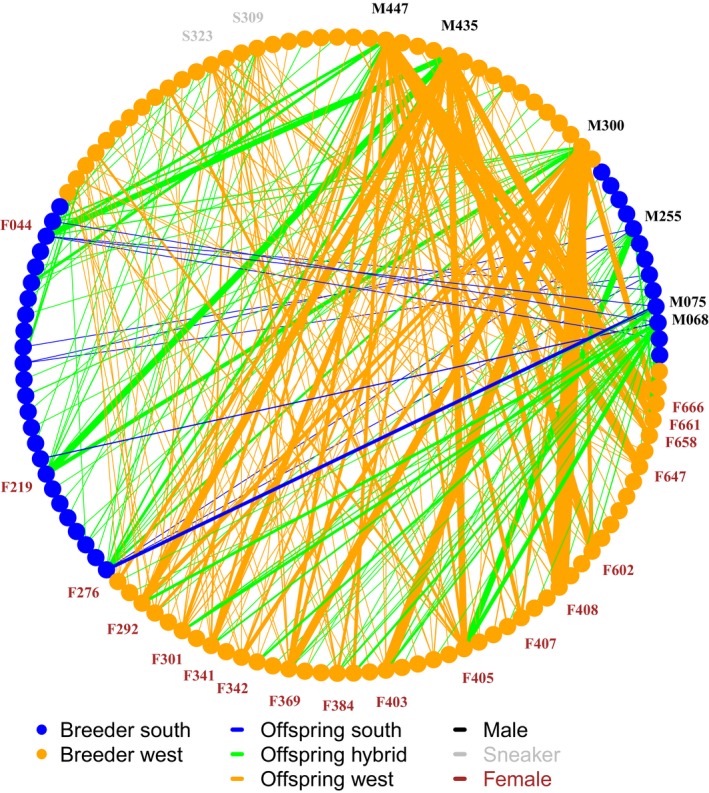
Translocation of organisms within or outside its native range carries the risk of modifying the community of the recipient ecosystems and induces gene flow between locally adapted populations or closely related species. In this study, we evaluated the genetic consequences of large-scale translocation of cleaner wrasses that has become a common practice within the salmon aquaculture industry in northern Europe to combat sea lice infestation. A major concern with this practice is the potential for hybridization of escaped organisms with the local, recipient wrasse population, and thus potentially introduce exogenous alleles and breaking down coadapted gene complexes in local populations. We investigated the potential threat for such genetic introgressions in a large seminatural mesocosm basin. The experimental setting represented a simulated translocation of corkwing wrasse (Symphodus melops) that occurs on a large scale in the Norwegian salmon industry. Parentage assignment analysis of mesocosm's offspring revealed 30% (195 out of 651 offspring) interbreeding between the two populations, despite their being genetically (F ST = 0.094, p < 0.05) and phenotypically differentiated. Moreover, our results suggest that reproductive fitness of the translocated western population doubled that of the local southern population. Our results confirm that human translocations may overcome the impediments imposed by natural habitat discontinuities and urge for immediate action to manage the genetic resources of these small benthic wrasses.
Keywords: Symphodus melops; corkwing wrasse; mating behavior; microsatellites; parentage assignment; reproductive fitness.
Conflict of interest statement
None declared.
Figures
References
-
- Almada, F. , Francisco, S. M. , Lima, C. S. , FitzGerald, R. , Mirimin, L. , Villegas‐Ríos, D. , … Robalo, J. I. (2017). Historical gene flow constraints in a northeastern Atlantic fish: Phylogeography of the ballan wrasse Labrus bergylta across its distribution range. Royal Society Open Science, 4, 160773 10.1098/rsos.160773 - DOI - PMC - PubMed
-
- Araki, H. , & Schmidt, H. (2010). Is hatchery stocking a help or harm? Evidence, limitations and future directions in ecological and genetic surveys. Aquaculture, 308, S2–S11. 10.1016/j.aquaculture.2010.05.036 - DOI
LinkOut - more resources
Full Text Sources
