


Testing a Motivational Interviewing Implementation Intervention in Adolescent HIV Clinics: Protocol for a Type 3, Hybrid Implementation-Effectiveness Trial
- PMID: 31237839
- PMCID: PMC6682301
- DOI: 10.2196/11200
Testing a Motivational Interviewing Implementation Intervention in Adolescent HIV Clinics: Protocol for a Type 3, Hybrid Implementation-Effectiveness Trial
Abstract
Background: Motivational interviewing (MI) has been shown to effectively improve self-management for youth living with HIV (YLH) and has demonstrated success across the youth HIV care cascade-currently, the only behavioral intervention to do so. Substantial barriers prevent the effective implementation of MI in real-world settings. Thus, there is a critical need to understand how to implement evidence-based practices (EBPs), such as MI, and promote behavior change in youth HIV treatment settings as risk-taking behaviors peak during adolescence and young adulthood.
Objective: This study aims to describe the Adolescent Medicine Trials Network for HIV/AIDS Interventions (ATN) protocol of a tailored MI (TMI) implementation-effectiveness trial (ATN 146 TMI) to scale up an EBP in multidisciplinary adolescent HIV settings while balancing flexibility and fidelity. This protocol is part of the Scale It Up program described in this issue.
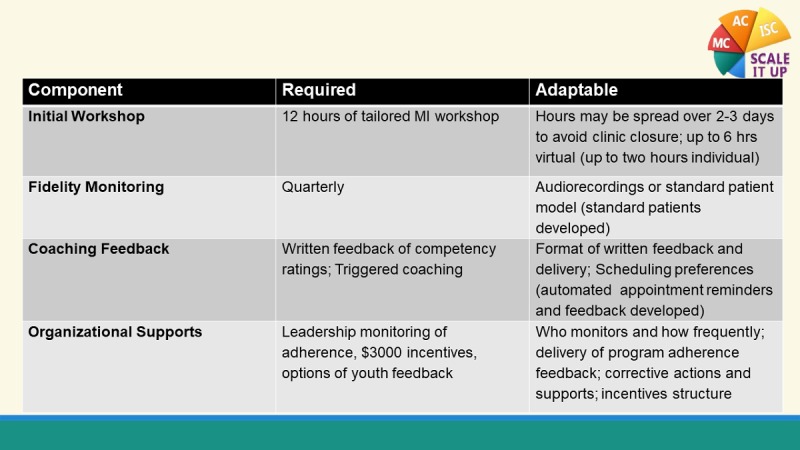
Methods: This study is a type 3, hybrid implementation-effectiveness trial that tests the effect of TMI on fidelity (MI competency and adherence to program requirements) while integrating findings from two other ATN protocols described in this issue-ATN 153 Exploration, Preparations, Implementation, Sustainment and ATN 154 Cascade Monitoring. ATN 153 guides the mixed methods investigation of barriers and facilitators of implementation, while ATN 154 provides effectiveness outcomes. The TMI study population consists of providers at 10 adolescent HIV care sites around the United States. These 10 clinics are randomly assigned to 5 blocks to receive the TMI implementation intervention (workshop and trigger-based coaching guided by local implementation teams) utilizing the dynamic wait-listed controlled design. After 12 months of implementation, a second randomization compares a combination of internal facilitator coaching with the encouragement of communities of practice (CoPs) to CoPs alone. Participants receive MI competency assessments on a quarterly basis during preimplementation, during the 12 months of implementation and during the sustainment period for a total of 36 months. We hypothesize that MI competency ratings will be higher among providers during the TMI implementation phase compared with the standard care phase, and successful implementation will be associated with improved cascade-related outcomes, namely undetectable viral load and a greater number of clinic visits among YLH.
Results: Participant recruitment began in August 2017 and is ongoing. As of mid-May 2018, TMI has 150 active participants.
Conclusions: This protocol describes the underlying theoretical framework, study design, measures, and lessons learned for TMI, a type 3, hybrid implementation-effectiveness trial, which has the potential to scale up MI and improve patient outcomes in adolescent HIV settings.
Trial registration: ClinicalTrials.gov NCT03681912; https://clinicaltrials.gov/ct2/show/NCT03681912 (Archived by WebCite at http://www.webcitation.org/754oT7Khx).
International registered report identifier (irrid): DERR1-10.2196/11200.
Keywords: implementation science; motivational interviewing; youth living with HIV.
©Sylvie Naar, Karen MacDonell, Jason E Chapman, Lisa Todd, Sitaji Gurung, Demetria Cain, Rafael E Dilones, Jeffrey T Parsons. Originally published in JMIR Research Protocols (http://www.researchprotocols.org), 07.06.2019.
Conflict of interest statement
Conflicts of Interest: None declared.
Figures

References
-
- Pangaea Global AIDS Foundation . Report from the Expert Consultation on Implementation Science Research: A Requirement for Effective HIV/AIDS Prevention and Treatment Scale-Up. Cape Town, South Africa: Pangaea Global AIDS Foundation; 2009.
-
- Eccles MP, Armstrong D, Baker R, Cleary K, Davies H, Davies S, Glasziou P, Ilott I, Kinmonth A, Leng G, Logan S, Marteau T, Michie S, Rogers H, Rycroft-Malone J, Sibbald B. An implementation research agenda. Implement Sci. 2009 Apr 07;4:18. doi: 10.1186/1748-5908-4-18. https://implementationscience.biomedcentral.com/articles/10.1186/1748-59... 1748-5908-4-18 - DOI - PMC - PubMed
-
- Cross WF, West JC. Examining implementer fidelity: Conceptualizing and measuring adherence and competence. J Child Serv. 2011;6(1):18–33. doi: 10.5042/jcs.2011.0123. http://europepmc.org/abstract/MED/21922026 - DOI - PMC - PubMed
-
- Norton WE, Amico KR, Cornman DH, Fisher WA, Fisher JD. An agenda for advancing the science of implementation of evidence-based HIV prevention interventions. AIDS Behav. 2009 Jun;13(3):424–9. doi: 10.1007/s10461-009-9556-8. http://europepmc.org/abstract/MED/19360464 - DOI - PMC - PubMed
-
- Schackman BR. Implementation science for the prevention and treatment of HIV/AIDS. J Acquir Immune Defic Syndr. 2010 Dec;55 Suppl 1:S27–31. doi: 10.1097/QAI.0b013e3181f9c1da. http://europepmc.org/abstract/MED/21045596 00126334-201012011-00006 - DOI - PMC - PubMed
Associated data
Grants and funding
LinkOut - more resources
Full Text Sources
Medical
Molecular Biology Databases
Research Materials
