Controlled Clinical Trial
. 2019 Nov-Dec;7(8):2790-2800.e15.
doi: 10.1016/j.jaip.2019.06.011. Epub 2019 Jun 22.

Abatacept as a Long-Term Targeted Therapy for LRBA Deficiency

Affiliations
Controlled Clinical Trial

Abatacept as a Long-Term Targeted Therapy for LRBA Deficiency

Ayca Kiykim et al. J Allergy Clin Immunol Pract. 2019 Nov-Dec.

Abstract

Background: LPS-responsive beige-like anchor (LRBA) deficiency presents with susceptibility to infections, autoimmunity, and lymphoproliferation. The long-term efficacy of cytotoxic T-lymphocyte-associated antigen 4-immunoglobulin (abatacept) as targeted therapy for its immune dysregulatory features remains to be established.

Objective: To determine the clinical and immunologic features of LRBA deficiency and long-term efficacy of abatacept treatment in controlling the different disease manifestations.

Methods: Twenty-two LRBA-deficient patients were recruited from different immunology centers and followed prospectively. Eighteen patients on abatacept were evaluated every 3 months for long-term clinical and immunologic responses. LRBA expression, lymphocyte subpopulations, and circulating T follicular helper cells were determined by flow cytometry.

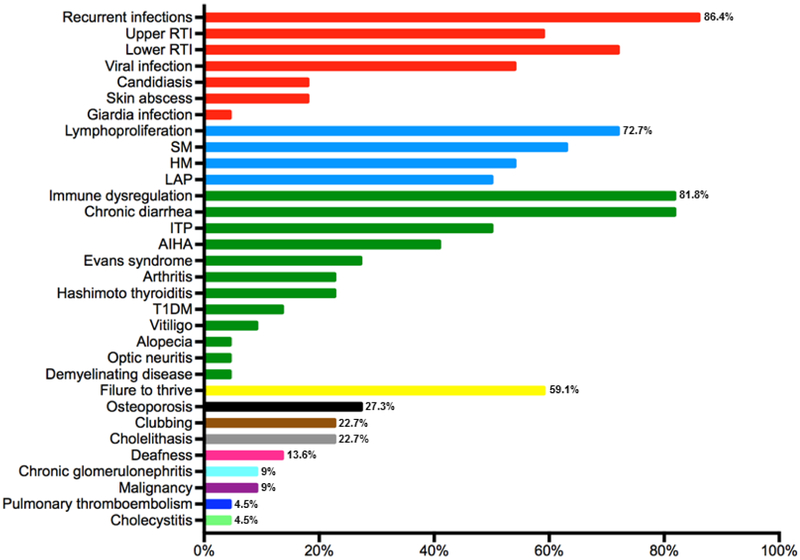
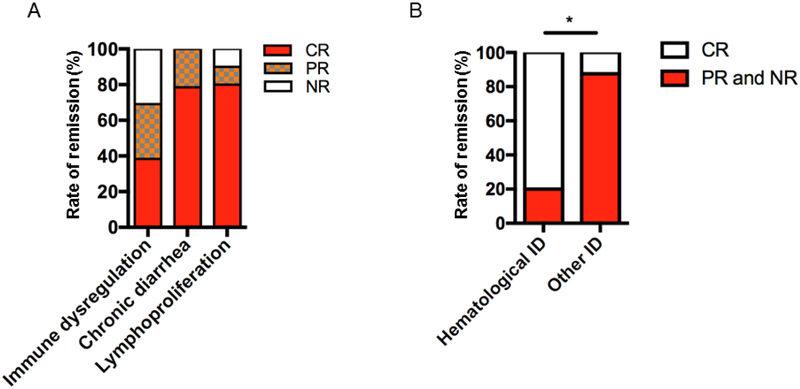
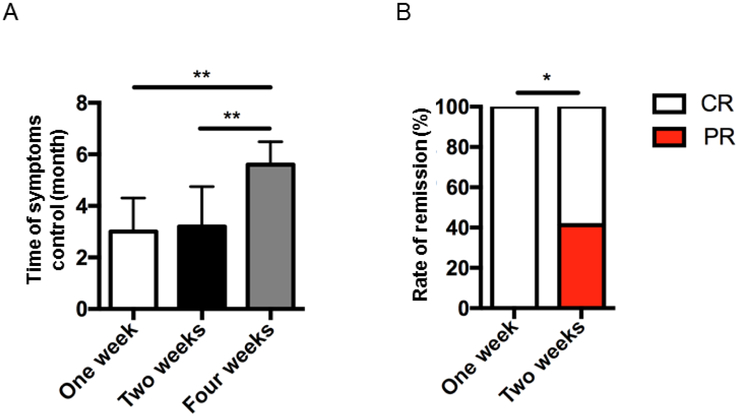
Results: The mean age of the patients was 13.4 ± 7.9 years, and the follow-up period was 3.4 ± 2.3 years. Recurrent infections (n = 19 [86.4%]), immune dysregulation (n = 18 [81.8%]), and lymphoproliferation (n = 16 [72.7%]) were common clinical features. The long-term benefits of abatacept in 16 patients were demonstrated by complete control of lymphoproliferation and chronic diarrhea followed by immune dysregulation, most notably autoimmune cytopenias. Weekly or every other week administration of abatacept gave better disease control compared with every 4 weeks. There were no serious side effects related to the abatacept therapy. Circulating T follicular helper cell frequencies were found to be a reliable biomarker of disease activity, which decreased on abatacept therapy in most subjects. However, high circulating T follicular helper cell frequencies persisted in 2 patients who had a more severe disease phenotype that was relatively resistant to abatacept therapy.

Conclusions: Long-term abatacept therapy is effective in most patients with LRBA deficiency.

Keywords: Abatacept; Autoimmunity; Immune dysregulation; LPS-responsive beige-like anchor; T follicular helper cells.


Conflict of interest statement

Conflict of interest: Authors declare no conflict of interest.

Figures

Figure 1.
Figure 1.
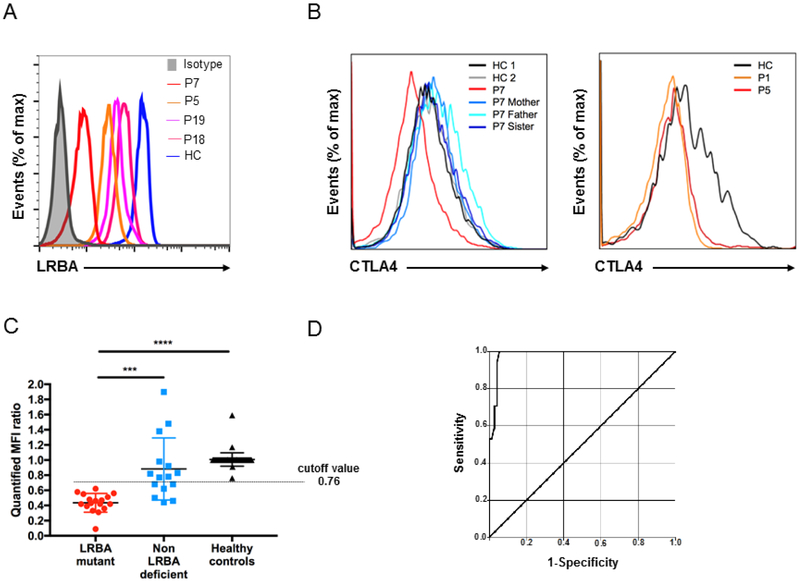
LRBA-deficient patients have low or absent LRBA and CTLA4 protein expression. A, LRBA expression in lymphocytes from LRBA-deficient patients, P7 (red line), P5 (orange line), P19 (purple line) and P18 (pink line) compared with a healthy control (blue line). B, Flow cytometric analysis demonstrates low CTLA4 expression on CD4+FOXP3+ Treg cells in LRBA-deficient patients P1, P5, and P7 compared to healthy controls (HC) and unaffected family members. C, LRBA mutant patients (red dots) have significantly decreased mean fluorescence intensity (MFI) ratio of LRBA expression in peripheral blood mononuclear cells compared to non-LRBA-deficient (blue dots) and healthy controls (black dots). D, Receiver operating characteristic (ROC) curve analysis shows the sensitivity and specificity of flow cytometric analysis for the detection of LRBA-deficient patients. The analysis was conducted on 17 mutation-verified LRBA-deficient patients, 15 patients who presented with a LRBA phenotype but had no LRBA mutation and 57 healthy controls. Area under curve was yielded as 0.98 with a 95% CI (0.96-1.00). *** p<.001 and **** p<.0001, Student unpaired 2-tailed t-test.
Figure 2.
Figure 2.
Clinical features of LRBA-deficient patients. The bars are depicted as percentages. The disease symptom clusters are indicated with different colors. Red bars show infections, blue bars denote lymphoproliferation, green bars demonstrate immune dysregulation, yellow bar shows failure to thrive, black bar indicates osteoporosis, brown bar represents clubbing, silver bar indicates cholelithasis, pink bar show deafness, light blue, purple, dark blue and light green bars indicate chronic glomerulonephritis, malignancy, pulmonary thromboembolism and cholecystitis, respectively. RTI, respiratory tract infection; SM, splenomegaly; HM, hepatomegaly; LAP, lymphadenopathy; ITP, immune thrombocytopenia; AIHA, autoimmune hemolytic anemia; T1DM, type 1 diabetes mellitus.
Figure 3.
Figure 3.
LRBA disease symptoms display different responses to abatacept treatment. A, The remission rates for immune dysregulation (ID), chronic diarrhea and lymphoproliferation. B, The comparison of the remission rates of hematological ID (autoimmune hemolytic anemia, immune thrombocytopenia) versus other immune dysregulatory symptomatologies (Diabetes, alopecia, arthritis, demyelinating disease, granulomatous-lymphocytic interstitial lung disease). The remissions are indicated as complete (CR), partial (PR) or non-responsive (NR). The bars are presented as percentages. * p<.01, Chi-square test.
Figure 4.
Figure 4.
Various complete remission rates in LRBA-deficient patients after treatment with abatacept according to dosing interval. A, The complete remission (CR) rates in patients received abatacept with one-week or two-weeks interval in comparison to four-weeks. C, The percentages of CR or partial remission (PR) rate in LRBA-deficient patients in terms of dose interval. ** p<.01, 1-way ANOVA test, * p<.05, Chi-square test.
Figure 5.
Figure 5.
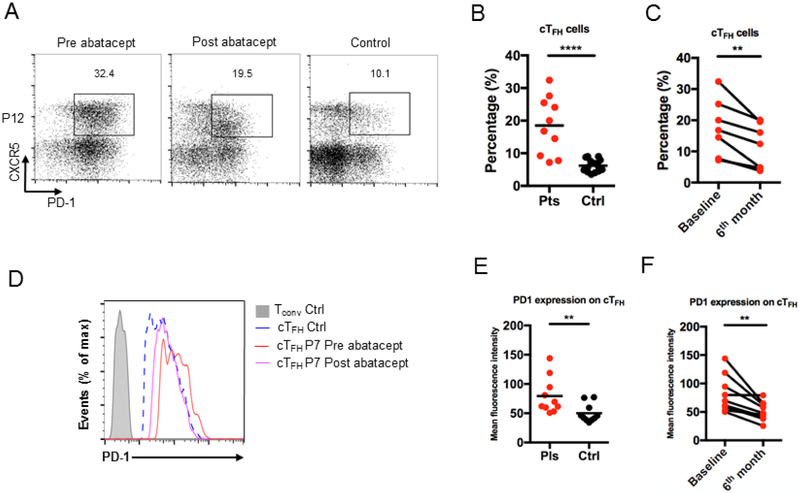
LRBA-deficient patients have increased activated cTFH cells at baseline, which are normalized after abatacept treatment. Flow cytometric analysis of CXCR5 and PD-1 expression in CD4+ T cells in LRBA-deficient patients before (A, B) and after (A, C) treatment with abatacept. PD-1 expression on patients’ cTFH cells before (D, E) and after (D, F) abatacept treatment. **** p<.0001, ** p<.01, Student unpaired and paired 2-tailed t-test.
Figure 6.
Figure 6.
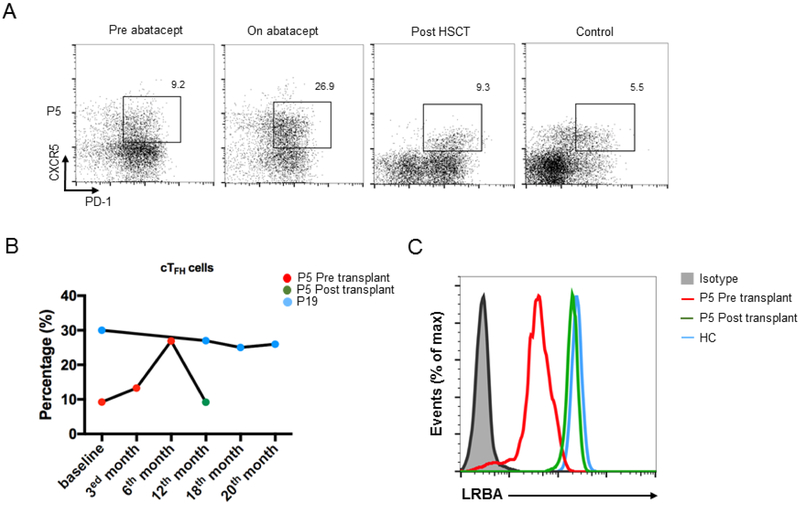
The cTFH cells guide the disease activity in LRBA patients. A. Flow cytometric analysis of CXCR5 and PD-1 expression in CD4+ T cells in patient (P5) at baseline, on abatacept and after HSCT compared to the healthy control. B. The change of cTFH cells percentages in LRBA-deficient patients on abatacept (P5, P19) and after transplantation (P5). C. The LRBA protein expression in P5 after transplant compared to the baseline level and healthy control.

Comment in

References

    1. Lo B, Zhang K, Lu W, Zheng L, Zhang Q, Kanellopoulou C, et al. AUTOIMMUNE DISEASE. Patients with LRBA deficiency show CTLA4 loss and immune dysregulation responsive to abatacept therapy. Science. 2015;349(6246):436–40. - PubMed
    1. Lo B, Fritz JM, Su HC, Uzel G, Jordan MB, Lenardo MJ. CHAI and LATAIE: new genetic diseases of CTLA-4 checkpoint insufficiency. Blood. 2016;128(8):1037–42. - PMC - PubMed
    1. Walker LSK. EFIS Lecture: Understanding the CTLA-4 checkpoint in the maintenance of immune homeostasis. Immunol Lett. 2017;184:43–50. - PubMed
    1. Kuehn HS, Ouyang W, Lo B, Deenick EK, Niemela JE, Avery DT, et al. Immune dysregulation in human subjects with heterozygous germline mutations in CTLA4. Science. 2014;345(6204):1623–7. - PMC - PubMed
    1. Schubert D, Bode C, Kenefeck R, Hou TZ, Wing JB, Kennedy A, et al. Autosomal dominant immune dysregulation syndrome in humans with CTLA4 mutations. Nat Med. 2014;20(12):1410–6. - PMC - PubMed

Publication types