


Heart failure hospitalization reduction and cost savings achieved by improved delivery of effective biventricular pacing: economic implications of the OLE study under the US setting
- PMID: 31239735
- PMCID: PMC6559257
- DOI: 10.2147/CEOR.S205501
Heart failure hospitalization reduction and cost savings achieved by improved delivery of effective biventricular pacing: economic implications of the OLE study under the US setting
Abstract
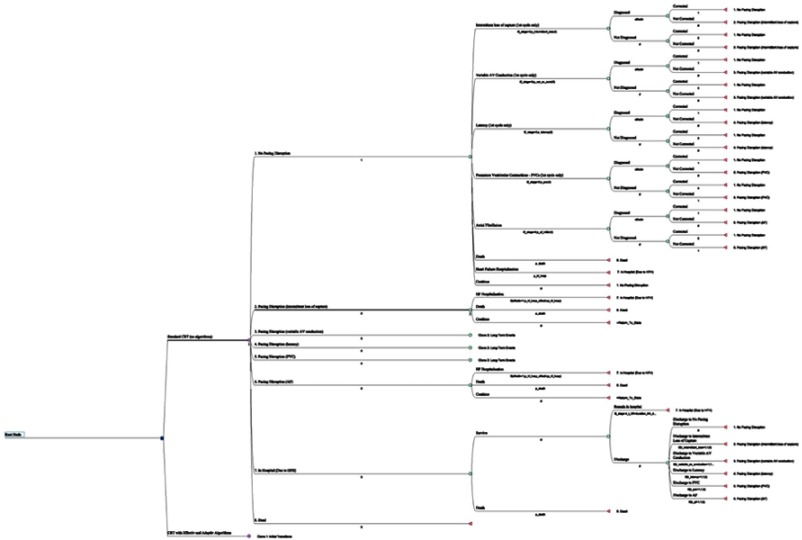
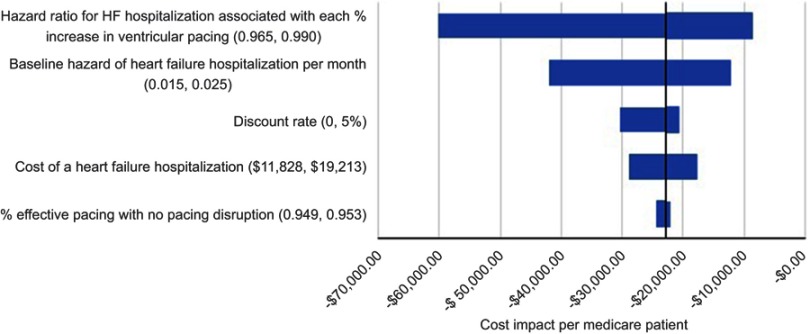
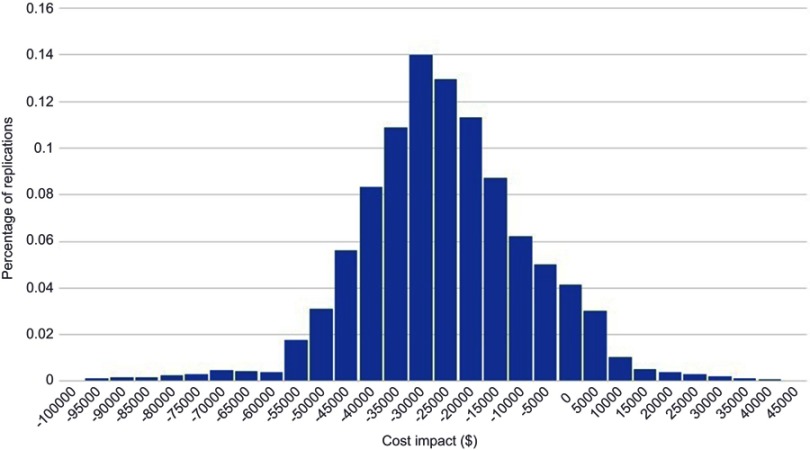
Background: The hOLter for Efficacy analysis (OLE) study demonstrated that current device pacing diagnostics overestimate the amount of cardiac resynchronization therapy (CRT) pacing that effectively stimulates the cardiac tissue. Sub-optimal pacing increases mortality, hospitalizations, and associated health-care costs. We sought to estimate the expected number of hospital admissions due to heart failure (HF) and its respective financial impact in patients with maximized effective pacing versus conventional pacing. Methods: A Markov model was developed to project HF hospitalizations and quantify the costs that could be avoided if pacing was maximally effective. OLE data were used to inform the prevalence of ineffective pacing among CRT patients and and average loss of pacing by causes. Adaptive CRT trial data quantified the reduction in underlying hospitalization risk by increasing effective pacing delivered. Survival was informed by a meta-analysis of 5 randomized clinical trials. Costs were analyzed from a US payer perspective. Results: Projected average hospitalizations totaled 4.58 over a lifetime horizon for CRT patients with conventional pacing. Maximizing effective pacing delivery was projected to avoid 1.83 HF admissions/patient over the lifetime. This equates to a savings of 40% (US$22,802) compared with conventional pacing from the Medicare perspective. In a sensitivity analysis, CRT with effective pacing was projected to provide cost savings in all scenarios. Conclusions: Maximized effective pacing leads to a lower number of HF hospitalizations, thus allowing significant cost offsets in the US setting.
Keywords: cost savings; effective pacing; heart failure; hospitalization reduction; ventricular pacing.
Conflict of interest statement
AHM received consulting fees/honoraria from Medtronic; XL is an employee/shareholder of Medtronic. SIT is an employee/shareholder of Medtronic. DHF is an employee/shareholder of Medtronic. RNK is an employee/shareholder of Medtronic; she also has a patent 86613848 pending. ESC received consulting fees/honoraria from Medtronic. He also received personal fees from Abbott and Boston Scientific, outside the submitted work. The authors report no other conflicts of interest in this work.
Figures
References
-
- Hobbs FD, Kenkre JE, Roalfe AK, Davis RC, Hare R, Davies MK. Impact of heart failure and left ventricular systolic dysfunction on quality of life: a cross-sectional study comparing common chronic cardiac and medical disorders and a representative adult population. Eur Heart J. 2002;23:1867–1876. - PubMed
-
- Brignole M, Auricchio A, Baron-Esquivias G, et al. 2013 ESC guidelines on cardiac pacing and cardiac resynchronization therapy: the task force on cardiac pacing and resynchronization therapy of the European Society of Cardiology (ESC). Developed in collaboration with the European Heart Rhythm Association (EHRA). Eur Heart J. 2013;34:2281–2329. doi: 10.1093/eurheartj/eht150 - DOI - PubMed
LinkOut - more resources
Full Text Sources
Research Materials
Miscellaneous
