Review
. 2016 Sep;6(3):486-498.
doi: 10.23907/2016.049. Epub 2016 Sep 1.

The Laryngohyoid Complex in Medicolegal Death Investigations

Affiliations
Review

The Laryngohyoid Complex in Medicolegal Death Investigations

Deborrah C Pinto. Acad Forensic Pathol. 2016 Sep.

Abstract

The laryngohyoid complex, composed of the hyoid bone and laryngeal cartilages, can be of interest in the autopsy setting, particularly when injuries are observed. Analysis of trauma to this structure can assist in establishing cause and manner of death. In many situations, the forensic anthropologist, with their expertise in analyzing bone and cartilage trauma, can assist in analyzing trauma to this complex. Although researchers have tried to study the relationships between causes of trauma to the osseocartilaginous structure and the observed injury pattern, they have not been successful in identifying unique signatures associated with different causes of trauma. This is because different causes can result in the same or similar injury patterns. In addition, variation due to growth and development or due to remote injury may change the structure's biomechanical response. The goal of this paper is to address issues that a forensic pathologist may encounter when assessing potential trauma to the osseocartilaginous structures of the laryngohyoid complex; in particular, it focuses on anatomical variants and trauma resulting from various causes.

Keywords: Forensic anthropology; Forensic pathology; Hanging; Laryngohyoid complex; Neck trauma; Strangulation.


Conflict of interest statement

DISCLOSURES & DECLARATION OF CONFLICTS OF INTEREST The authors, reviewers, editors, and publication staff do not report any relevant conflicts of interest

Figures
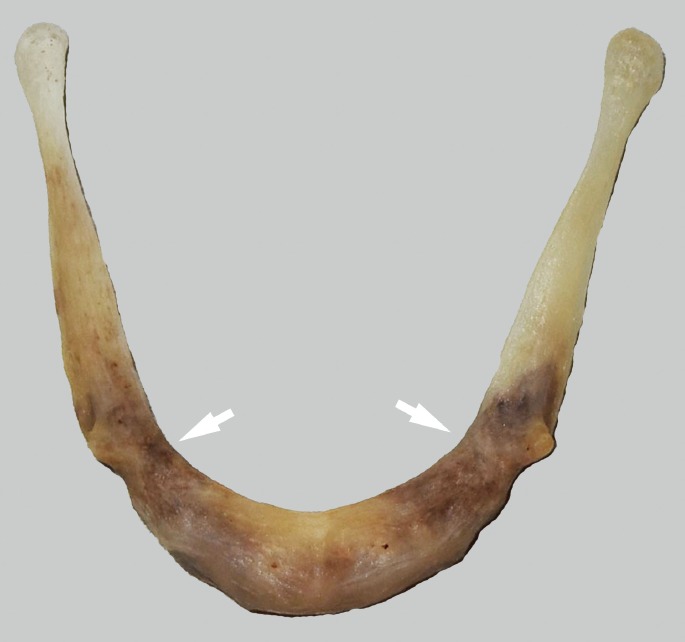
Image 1
Image 1
Superior view of a fused hyoid bone. The white arrows indicate the fused synchondrosis connecting the body and the greater horns. The bone has been chemically processed to remove all soft tissue.
Image 2
Image 2
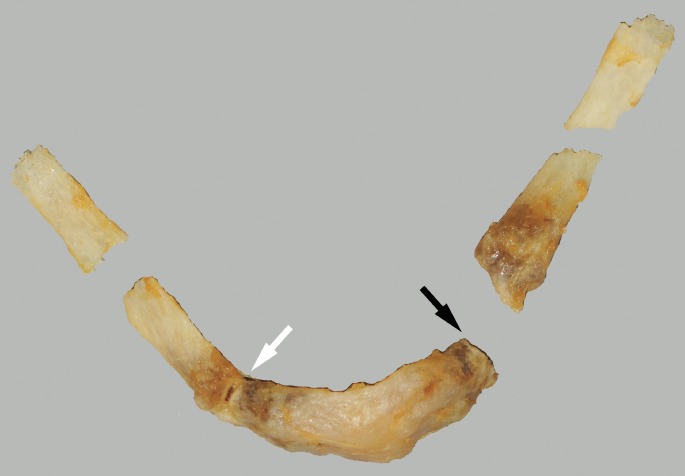
A fractured hyoid from a case of a suicidal hanging. The greater horns are fractured. The white arrow indicates a partially fused synchondrosis. The black arrow indicates an unfused synchondrosis. The bone has been chemically processed. Without removal of all soft tissue, the unfused synchondrosis could be mistaken for a fracture.
Image 3
Image 3
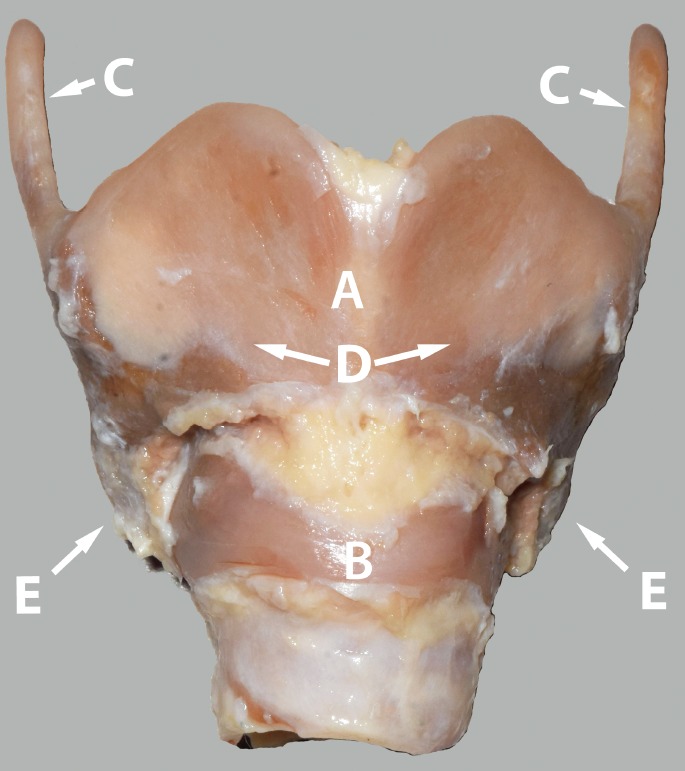
Anterior view of the articulated thyroid and cricoid cartilage. The perichondrium has been removed. A = thyroid cartilage, B = cricoid cartilage, C = superior horns of the thyroid cartilage, D = laminae of the thyroid cartilage, and E = inferior horns of the thyroid cartilage.
Image 4
Image 4
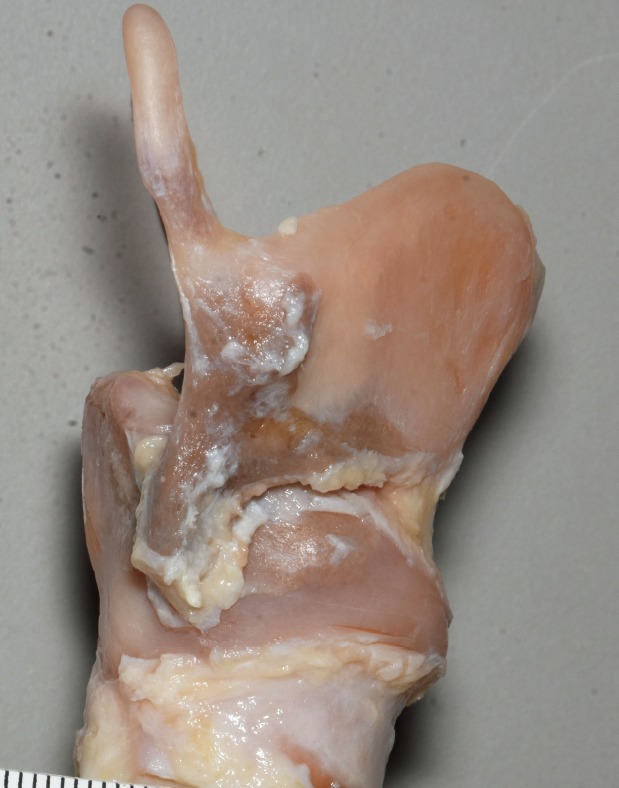
A lateral view of the thyroid-cricoid cartilage complex. Note that the structures are closely connected. The perichondrium has been removed.
Image 5
Image 5
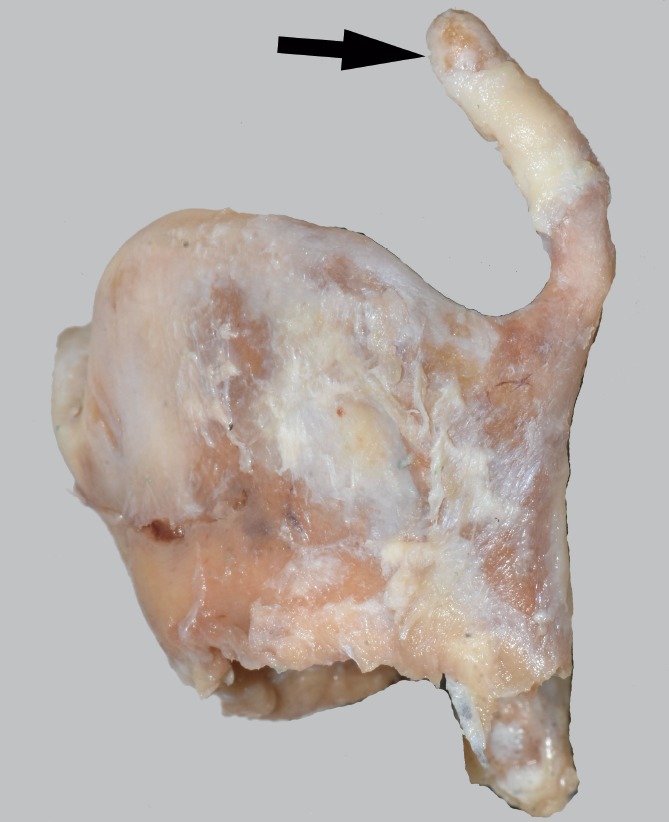
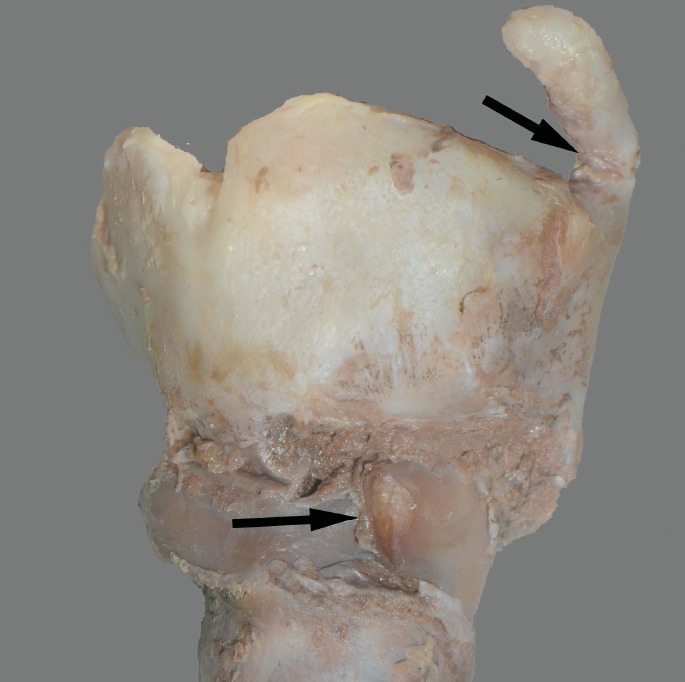
A unilateral triticeal cartilage (black arrow). These can also occur bilaterally.
Image 6
Image 6
Fractured thyroid and cricoid cartilages from a homicide case involving asphyxia with neck compression. The black arrows indicate the fractured left superior thyroid horn and left anterior arch of the cricoid cartilage.

References

    1. Dunsby A.M., Davison A.M. Causes of laryngeal cartilage and hyoid bone fractures found at postmortem. Med Sci Law. 2011. Apr; 51(2): 109–13. PMID: 21793475. 10.1258/msl.2010.010209. - DOI - PubMed
    1. Gray H. Gray's anatomy: the classic collector's edition. New York: Bounty Books; 1977. 1248 p.
    1. Scheurer L., Black S. Developmental juvenile osteology. San Diego: Elsevier Academic Press; 2000. 587 p.
    1. Soerdjbalie-Maikoe V., van Rijn R.R. Embryology, normal anatomy, and imaging techniques of the hyoid and larynx with respect to forensic purposes: a review article. Forensic Sci Med Pathol. 2008; 4(2): 132–9. PMID: 19291485. 10.1007/s12024-008-9032-1. - DOI - PubMed
    1. MacDonald-Jankowski D.S. The synchondrosis between the greater horn and the body of the hyoid bone: a radiological assessment. Dentomaxillofac Radiol. 1990. Nov; 19(4): 171–2. PMID: 2097227. 10.1259/dmfr.194.2097227. - DOI - PubMed