


Analysis of the Qatari R336C cystathionine β-synthase protein in mice
- PMID: 31240737
- PMCID: PMC7336392
- DOI: 10.1002/jimd.12140
Analysis of the Qatari R336C cystathionine β-synthase protein in mice
Abstract
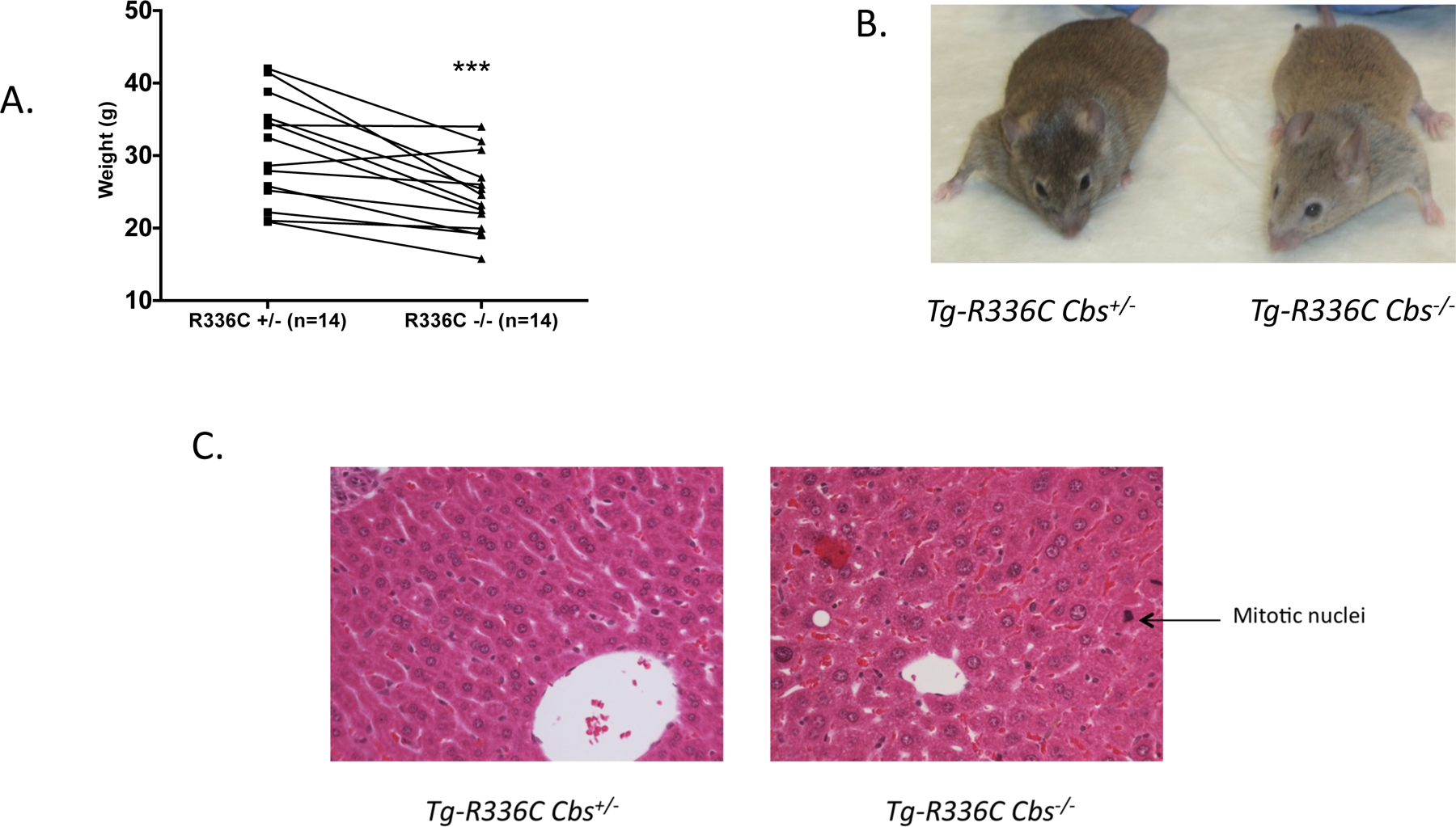
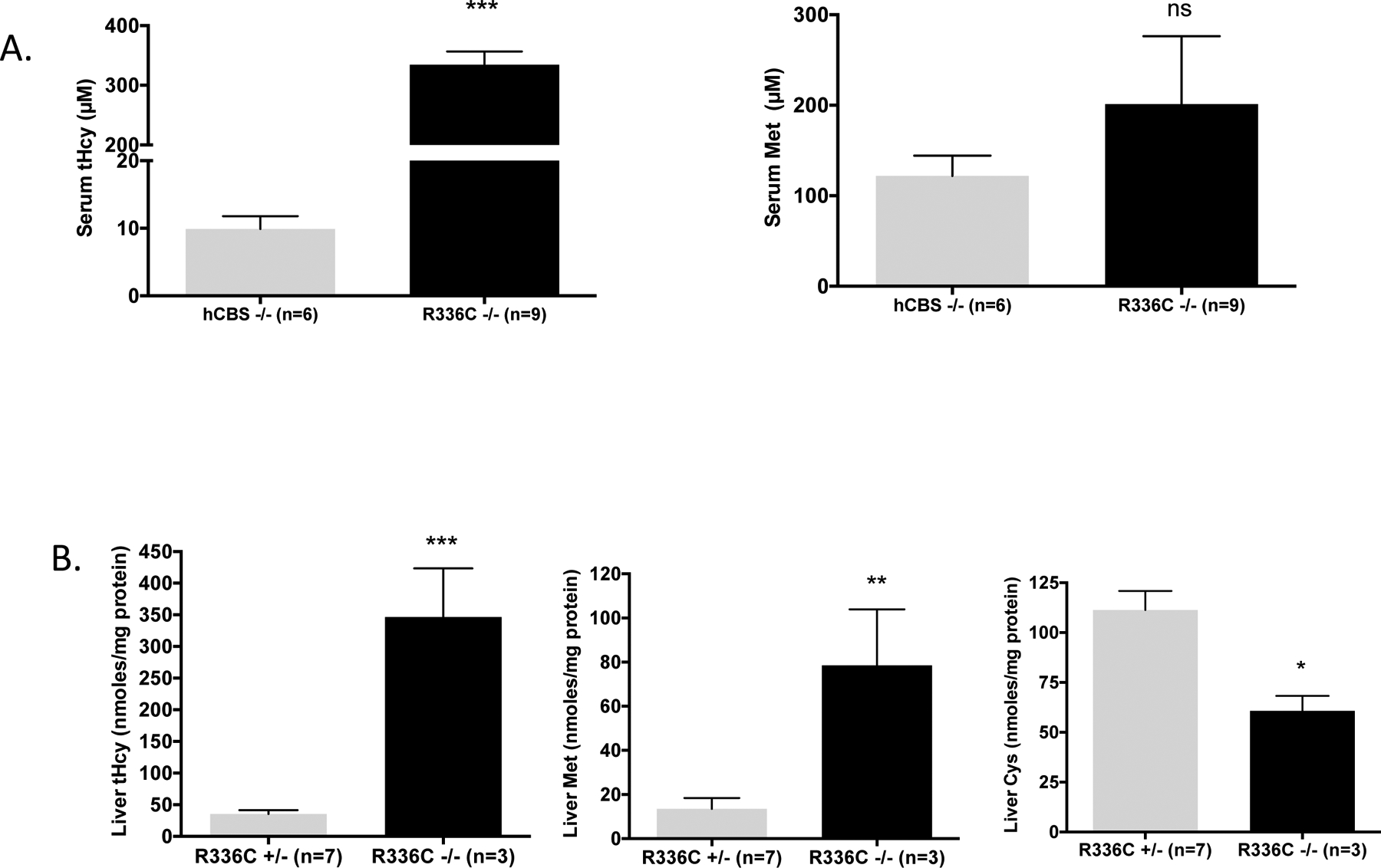
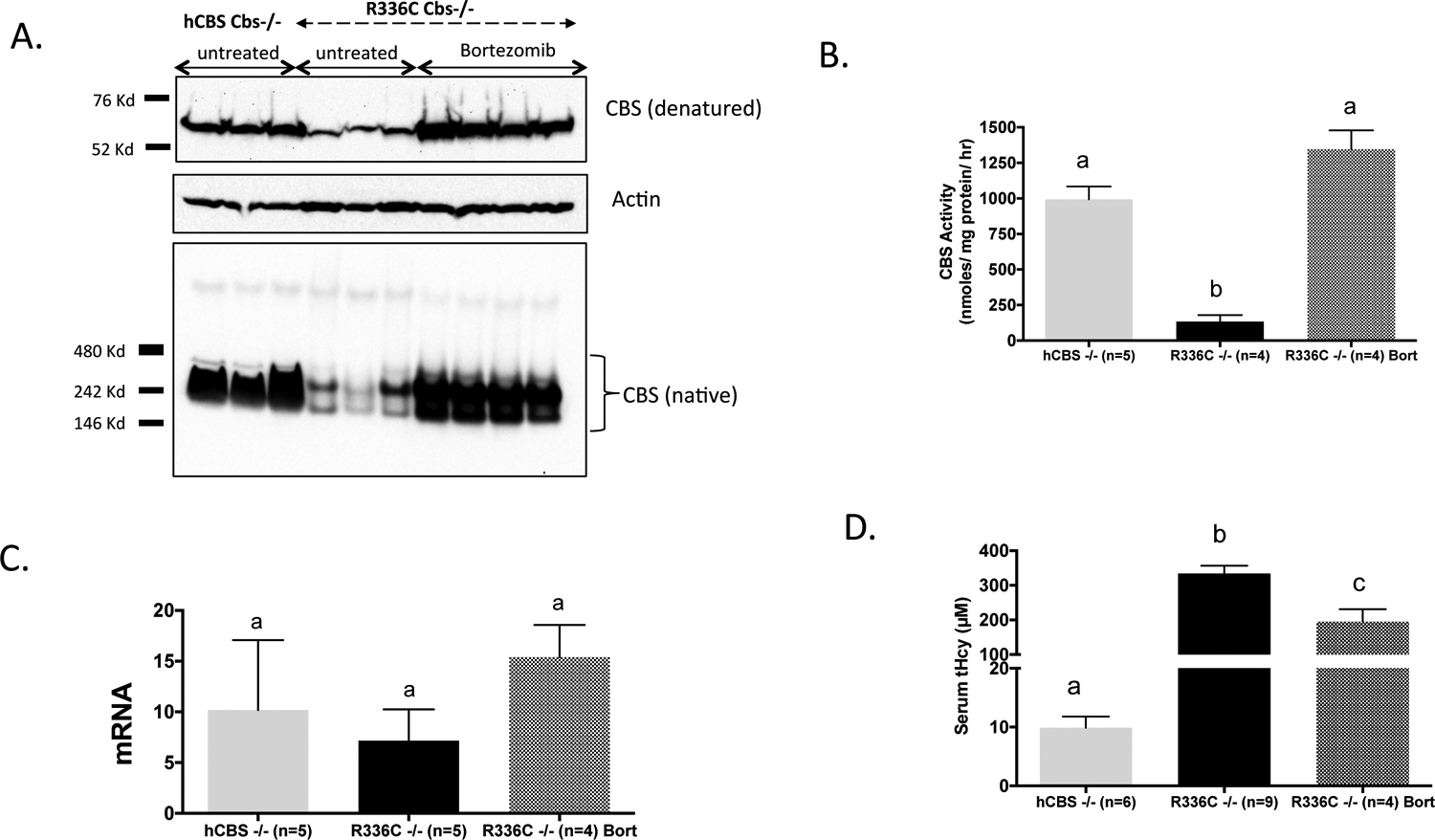
Classical homocystinuria is a recessive inborn error of metabolism caused by mutations in the cystathionine beta-synthase (CBS) gene. The highest incidence of CBS deficiency in the world is found in the country of Qatar due to the combination of high rates of consanguinity and the presence of a founder mutation, c.1006C>T (p.R336C). This mutation does not respond to pyridoxine and is considered severe. Here we describe the creation of a mouse that is null for the mouse Cbs gene and expresses human p.R336C CBS from a zinc-inducible transgene (Tg-R336C Cbs -/- ). Zinc-treated Tg-R336C Cbs -/- mice have extreme elevation in both serum total homocysteine (tHcy) and liver tHcy compared with control transgenic mice. Both the steady-state protein levels and CBS enzyme activity levels in liver lysates from Tg-R336C Cbs -/- mice are significantly reduced compared to that found in Tg-hCBS Cbs -/- mice expressing wild-type human CBS. Treatment of Tg-R336C Cbs -/- mice with the proteasome inhibitor bortezomib results in stabilization of liver CBS protein and an increase in activity to levels found in corresponding Tg-hCBS Cbs -/- wild type mice. Surprisingly, serum tHcy did not fully correct even though liver enzyme activity was as high as control animals. This discrepancy is explained by in vitro enzymatic studies of mouse liver extracts showing that p.R336C causes reduced binding affinity for the substrate serine by almost 7-fold and significantly increased dependence on pyridoxal phosphate in the reaction buffer. These studies demonstrate that the p.R336C alteration effects both protein stability and substrate/cofactor binding.
Keywords: homocysteine; inborn error; metabolism; methionine; missense mutation; mouse model.
© 2019 SSIEM.
Conflict of interest statement
Competing Interest Statement: Authors have no competing interests.
Figures
Similar articles
-
The c.797 G>A (p.R266K) cystathionine β-synthase mutation causes homocystinuria by affecting protein stability.Hum Mutat. 2017 Jul;38(7):863-869. doi: 10.1002/humu.23240. Epub 2017 May 22. Hum Mutat. 2017. PMID: 28488385 Free PMC article.
-
Mouse modeling and structural analysis of the p.G307S mutation in human cystathionine β-synthase (CBS) reveal effects on CBS activity but not stability.J Biol Chem. 2018 Sep 7;293(36):13921-13931. doi: 10.1074/jbc.RA118.002164. Epub 2018 Jul 20. J Biol Chem. 2018. PMID: 30030379 Free PMC article.
-
In silico and in vivo models for Qatari-specific classical homocystinuria as basis for development of novel therapies.Hum Mutat. 2019 Feb;40(2):230-240. doi: 10.1002/humu.23682. Epub 2018 Nov 23. Hum Mutat. 2019. PMID: 30408270 Free PMC article.
-
Cystathionine β-synthase deficiency: Of mice and men.Mol Genet Metab. 2017 Jul;121(3):199-205. doi: 10.1016/j.ymgme.2017.05.011. Epub 2017 May 19. Mol Genet Metab. 2017. PMID: 28583326 Free PMC article. Review.
-
Cystathionine beta-synthase mutations in homocystinuria.Hum Mutat. 1999;13(5):362-75. doi: 10.1002/(SICI)1098-1004(1999)13:5<362::AID-HUMU4>3.0.CO;2-K. Hum Mutat. 1999. PMID: 10338090 Review.
Cited by
-
How to fix a broken protein: restoring function to mutant human cystathionine β-synthase.Hum Genet. 2022 Jul;141(7):1299-1308. doi: 10.1007/s00439-021-02386-w. Epub 2021 Oct 12. Hum Genet. 2022. PMID: 34636997 Free PMC article. Review.
-
Recent therapeutic approaches to cystathionine beta-synthase-deficient homocystinuria.Br J Pharmacol. 2023 Feb;180(3):264-278. doi: 10.1111/bph.15991. Epub 2022 Dec 8. Br J Pharmacol. 2023. PMID: 36417581 Free PMC article. Review.
-
The Spectrum of Mutations of Homocystinuria in the MENA Region.Genes (Basel). 2020 Mar 20;11(3):330. doi: 10.3390/genes11030330. Genes (Basel). 2020. PMID: 32245022 Free PMC article. Review.
-
Examination of two different proteasome inhibitors in reactivating mutant human cystathionine β-synthase in mice.PLoS One. 2023 Jun 15;18(6):e0286550. doi: 10.1371/journal.pone.0286550. eCollection 2023. PLoS One. 2023. PMID: 37319242 Free PMC article.
-
Genetic and Pharmacological Modulation of Cellular Proteostasis Leads to Partial Functional Rescue of Homocystinuria-Causing Cystathionine-Beta Synthase Variants.Mol Cell Biol. 2023;43(12):664-674. doi: 10.1080/10985549.2023.2284147. Epub 2023 Dec 20. Mol Cell Biol. 2023. PMID: 38051092 Free PMC article.
References
-
- Akahoshi N, Kobayashi C, Ishizaki Y, et al. (2008) Genetic background conversion ameliorates semi-lethality and permits behavioral analyses in cystathionine beta-synthase-deficient mice, an animal model for hyperhomocysteinemia. Hum Mol Genet 17: 1994–2005. - PubMed
-
- Balch WE, Morimoto RI, Dillin A, Kelly JW (2008) Adapting proteostasis for disease intervention. Science 319: 916–919. - PubMed
-
- Chen X, Wang L, Fazlieva R, Kruger WD (2006) Contrasting behaviors of mutant cystathionine beta-synthase enzymes associated with pyridoxine response. Hum Mutat 27: 474–482. - PubMed
-
- El-Said MF, Badii R, Bessisso MS, et al. (2006) A common mutation in the CBS gene explains a high incidence of homocystinuria in the Qatari population. Hum Mutat 27: 719. - PubMed
Publication types
MeSH terms
Substances
Grants and funding
LinkOut - more resources
Full Text Sources
Molecular Biology Databases
Miscellaneous
