


Practice and predictors of self-care behaviors among ambulatory patients with hypertension in Ethiopia
- PMID: 31242265
- PMCID: PMC6594646
- DOI: 10.1371/journal.pone.0218947
Practice and predictors of self-care behaviors among ambulatory patients with hypertension in Ethiopia
Abstract
Background: Despite the benefits of evidence-based self-care behaviors in the management of hypertension, hypertensive patients have low rate of adherence to the recommended self-care behaviors. Studies related to self-care behaviors among hypertensive patients are limited in Ethiopia.
Objective: To assess the rate of adherence to self-care behaviors and associated factors among hypertensive patients.
Method: A cross-sectional study was conducted at the cardiac clinic of Ayder comprehensive specialized hospital among ambulatory hypertensive patients. Self-care behaviors were assessed using an adopted Hypertension Self-Care Activity Level Effects (H-SCALE). Data were collected through patient interview and review of medical records. Binary logistic regression analysis was performed to identify predictors of self-care behaviors.
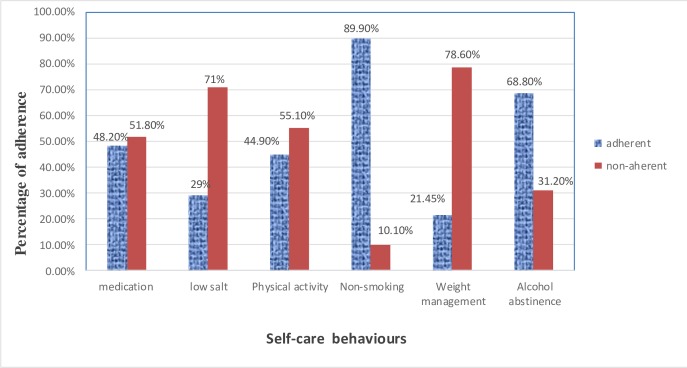
Result: A total of 276 patients were included in the study. The majority of the participants were nonsmokers (89.9%) and alcohol abstainers (68.8%). Less than half of the participants were adherent to the prescribed antihypertensive medications (48.2%) and recommended physical activity level (44.9%). Moreover, only 21.45% and 29% were adherent to weight management and low salt diet recommendations, respectively. Our finding indicated that rural resident (adjusted odds ratio [AOR]: 0.45, 95% confidence interval [CI]: 0.21-0.97), comorbidity (AOR: 0.16, 95% CI: 0.08-0.31), and negative medication belief (AOR: 0.25, 95% CI: 0.14-0.46) were significantly associated with medication adherence. Female sex (AOR: 0.46, 95% CI: 0.23-0.92), old age (AOR: 0.19, 95% CI: 0.06-0.60) and lack of knowledge on self-care behaviors (AOR: 0.13, 95% CI: 0.03-0.57) were significantly associated with adherence to weight management. Female sex (AOR: 1.97, 95% CI: 1.03-3.75) and lack of knowledge on self-care (AOR: 0.07, 95% CI: 0.03-0.16) were significantly associated with adherence to alcohol abstinence. Female sex (AOR: 6.33, 95% CI: 1.80-22.31) and khat chewing (AOR: 0.08, 95% CI: 0.03-0.24) were significantly associated with non-smoking behavior. There was also a significant association between female sex and physical activity (AOR: 0.22, 95% CI: 0.12-0.40).
Conclusion: The rate of adherence to self-care behaviors particularly weight management, low salt intake, physical exercise, and medication intake was low in our study. Elders, females, khat chewers, rural residents, and patients with negative medication belief, comorbidity, and inadequate knowledge of SCBs were less adherent to self-care behaviors compared to their counterparts. Therefore, health care providers should pay more emphasis to patients at risk of having low self-care behaviors.
Conflict of interest statement
The authors have declared that no competing interests exist.
Figures
References
-
- James PA, Oparil S, Carter BL, Cushman WC, Dennison-Himmelfarb C, Handler J, et al. 2014 evidence-based guideline for the management of high blood pressure in adults: report from the panel members appointed to the Eighth Joint National Committee (JNC 8). Jama. 2014;311(5):507–20. 10.1001/jama.2013.284427 - DOI - PubMed
-
- Mills KT, Bundy JD, Kelly TN, Reed JE, Kearney PM, Reynolds K, et al. Global Disparities of Hypertension Prevalence and Control Clinical Perspective: A Systematic Analysis of Population-Based Studies From 90 Countries. Circulation. 2016;134(6):441–50. 10.1161/CIRCULATIONAHA.115.018912 - DOI - PMC - PubMed
-
- Sharifirad G, Mostafavi F, Kamran A, Mohebi S, Mirkarimi K. Perceptions of the hypertensive patients from disease and its treatment: A review article. J Health Syst Res. 2013;9:1–10.
MeSH terms
Substances
LinkOut - more resources
Full Text Sources
Medical
