


Prediction of the Lethal Outcome of Acute Recurrent Cerebral Ischemic Hemispheric Stroke
- PMID: 31242700
- PMCID: PMC6631068
- DOI: 10.3390/medicina55060311
Prediction of the Lethal Outcome of Acute Recurrent Cerebral Ischemic Hemispheric Stroke
Abstract
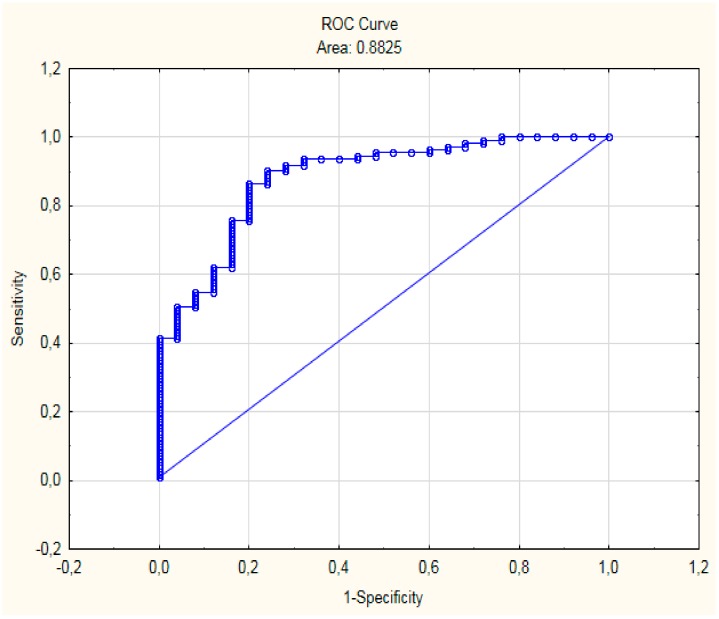
Background and objectives. Stroke-induced mortality is the third most common cause of death in developed countries. Intense interest has focused on the recurrent ischemic stroke, which rate makes up 30% during first 5 years after first-ever stroke. This work aims to develop criteria for the prediction of acute recurrent cerebral ischemic hemispheric stroke (RCIHS) outcome on the basis of comprehensive baseline clinical, laboratory, and neuroimaging examinations. Materials and Methods. One hundred thirty-six patients (71 males and 65 females, median age 74 (65; 78)) with acute RCIHS were enrolled in the study. All patients underwent a detailed clinical and neurological examination using National Institutes of Health Stroke Scale (NIHSS), computed tomography of the brain, hematological, and biochemical investigations. In order to detect the dependent and independent risk factors of the lethal outcome of the acute period of RCIHS, univariable and multivariable regression analysis were conducted. A receiver operating characteristic (ROC) analysis with the calculation of sensitivity and specificity was performed to determine the prediction variables. Results. Twenty-five patients died. The independent predictors of the lethal outcome of acute RCIHS were: Baseline NIHSS score (OR 95% CІ 1.33 (1.08-1.64), p = 0.0003), septum pellucidum displacement (OR 95% CI 1.53 (1.17-2.00), p = 0.0021), glucose serum level (OR 95% CI 1.28 (1.09-1.50), p = 0.0022), neutrophil-to-lymphocyte ratio (OR 95% CI 1.11 (1.00-1.21), p = 0.0303). The mathematical model, which included these variables was developed and it could determine the prognosis of lethal outcome of the acute RCIHS with an accuracy of 86.8% (AUC = 0.88 ± 0.04 (0.88-0.93), p < 0.0001).
Keywords: NLR; National Institutes of Health Stroke Scale (NIHSS); glycemia; outcome; prognosis; recurrent ischemic stroke; septum pellucidum.
Conflict of interest statement
The authors declare no conflict of interest.
References
-
- Feigin V.L., Roth G.A., Naghavi M., Parmar P., Krishnamurthi R., Chugh S., Mensah G.A., Norrving B., Shiue I., Ng M., et al. Global burden of stroke and risk factors in 188 countries, during 1990–2013: A systematic analysis for the global burden of disease study 2013. Lancet Neurol. 2016;15:913–924. doi: 10.1016/S1474-4422(16)30073-4. - DOI - PubMed
-
- Chin Y.Y., Sakinah H., Aryati A., Hass B.M. Prevalence, risk factors and secondary prevention of Stroke recurrence in eight countries from south, east and southeast asia: A scoping review. Med. J. Malays. 2018;73:90–99. - PubMed
MeSH terms
LinkOut - more resources
Full Text Sources
Medical
