Review
. 2019 Jun 26;28(152):190002.
doi: 10.1183/16000617.0002-2019. Print 2019 Jun 30.

Breath analysis of cancer in the present and the future

Affiliations
Review

Breath analysis of cancer in the present and the future

Reef Einoch Amor et al. Eur Respir Rev. .

Abstract

Most of the currently used diagnostics for cancerous diseases have yet to meet the standards of screening, as they are insufficiently accurate and/or invasive and risky. In this review, we describe the rationale, the progress made to date, and the potential of analysing the exhaled volatile organic compounds as a pathway for enabling early diagnosis of cancer and, therefore, for achieving better clinical prognosis and survival rates. The review highlights the major advancements made in this field, from fundamentals, up to translational phases and clinical trials, with a special emphasis on sensing platforms based on nanomaterials. The prospects for breath analysis in early cancerous disease are presented and discussed.


Conflict of interest statement

Conflict of interest: R. Einoch Amor has nothing to disclose. Conflict of interest: M.K. Nakhleh has nothing to disclose. Conflict of interest: O. Barash has nothing to disclose. Conflict of interest: H. Haick has nothing to disclose.

Figures
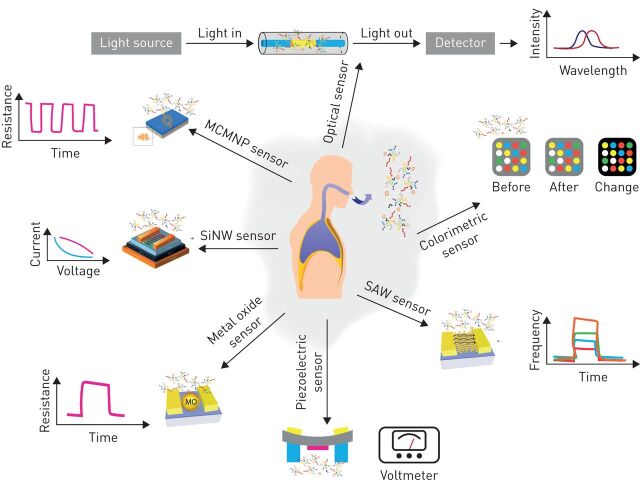
FIGURE 1
FIGURE 1
Nanomaterial-based sensors as a volatolomic analytical platform: simplified working mechanisms. These sensors may be used in medical care in future volatolome-based diagnostic devices. Clockwise: optical sensors, colorimetric sensors, surface acoustic wave (SAW) sensors, piezoelectric sensors, metal oxide (MO) sensors, silicon nanowire (SiNW) sensors and monolayer-coated metal nanoparticle (MCMNP) sensors.
FIGURE 2
FIGURE 2
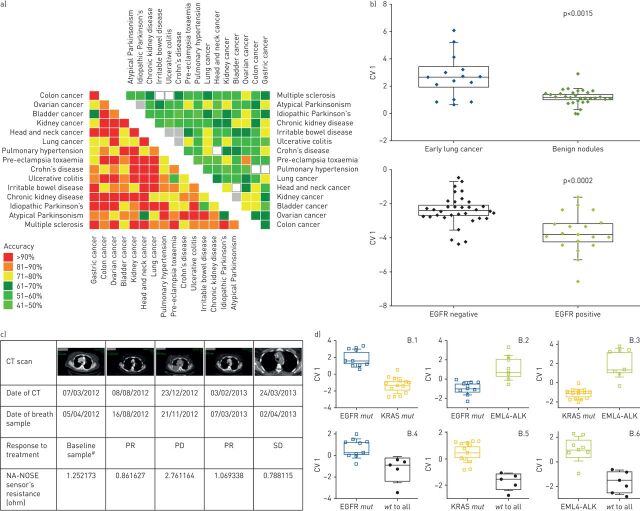
Volatolomics in cancer. a) Discrimination between different cancers: graphical representation for the accuracies calculated of binary discriminant factor analysis (DFA) classifiers for disease classification by breath analysis. The left heat map gives comparisons between patients from each group, including eight cancers, resulting in an average of 86% accuracy. The right heat map represents a comparison of healthy volunteers from each group, resulting in a 58% accuracy. Reproduced and modified from [35] with permission. b) Cancer histology classification and staging: graphical representation of canonical variable (CV) values calculated from the responses of the sensor array to breath samples taken from lung cancer patients at early stages of the disease compared with benign nodules. A volatolomic signature was also calculated for the discrimination between lung cancer patients harbouring the epidermal growth factor receptor (EGFR) mutation and those without. Reproduced and modified from [4] with permission. c) Cancer monitoring: computed tomography (CT) scans from a lung cancer patient undergoing CT follow-up while receiving chemotherapy. Dates of CT scans, as well as of breath samples, are indicated. The corresponding sensor response in ohms is indicated with relation to each CT scan. PR: partial response; PD: progressive disease; SD: stable disease. #: before initiation of treatment. Reproduced and modified from [5] with permission. d) Genetic mutations in cancer: DFA maps calculated from signals obtained from sensor arrays to VOCs in the headspace samples of cell lines bearing different genetic mutations associated with lung cancer (EGFR, KRAS and echinoderm microtubule-associated protein-like 4 (EML4)–anaplastic lymphoma kinase (ALK) fusion). wt: wild type. Reproduced and modified from [46] with permission.
FIGURE 3
FIGURE 3
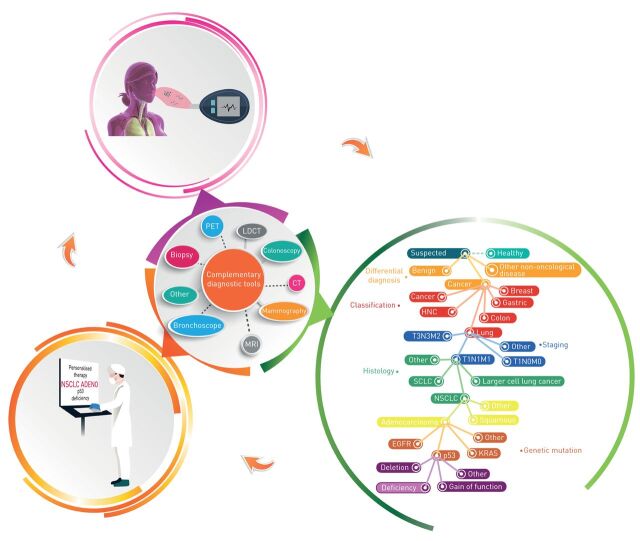
Potential of breath analysis as a complementary diagnostic tool in cancer. This is an illustration of the potential of breath analysis and its implementation as a dependent or complementary test that could be beneficial for cancer management. Noninvasive and easy to perform, volatolome assessment could promote early and differential diagnosis, cancer classification, staging and monitoring. However, extensive research and development are required to increase both clinical performance and integration into real clinical-world conditions. PET: positron emission tomography; CT: computed tomography; LDCT: low-dose CT; MRI: magnetic resonance imaging; HNC: head and neck cancer; SCLC: small cell lung cancer; NSCLC: nonsmall cell lung cancer; EGFR: epidermal growth factor receptor.

References

    1. Lawrence MS, Stojanov P, Polak P, et al. Mutational heterogeneity in cancer and the search for new cancer-associated genes. Nature 2013; 499: 214–218. - PMC - PubMed
    1. Humphrey LL, Deffebach M, Pappas M, et al. Screening for lung cancer with low-dose computed tomography: a systematic review to update the US Preventive Services Task Force recommendation. Ann Intern Med 2013; 159: 411–420. - PubMed
    1. Toyoda Y, Nakayama T, Kusunoki Y, et al. Sensitivity and specificity of lung cancer screening using chest low-dose computed tomography. Br J Cancer 2008; 98: 1602–1607. - PMC - PubMed
    1. Shlomi D, Abud M, Liran O, et al. Detection of lung cancer and EGFR mutation by electronic nose system. J Thorac Oncol 2017; 12: 1544–1551. - PubMed
    1. Nardi-Agmon I, Abud-Hawa M, Liran O, et al. Exhaled breath analysis for monitoring response to treatment in advanced lung cancer. J Thorac Oncol 2016; 11: 827–837. - PubMed

Substances

LinkOut - more resources