


Neural networks versus Logistic regression for 30 days all-cause readmission prediction
- PMID: 31243311
- PMCID: PMC6595068
- DOI: 10.1038/s41598-019-45685-z
Neural networks versus Logistic regression for 30 days all-cause readmission prediction
Abstract
Heart failure (HF) is one of the leading causes of hospital admissions in the US. Readmission within 30 days after a HF hospitalization is both a recognized indicator for disease progression and a source of considerable financial burden to the healthcare system. Consequently, the identification of patients at risk for readmission is a key step in improving disease management and patient outcome. In this work, we used a large administrative claims dataset to (1) explore the systematic application of neural network-based models versus logistic regression for predicting 30 days all-cause readmission after discharge from a HF admission, and (2) to examine the additive value of patients' hospitalization timelines on prediction performance. Based on data from 272,778 (49% female) patients with a mean (SD) age of 73 years (14) and 343,328 HF admissions (67% of total admissions), we trained and tested our predictive readmission models following a stratified 5-fold cross-validation scheme. Among the deep learning approaches, a recurrent neural network (RNN) combined with conditional random fields (CRF) model (RNNCRF) achieved the best performance in readmission prediction with 0.642 AUC (95% CI, 0.640-0.645). Other models, such as those based on RNN, convolutional neural networks and CRF alone had lower performance, with a non-timeline based model (MLP) performing worst. A competitive model based on logistic regression with LASSO achieved a performance of 0.643 AUC (95% CI, 0.640-0.646). We conclude that data from patient timelines improve 30 day readmission prediction, that a logistic regression with LASSO has equal performance to the best neural network model and that the use of administrative data result in competitive performance compared to published approaches based on richer clinical datasets.
Conflict of interest statement
The authors declare no competing interests.
Figures
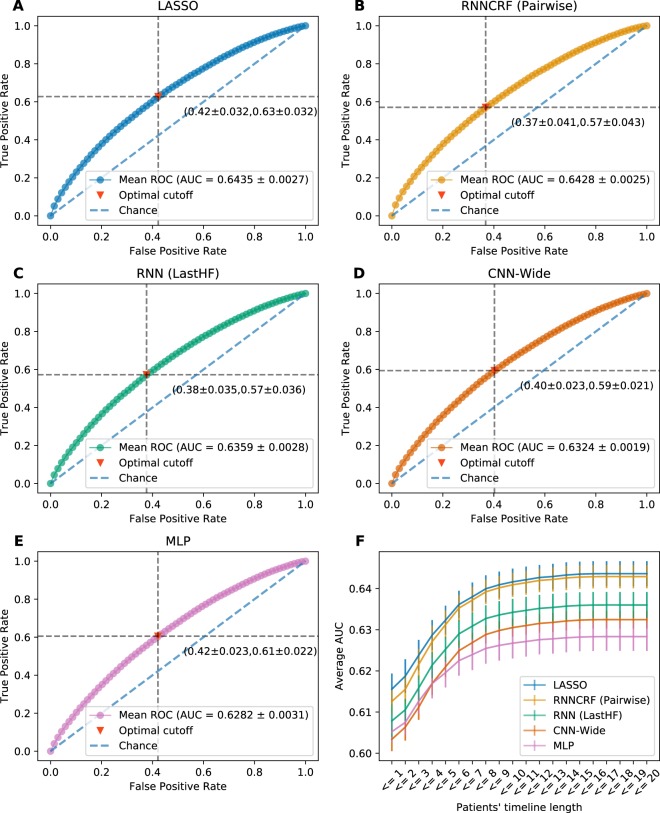
 is based on the average Youden-Index of each model for all 5-folds. Standard deviation of the optimal cutoff position is reported on the graph. Panel F reports the cumulative average AUC performance as a function of patients’ timeline length.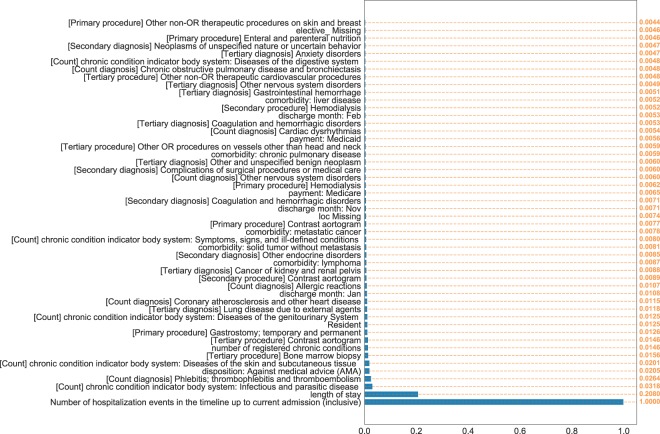
References
-
- Fingar, K. & Washington, R. Trends in Hospital Readmissions for Four High-Volume Conditions, 2009–2013: Statisticalc Brief number 196, http://www.hcup-us.ahrq.gov/reports/statbriefs/sb196-Readmissions-Trends... (2006). - PubMed
-
- Fingar, K. R., Barrett, M. L. & Jiang, H. J. A Comparison of All-Cause 7-Day and 30-Day Readmissions, 2014, https://www.hcup-us.ahrq.gov/reports/statbriefs/sb230-7-Day-Versus-30-Da... (2017). - PubMed
Publication types
MeSH terms
LinkOut - more resources
Full Text Sources
Medical
Research Materials
Miscellaneous
