. 2019 Nov;13(11):2690-2700.
doi: 10.1038/s41396-019-0466-0. Epub 2019 Jun 26.

In situ transformation of ethoxylate and glycol surfactants by shale-colonizing microorganisms during hydraulic fracturing

Affiliations

In situ transformation of ethoxylate and glycol surfactants by shale-colonizing microorganisms during hydraulic fracturing

Morgan V Evans et al. ISME J. 2019 Nov.

Abstract

In the last decade, extensive application of hydraulic fracturing technologies to unconventional low-permeability hydrocarbon-rich formations has significantly increased natural-gas production in the United States and abroad. The injection of surface-sourced fluids to generate fractures in the deep subsurface introduces microbial cells and substrates to low-permeability rock. A subset of injected organic additives has been investigated for their ability to support biological growth in shale microbial community members; however, to date, little is known on how complex xenobiotic organic compounds undergo biotransformations in this deep rock ecosystem. Here, high-resolution chemical, metagenomic, and proteomic analyses reveal that widely-used surfactants are degraded by the shale-associated taxa Halanaerobium, both in situ and under laboratory conditions. These halotolerant bacteria exhibit surfactant substrate specificities, preferring polymeric propoxylated glycols (PPGs) and longer alkyl polyethoxylates (AEOs) over polyethylene glycols (PEGs) and shorter AEOs. Enzymatic transformation occurs through repeated terminal-end polyglycol chain shortening during co-metabolic growth through the methylglyoxal bypass. This work provides the first evidence that shale microorganisms can transform xenobiotic surfactants in fracture fluid formulations, potentially affecting the efficiency of hydrocarbon recovery, and demonstrating an important association between injected substrates and microbial growth in an engineered subsurface ecosystem.


Conflict of interest statement

The authors declare that they have no conflict of interest.

Figures
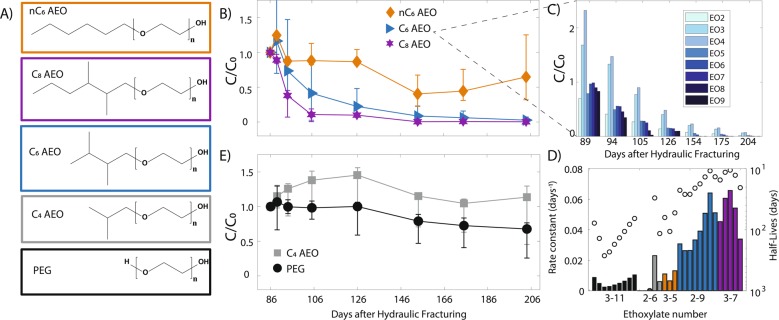
Fig. 1
Fig. 1
a Structures of polyglycol compounds observed in this Utica-Point Pleasant natural-gas well. b Produced fluid temporal change in total AEO species for linear nC6, branched C6, and C8 AEOs where C0 is the sum of all ethoxylates of a particular alkyl species at Day 86. Error bars correspond to the standard deviation of the average change experienced by the sum of all ethoxylates for a given alkyl chain. c Branched C6 AEO temporal trends relative to Day 86, with each bar representing a different C6 ethoxylate. d First-order rate constants (bars, left y-axis) and half-lives (circles, right y-axis) for PEGs, C4, nC6, C6, and C8 AEOs. Colors correspond to legend given in b, e. e Produced fluid temporal change in total AEO for C4 AEOs and PEGs where C0 is the sum of all ethoxylates of a particular alkyl species at Day 86. Error is the same as described in b
Fig. 2
Fig. 2
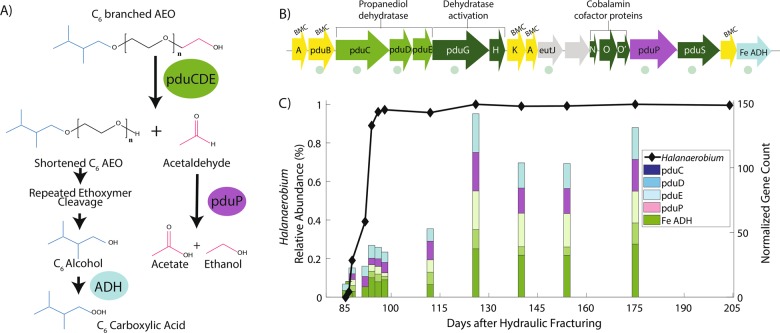
a Scheme for enzymatic biotransformation of a branched C6 alcohol ethoxylate based on Huber et al. [31] and Trifunović et al. [46] . b H. congolense WG10 genomic contig containing pdu and related genes with homologous genes to Acetobacterium woodii denoted by green circles (bitscore > 200, identity > 35%) c Relative abundance of Halanaerobium through time and the normalized gene copies ((gene count/assembled metagenome size) × 108) present in produced fluid metagenomes using blastp (>90% identity and bit-score > 250) compared to the genes present in the genome of H. congolense WG10
Fig. 3
Fig. 3
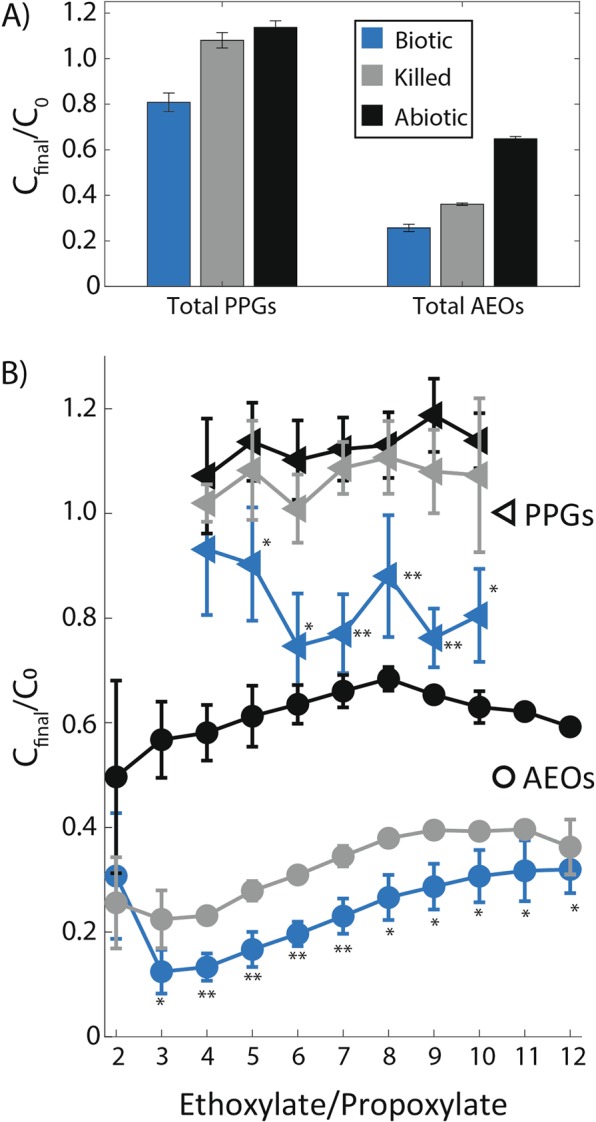
Relative change in initial and final concentrations of polypropylene glycols (PPGs) and C8 alkyl polyethoxylates (AEOs) in surfactant amended cell cultures between inoculation (t0) and stationary phase (ts, 51 h). a The sum of all PPG and C8 AEO polyglycol species. b Relative change in each individual ethoxylate/propoxylate. Error bars correspond to standard deviations between triplicate measurements, and statistical significance for biotic cells (p < 0.1) is denoted by (*) compared to abiotic controls only and (**) compared to both killed and abiotic controls
Fig. 4
Fig. 4
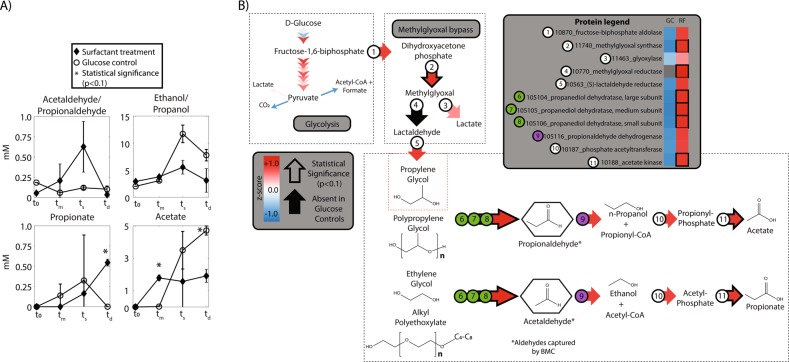
a Relevant metabolite concentrations for surfactant grown cultures and glucose controls at t0, tm (mid-log), ts (stationary phase), and td (death phase), and statistical significance (p < 0.1) is denoted by (*) next to the measurement. b Proposed surfactant metabolic reconstruction of Halanaerobium congolense WG10 cultured with surfactants compared to glucose controls. Arrow color represents average z-score in proteins from surfactant cultures. Each arrow denotes one biochemical step, whereas each number corresponds to individual proteins. Statistical significance (p < 0.1) for differences in protein relative abundance in surfactant grown cultures are denoted by a black outline around the corresponding arrow. Blacked out arrows indicate the protein was solely found in surfactant grown cultures and not in glucose controls. The protein legend includes the gene number, name, and z-score differences between glucose controls and surfactant grown cultures

References

    1. Arthur JD, Bohm B, Layne M. Hydraulic fracturing considerations for natural-gas wells of the Marcellus Shale. 2009. http://archives.datapages.com/data/gcags_pdf/2009/arthetal.htm.
    1. U.S. Energy Information Administration (EIA). The United States exported more natural-gas than it imported in 2017—Today in Energy. https://www.eia.gov/todayinenergy/detail.php?id=35392.

    1. Vidic RD, Brantley SL, Vandenbossche JM, Yoxtheimer D, Abad JD. Impact of shale-gas development on regional water quality. Science. 2013;340:1235009. doi: 10.1126/science.1235009. - DOI - PubMed
    1. Cluff MA, Hartsock A, MacRae JD, Carter K, Mouser PJ. Temporal changes in microbial ecology and geochemistry in produced water from hydraulically fractured Marcellus shale-gas wells. Environ Sci Technol. 2014;48:6508–17. doi: 10.1021/es501173p. - DOI - PubMed
    1. Barbot E, Vidic NS, Gregory KB, Vidic RD. Spatial and temporal correlation of water quality parameters of produced waters from Devonian-age shale following hydraulic fracturing. Environ Sci Technol. 2013;47:2562–9. doi: 10.1021/es304638h. - DOI - PubMed

Publication types